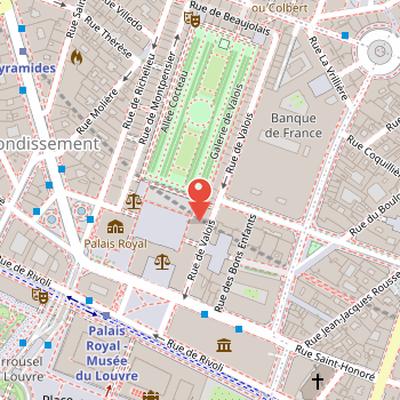
Les Deux Plateaux is a work of art by Daniel Buren located in the courtyard of the Palais-Royal in Paris, France, near the Ministry of Culture, the Council of State, and the Comédie-Française. Created with the help of architect Patrick Bouchain, it is commonly known as les colonnes de Buren. The garden of the Palais-Royal has been classified as a historical monument since 1920, and the entire domain, including this work, was classified in 1994.
The installation occupies the courtyard and consists of a grid of 260 truncated octagonal columns made of white marble with white and black stripes. The columns vary in height and are arranged in a 13 by 20 grid. Their layout follows multiple axes linked to the column spacing of the gallery d'Orléans and the measurements of the Palais-Royal columns. Set in trenches, the work references the site’s former semi-subterranean electrical plant and includes lighting elements such as red or green luminous nails and blue diodes. The arrangement creates a two-level composition with an upper plateau and a lower plateau formed by excavated trenches.
Nearby Objects
-
 Théâtre du Palais-Royal 80 m away
 -
 Hommage à Arago 100 m away
 -
 Comédie-Française 120 m away
 -
 Marly Horses 200 m away
 -
 Hôtel de Rambouillet 250 m away
Location and Heritage Status
Les Deux Plateaux, also known as "les colonnes de Buren," is a work of art by Daniel Buren located in the courtyard of the Palais-Royal in Paris, France. It was created with the help of architect Patrick Bouchain. The work stands near the Ministry of Culture, the Council of State, and the Comedie-Francaise. The garden of the Palais-Royal has been classified as a historical monument since 1920, and the entire domain including Les Deux Plateaux was classified as a historical monument in 1994.
Design and Spatial Structure
Les Deux Plateaux replaces a former parking space for adjacent institutions with an urban character installation by Daniel Buren. The work occupies the courtyard as a grid of 260 truncated columns made of white marble with white and black stripes. The octagonal columns vary in height from 8.7 to 62 cm, and the stripes are 8.7 cm wide. Their arrangement uses three varying heights and shafts aligned in a 13 by 20 grid, creating a repeated pattern that gives the installation rhythmic unity and structure.
The columns are made from Carrare marble and white and black marble from the Pyrenees. Their checkerboard arrangement is aligned with the classical architectural inspiration of the site, while the layout follows multiple axes determined by the column spacing of the gallery d'Orleans and the measurements of the Palais-Royal columns. The columns are placed in trenches that refer to the site's 1899 semi-subterranean electrical plant history.
The work is conceived as a two-level composition. The upper plateau is formed by the aligned tops of the columns in the central space, while the lower plateau consists of three excavated trenches with columns of equal height that reveal the underground slope. These trenches also reflect an original water plane, producing visual and audible reflections of the upper level. Lighting elements contribute to the installation, with red or green luminous nails at grid intersections and blue diodes under the grates in the trenches. The design aims to place the observer between two platforms and to allow multiple readings of the site.
Commission and Design at Palais-Royal
Les Deux Plateaux was created in response to a public commission for the Cour d'Honneur of the Palais-Royal in Paris in 1983. The commission, called Histoire, was launched by the Ministry of Culture under President Francois Mitterrand. Jack Lang, then Minister of Culture, proposed replacing car parking with a work of art at Palais-Royal and contacted Claude Mollard, president of the Centre national des arts plastiques, to commission artists. Mollard selected three projects by Guy de Rougemont, Pierre Paulin, and Daniel Buren. After reviewing them, Francois Mitterrand chose Les Deux Plateaux by Daniel Buren. The work was based on revealing the subsoil and integrating with the linear, repetitive architecture of Palais-Royal.
Controversy and Completion
The announcement of Histoire in March 1984 drew little immediate media response, but it quickly became controversial. On March 12, 1984, the Commission superieure des monuments historiques opposed the project, describing it as too modern. Despite this, Jack Lang decided to proceed. Construction began in April 1985, and an exhibition of the model helped trigger the affaire des colonnes de Buren controversy. An association of heritage friends also opposed the project and wrote to President Francois Mitterrand to ask for protection of the site, while Bernard-Henri Levy publicly supported Daniel Buren's project.
Histoire was completed in 1986 and generated extensive media debate. It was covered in about 225 articles across 45 newspapers and magazines, and Le Figaro led the opposition with a headline on April 5, 1986, describing it as a modern battle of Hernani. The work was also discussed several times in Parliament and led to legal actions and defense associations. Opposition included a negative petition signed by members of the Conseil d'Etat in 1986, while a positive petition from the artistic community appeared in 1987. The legal challenges ended in December 1992.
Construction and later restoration issues
Les Deux Plateaux, also known as Autre histoire plus recente, was affected by a series of construction and maintenance problems. During construction, a budget cut reduced the quality of the concrete and affected waterproofing. This led to water infiltration into the basements occupied by the Comedie-Francaise. Later renovation work also faced waterproofing difficulties because three Comedie-Francaise rehearsal rooms were built below the installation. The work deteriorated further through heavy use, especially by skaters, and the fountain water supply stopped working in 2000, which caused dirt to accumulate in the underground parts.
The sculptor expressed indignation over the deterioration of the artwork, saying that it harmed the author's moral rights, and at one point considered requesting its destruction if restoration was not carried out quickly. Restoration costs also increased over time: the columns were first estimated at 3.2 million euros, then reached a final cost of 5.8 million euros. The restoration formed part of a broader Palais-Royal works plan for 2007 to 2011, valued at 14 million euros, but without secured budgeting.
Despite these issues, the central column of the underground fountain remains used by tourists, who throw coins into it to make wishes, following a custom modeled on the Trevi Fountain in Rome.
Academic Study of the Palais-Royal Controversy
A master's thesis on Les colonnes de Daniel Buren au Palais-Royal : histoire d'une polemique, 1985-1992 was completed in 2003 at the Universite de Versailles-Saint-Quentin-en-Yvelines. It was written under the direction of Christian Delporte and formed part of a master's degree in cultural history of contemporary societies. The study focuses on the controversy surrounding the work at the Palais-Royal and also refers to Nathalie Heinich's book L'Art contemporain expose aux rejets, published by Jacqueline Chambon in 1998.