Founded in 1680, the Comédie-Française is a French cultural institution installed in the Salle Richelieu at the Palais-Royal in the 1st arrondissement of Paris. Since 1995, it has been a public industrial and commercial establishment. It is the only national theater in France with a permanent troupe of actors, known as the Troupe des Comédiens-Français.
The institution is nicknamed the Maison de Molière, and Molière is considered its patron. The legacy of Molière was preserved within the institution by Armande Béjart and La Grange, who joined from Molière’s former troupe, the Troupe du Roy, and maintained the company at the Théâtre du Guénégaud by their own means. The institution’s motto is In utrumque paratus, meaning “Prepared for both,” and its emblem is a hive with bees. The chair where Molière died during a performance of Le Malade imaginaire is currently exhibited at the end of the peristyle upon entering the theater.
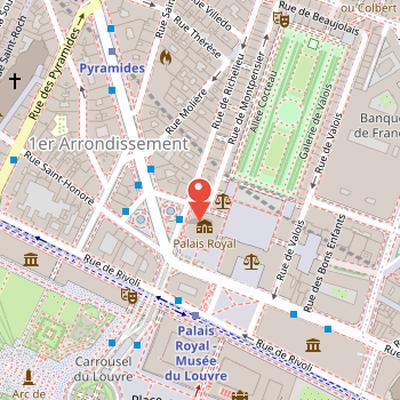
Nearby Objects
-
 Hommage à Arago 40 m away
 -
 Théâtre du Palais-Royal 120 m away
 -
 Les colonnes de Buren 120 m away
 -
 Marly Horses 150 m away
 -
 Musée des Arts Décoratifs 200 m away
Moliere, Legacy, and Institutional Identity
Founded in 1680 and installed in the Salle Richelieu at the Palais-Royal in the 1st arrondissement of Paris, the Comedie-Francaise is a French cultural institution that has been a public industrial and commercial establishment since 1995. It is the only national theater in France with a permanent troupe of actors, the Troupe des Comediens-Francais. The institution is commonly nicknamed the Maison de Moliere, and Moliere is regarded as its patron, even though he had died seven years before the troupe was created.
The association with Moliere was strengthened through the efforts of Armande Bejart and La Grange, who worked to preserve his legacy within the institution. Both had joined from Moliere's troupe, formerly called the Troupe du Roy, and had maintained the troupe at the Theatre du Guenegaud by their own means. This historical continuity helped anchor the institution's identity in the memory of Moliere and his company.
The theater also preserves objects linked to that history. The chair where Moliere died during a performance of Le Malade imaginaire was formerly exhibited at the end of the gallery of busts after the Foyer Public Pierre Dux, and it is now displayed at the end of the peristyle upon entering the theater. The institution's motto, In utrumque paratus, translates as Prepared for both, and its emblem is a hive with bees.
Formation and Major Changes
The Comedie-Francaise was founded by royal ordinance on 24 August 1680 to merge two French troupes in Paris. Its first joint performance followed on 25 August 1680, with Phedre and Les Carrosses d'Orleans. In the 17th century, it also received a royal monopoly to perform in Paris. By 1685, its members had signed an association act that regulated pensions for retired actors, and its repertoire included works by Moliere, Jean Racine, Pierre Corneille, Paul Scarron, and Jean Rotrou.
The institution later passed through periods of interruption and reorganization. It was closed by order of the Committee of Public Safety on 16 April 1793, and the actors were imprisoned. In 1795 it hosted the military commission that condemned the royalist insurrection, and on 25 July 1799 it was allocated the Theatre de la Republique hall for troupe reformation and performances. The new installation included a cafe-cellar extending under the glass gallery to the Chevet house, which became popular during the First Empire and the early Restoration. Napoleon reorganized the company on 29 September 1812 with the Moscow decree containing 87 articles.
During the Second Empire, architect Pierre Prosper Chabrol remodeled the 18th-century hall and extended its facade in 1858. The new ceiling was executed by painters Francois Joseph Nolau and Auguste Alfred Rube, based on a design by Felix-Joseph Barrias. The remodeled hall was inaugurated in 1858, although its new decoration was damaged by fire in 1900. Since its creation, the Comedie-Francaise has occupied several halls.
Pandemic Closures and Online Programming
During the COVID-19 pandemic, the Historique de la Comedie-Francaise closed during the three lockdowns in 2020 and 2021. It also launched online representations, including a full reading of A la recherche du temps perdu. In addition, it created the Theatre a la table program, in which plays were performed on YouTube after one week of rehearsal. These measures show how the institution continued to present work to the public despite the repeated closures.
Trupe and Set Design
The troupe consisted of 40 members, including 15 honorary members and 10 auxiliary members. Set creation was handled by a team of twenty people. Over time, the sets were designed by artists including Marie Laurencin, Valentine Hugo, Christian Berard, Jean Carzou, Cassandre, Raoul Dufy, Pierre Clayette, Richard Peduzzi, and director and visual artist Bob Wilson.
The Bibliotheque-Musee of Comedie-Francaise
The Bibliotheque-musee of La Comedie-Francaise preserves a large collection of books, documents, manuscripts, paintings, sculptures, drawings, and art objects connected to the theatre. Its offices are located in the Palais-Royal, in the galerie du Beaujolais. The institution is open to researchers, but it is not open for public visits. It also lends artworks for exhibitions when necessary.
The collection includes commissioned works created for performances or to decorate theater rooms, as well as numerous paintings and sculptures donated to La Comedie-Francaise by admirers. Together, these holdings trace the history of La Comedie-Francaise and the evolution of the actor's status since the 17th century. The Bibliotheque-musee has also taken part in major public exhibitions, including a retrospective at the Centre Georges-Pompidou in 1980 for the theatre's tricentennial and an exhibition of part of its collection at the Petit Palais de Paris in 2011-2012.
Repertoire and Recent Stage Activity
By 2020, the Repertoire at La Comedie-Francaise contained nearly 2000 works, showing the scale of the institution's staged heritage. In 2016, Eric Ruf announced the return of the Repertoire's Comediens-Francais to the Avignon Festival, reflecting continued engagement with major theatrical events. That same year, the Repertoire presented a stage adaptation of The Damned by Luchino Visconti, directed by Ivo van Hove. These activities indicate an active repertory that combines breadth, festival presence, and contemporary staging.
Visual Identity Update
In 2015, the Comedie-Francaise adopted a new logo created by Identite visuelle. Identite visuelle is the French design agency c-album, based in Paris. The change marked a visual update to the institution's identity through the work of a Paris-based design firm.