The Marly Horses are two symmetrical sculptural groups by French sculptor Guillaume Coustou the Elder, created in Carrara marble between 1743 and 1745. Commissioned by King Louis XV to restore the sculpture ensemble at the park and Château de Marly, they were made to decorate the Marly watering basin. The sculptures replaced two earlier works by Antoine Coysevox, whose Pegasus figures had been moved to the Tuileries Garden in Paris in 1719.
Coustou’s models were approved by the king in 1743 and installed at Marly in 1745 after two years of work. The sculptor drew directly in the royal stables while developing the models and invited live models for the charioteers. The paired sculptures depict rearing horses being controlled by charioteers, and their composition was inspired by late antique sculptural groups of the Dioscuri in Rome. Their style combines Baroque dynamism and expression with a strict rhythmic organization and a coherent overall impression.
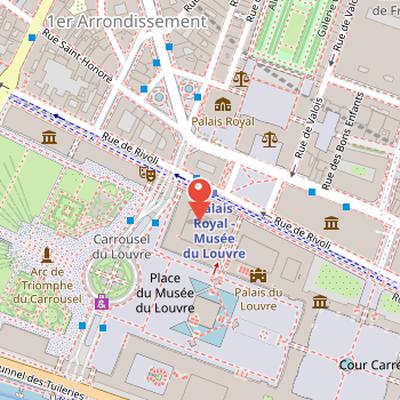
Nearby Objects
-
 Hôtel de Rambouillet 60 m away
 -
 Carrousel du Louvre 120 m away
 -
 Louvre Palace 120 m away
 -
 Hommage à Arago 140 m away
 -
 Place du Carrousel 140 m away
Design and History of the Marly Horses
The Marly horses are a work by the French sculptor Guillaume Coustou the Elder. They consist of two symmetrical sculptural groups in Carrara marble, created between 1743 and 1745 and installed in Marly in 1745 after two years of work. Commissioned by King Louis XV, the ensemble was intended to restore the sculpture group at the park and Chateau de Marly and was placed to decorate the Marly watering basin.
The work replaced two earlier sculptures by Antoine Coysevox, Mercure a Cheval sur Pegasus and La Renommee a Cheval sur Pegasus, which had been moved to the Tuileries Garden in Paris in 1719. Coustou's models were approved by the king in 1743. While preparing them, Coustou drew directly in the royal stables and invited live models for the figures of the charioteers.
The composition shows rearing horses being tamed by charioteers, presented in paired sculptures. Its sources included late antique sculptural groups of the Dioscuri on the Quirinal and Capitoline Hill in Rome. In style, it is closer to the Horses of Apollo by the Marsy brothers in Versailles and the Chevaux du Soleil relief by Robert Le Lorrain from 1737. One figure represents America as a male of negroid type wearing a feathered hat, while another figure represents Europe without attributes.
Relocation and Legacy
The Horses of Marly were ordered to be relocated to Paris in 1794 during the revolution. They were then installed symmetrically at the entrance to the Champs-Elysees near the current Place de la Concorde. The original sculptures are now located in the Louvre, where they are exhibited in the Richelieu wing courtyard named Cour Marly among French sculptures from the 17th to 18th centuries.
The work is characterized by Baroque dynamism and expression. At the same time, Intro's style includes Baroque features subordinated to strict rhythm organization and a coherent overall impression. This style derives from the grand style of the late 17th century, the Sun King era, which combined Baroque and Classicism elements.
The Horses of Marly were successful in the Romantic era and anticipated Theodore Gericault's 1817 The Derby Run. They were also admired by Eugene Delacroix and Victor Hugo. Their influence extended beyond France, inspiring P. K. Klodt's The Horse Tamer for Anichkov Bridge in Saint Petersburg, created between 1838 and 1843. Copies of the Horses of Marly by Michel Bourbon were later placed at the original location in front of Chateau de Marly in 1985.