Théâtre du Palais-Royal was a theatre in the east wing of the Palais-Royal on the rue Saint-Honoré in Paris. It opened on 14 January 1641 with a performance of Jean Desmarets’ tragicomedy Mirame. The first theatre, located in the Palais-Royal and originally known as the Palais-Cardinal, was built in the 1630s and expanded by Jacques Le Mercier in 1637. Built between 1639 and 1640, it was known as the Grande Salle du Palais-Cardinal and was equipped with a proscenium arch, a solid stage curtain, two balconies, and advanced stage machinery. The opening production featured a single-perspective set and numerous mechanical effects. The theatre was used by Molière’s troupe from 1660 to 1673 and then by the Académie Royale de Musique from 1673 to 1763. After being destroyed by fire in 1763, it was rebuilt and reopened in 1770, but it was destroyed again in 1781 and was not rebuilt after that.
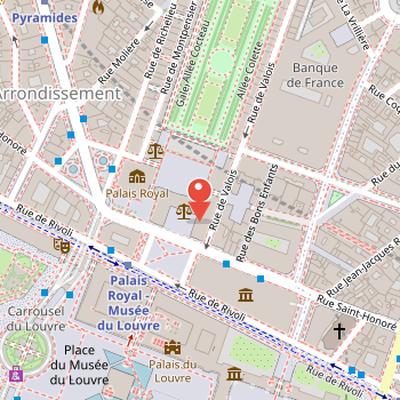
Nearby Objects
-
 Hommage à Arago 80 m away
 -
 Les colonnes de Buren 80 m away
 -
 Comédie-Française 120 m away
 -
 Marly Horses 150 m away
 -
 Hôtel de Rambouillet 200 m away
History of the Salle du Palais-Royal
The Salle du Palais-Royal, also known as the Theatre of the Palais-Royal, was located on the rue Saint-Honore in Paris in the east wing of the Palais-Royal. It opened on 14 January 1641 with a performance of Jean Desmarets' tragicomedy Mirame. From 1660 to 1673, it was used by the troupe of Moliere. Beginning in 1673, it served as an opera house for the Academie Royale de Musique and remained in that role until 1763. The theatre was destroyed by fire in 1763, then rebuilt and reopened in 1770. It was destroyed again by fire in 1781 and was not rebuilt after that date.
The First Theatre in the Palais-Royal
The first theatre in the Palais-Royal, originally known as the Palais-Cardinal, was built in the 1630s in a small theatre space called the Petite Salle des Comedies. A 1673 plan identified it as the Petite Salle des Ballets. The theatre was expanded by architect Jacques Le Mercier at Cardinal Richelieu's request in 1637, and it was built between 1639 and 1640 at a cost of 300,000 livres, including 100,000 livres for stage machinery. It was initially known as the Grande Salle du Palais-Cardinal.
The building used the proscenium arch and had a solid stage curtain raised by a roller behind the arch. It had two balconies and a capacity of about 3,000 spectators, and its stage was equipped with the latest theatre machinery. The theatre opened on 14 January 1641 with Jean Desmarets' tragicomedy Mirame. That production used a single perspective set depicting the Palais Royal d'Heraclee, which conformed to l'unite de lieu, one of the Three Unities. The opening performance also featured numerous mechanical effects, and the Gazette de France described the Grande Salle and its ornate stage on 19 January.
The stage effects in Mirame included gardens, grottoes, statues, fountains, and terraces above the sea, as well as lighting effects such as simulated moonlight, a transition from night to day, dawn, and sun. The theatre later hosted Richelieu's production of Ballet de la prosperite des armes de France on 7 February 1641, with sets designed by Giacomo Torelli. These sets showed the fields of Arras, the plain of Casal, the snow covered Alps, a stormy sea, hell, and heaven, and were changed rapidly using a system of weights and levers. The theatre probably staged Gabriel Gilbert's play Telephonte in 1641, performed by combined troupes of the Theatre du Marais and the Hotel de Bourgogne. It also hosted Richelieu's last production, Desmarets' play Europe, a political allegory celebrating Richelieu's career, which was already in rehearsal when Richelieu died.
The First Theatre at the Palais-Royal
The first theatre at the Palais-Royal became an important venue for Italian opera under Cardinal Mazarin after 1643. It hosted the comic opera Egisto, with music by Virgilio Mazzocchi and Marco Marazzoli, on 13 February 1646, and later premiered Luigi Rossi's Orfeo on 2 March 1647. For Orfeo, the theatre was remodeled by Giacomo Torelli, and the remodeling and production costs were considered excessive by Mazarin's enemies.
The theatre later changed role when Lully had it equipped with stage machinery designed by Carlo Vigarani, replacing older machinery by Torelli. It was then used as the opera house of the Académie royale de Musique before being moved to a new home at the Hotel de Gueneagaud by Lully. These changes show the theatre's close connection with early opera production and with the technical development of stage presentation at the Palais-Royal.
Lully's Operas at the Palais-Royal
The Salle du Palais-Royal was a premiere venue for several operas by Lully. Among the works first presented there were Alceste on 19 January 1674, Amadis on 18 January 1684, and Armide on 15 February 1686. These premieres show the Palais-Royal as an important site for the performance of Lully's operatic works during the late 17th century.
Rameau at the First Theatre
Many of Rameau's works were first performed at the First theatre in the 18th century. Among the premieres there were Hippolyte et Aricie on 1 October 1733, Les Indes galantes on 23 August 1735, Castor et Pollux on 24 October 1737, Dardanus on 19 November 1739, and Zoroastre on 5 December 1749. The First theatre was destroyed by fire on 6 April 1763.
Moreau's Opera House
The second theatre at the Salle du Palais-Royal was built on a site slightly further to the east in Paris and was designed by the architect Pierre-Louis Moreau Desproux. It was the first purpose-built opera house in Paris and had a capacity of more than 2,000 spectators. While it was under construction, performances were held in the Salle des Machines in the Tuileries Palace. The theatre opened on 20 January 1770 with a performance of Rameau's Zoroastre. It also served as the venue for most French operas by Christoph Willibald Gluck's premieres.
Premieres at the Second Theatre
The second theatre of the Salle du Palais-Royal was a significant venue for opera premieres in the 1770s and early 1780s. It hosted the first performances of Iphigenie en Aulide on 19 April 1774, Orphee et Eurydice on 2 August 1774, and the revised version of Alceste on 23 April 1776. Later premieres included Armide on 23 September 1777, Iphigenie en Tauride on 18 May 1779, and Echo et Narcisse on 24 September 1779. In 1780, the theatre presented Piccinni's Atys on 22 February, Gretry's Andromaque on 6 June, and Philidor's Persee on 27 October. The sequence of premieres continued with Piccinni's Iphigenie en Tauride on 23 January 1781. The Opera used the theatre until 8 June 1781, when it was destroyed by fire.