Place Darcy is a haussmannian type square in Dijon, located at the gates of the protected area of the city. It takes its name from Henry Darcy, a hydraulics engineer from Dijon who lived from 1803 to 1858. The square belongs to an area shaped by earlier urban and hydraulic developments linked to the former Porte Guillaume. In the Middle Ages and the Ancien Régime, this gate was guarded by two towers and a drawbridge and stood near roads arriving from Paris, Chalon-sur-Saône, and Langres. In the 18th century, architect Jean-Philippe Maret rebuilt it as the Arc de triomphe known as Porte Condé, later renamed Arc de la Liberté during the French Revolution and then restored as Porte Guillaume. Nearby, Henry Darcy introduced running water to Dijon in 1838, and a monumental drinking water reservoir was built in 1839 on the site of the present Jardin Darcy. The esplanade between Porte Guillaume and the reservoir was named Place du Château d'eau in 1850 and renamed Place Darcy in 1858.
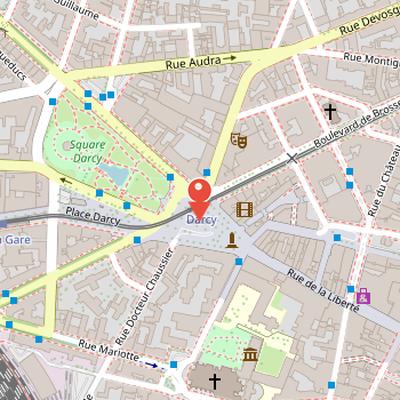
Nearby Objects
-
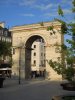 Guillaume's Gate 50 m away
 -
 Château Royal de Dijon 150 m away
 -
 Abbaye de Saint-Bénigne 200 m away
 -
 Musée archéologique de Dijon 200 m away
 -
 Dijon Cathedral 250 m away
Design and Naming
La place Darcy in Dijon is a haussmannian type square located at the gates of the protected area of the city. Its name comes from engineer Henry Darcy, a hydraulics engineer from Dijon who lived from 1803 to 1858. The square therefore combines a specific urban form with a name linked to a local figure associated with engineering history.
From Porte Guillaume to the Jardin Darcy
In the Middle Ages and during the Ancien Regime, the Dijon city walls included the porte Guillaume, which was guarded by two towers and a drawbridge. It stood near the roads arriving from Paris, Chalon-sur-Saone, and Langres, while the area beyond the gate was described as a large platform or wasteland. Between 1786 and 1788, architect Jean-Philippe Maret rebuilt the gate as an arc de triomphe and renamed it porte Conde in honor of prince Louis V Joseph de Bourbon-Conde, governor of Bourgogne. During the French Revolution, it became the arc de la Liberte before later being restored to the name porte Guillaume. In March and April 1815, preachers in Dijon ended their mission with a cross built at the present Jardin Darcy; this mission cross was removed after the 1830 revolution and moved to the north transept of cathedrale Saint-Benigne.
From Water Reservoir to Urban Square
The history of Darcy Square is closely tied to the introduction of running water to Dijon. In 1838, the hydraulician Henry Darcy brought running water to the city, and in 1839 a monumental drinking water reservoir was built at the site of the current Jardin Darcy according to his plans. The reservoir was fed by an underground aqueduct 17 kilometers long, which connected it to the Rosoir spring in the upper Suzon valley. It supplied running water to 5000 residents of Dijon. Above the reservoir, architect Emile Sagot constructed the monument des fontaines in 1841.
The square itself took shape in the mid-19th century. The esplanade between Porte Guillaume and the reservoir was named Place du Chateau d'eau in 1850, and after Henry Darcy's death it was renamed Place Darcy in 1858. A cast iron fountain with basins from Paris was installed there in 1850, later sold by the commune of Dijon to the city of Chatillon-sur-Seine in 1878 and installed on Place Marmont.
In 1880, architect Felix Vionnois created the Darcy garden in a neo-Renaissance style on top of the water reservoir. Further changes followed in the 1880s and 1890s, when houses and small buildings bordering the square were replaced by Haussmannian buildings with stone facades and slate roofs. The Hotel de la Cloche was built between 1881 and 1884, and a bronze statue of Francois Rude on a stone pedestal was erected near the center of the square in 1886; it was melted down under German occupation in 1942.
Place Darcy also functioned as a transport hub before World War I, with interurban steam trams and electric trams. Later developments altered the square again, including the opening of the Darcy Palace cinema in 1914, the installation of the Jeunesse fountain by Max Blondat in a small square near Porte Guillaume in 1907, the opening of an underground parking in the central part of the square in 1992, and the addition of new tram stations and pedestrianization near Porte Guillaume in the early 2010s.
Film and public memory
Place Darcy in Dijon has appeared in several filmed scenes for Bâtiments remarquables et lieux de memoire in 1966, including sequences shot on the square itself, at Jardin Darcy, and inside the former cafe Le Glacier. The same work also filmed La Seconde Verite in Dijon in 1966. Beyond cinema, Place Darcy serves as a starting location for demonstrations connected to Bâtiments remarquables et lieux de memoire and as a site for tributes. In a later public gesture, the Grand Hotel la Cloche in Dijon was illuminated in tricolor in November 2015.
Architectural Ensemble Around Darcy Square
Darcy square is presented through a series of photographed architectural and urban elements that show the varied character of the area. The nearby built environment includes an immeuble signed on the facade by Abel Boudier in 1883, the Grand hotel la Cloche by Louis Belin, built from 1881 to 1884, and a Haussmannian building at the start of boulevard de Brosses, built in 1896 by Albert Leprince for Julien Poinssot. Other recorded buildings include a Haussmannian building made by architects Auguste Drouot and Abel Boudier, a building at number 4 built for Paul Herard in 1897 and now housing Columbus Cafe & Co, and a building built in 1910 by Louis Perreau. The square also includes or adjoins several named public and commercial points of interest, such as Passage Darcy, Parking Darcy, the cinema Le Darcy in a Haussmannian building by Ardiot and Moncorget from 1895, and the building housing Brasserie L'Edito. Public space is represented by Jardin Darcy, while the Fontaine Jeunesse by Max Blondat and the Porte Guillaume add to the square's cultural and visual identity. The presence of the tramway of Dijon, photographed in 2015, further indicates the square's role within the city's urban circulation and contemporary use.