Guillaume's Gate is a city gate in Dijon constructed between 1786 and 1788 in place of an old gate of the city wall. It was first named Porte Condé in honor of the prince of Condé, governor of Burgundy, and was connected to the existing ramparts by walls and gates closed by a grille with visible sealing traces. During the Revolution, it was renamed arc de la Liberté in 1791, and later Porte Guillaume, in reference to Guillaume de Volpiano, abbot of the Abbey Saint-Bénigne. In 1814, during the First Restoration, the gate hosted the count of Artois in Dijon, and a plaster group by architect Jacques Caumont was added. The monument has a large arched doorway flanked by piédroits with continuous bossages in tables, topped by a Doric-style entablature with triglyphs and metopes. Four bas-reliefs by Claude-François Attiret decorate the arcade level on both faces.
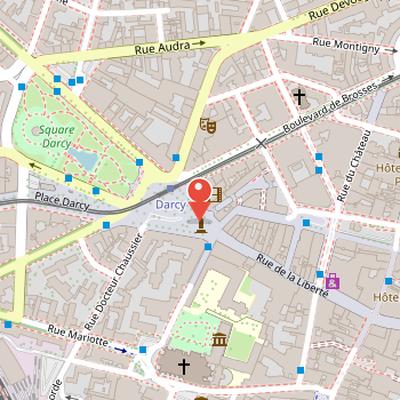
Nearby Objects
-
 Place Darcy 50 m away
 -
 Château Royal de Dijon 130 m away
 -
 Abbaye de Saint-Bénigne 150 m away
 -
 Musée archéologique de Dijon 200 m away
 -
 Dijon Cathedral 200 m away
History and Naming of Guillaume's Gate
Guillaume's Gate was built between 1786 and 1788 as a monument in place of an old gate of the city wall. It was first named Porte Conde in honor of the prince of Conde, governor of Burgundy. The monument was connected to the existing ramparts by walls and gates closed by a grille, and traces of sealing were visible on these elements. During the Revolution in 1791, the gate was renamed arc de la Liberte, and later it took the name Porte Guillaume, in reference to Guillaume de Volpiano, abbot of the Abbey Saint-Benigne.
In 1814, during the First Restoration, the count of Artois was hosted in Dijon. On this occasion, a plaster group by architect Jacques Caumont was added to the gate, then called Conde. The decoration showed a winged genius holding a lily and standing on a chariot drawn by horses. This plaster decoration remained in place for several years before deteriorating due to weather.
Architectural Features and Sculptural Program
Guillaume's Gate is marked by a large arched doorway flanked by piedroits with continuous bossages in tables. The piedroits are topped by a Doric style entablature with triglyphs and metopes, giving the structure a classical ornamental frame. At the arcade level, four bas-reliefs by sculptor Claude-Francois Attiret decorate both sides of the gate. On the Place Darcy side, one relief shows a genius presenting the arms of the Prince of Conde to Burgundy on the right, while another shows a genius presenting a document to Minerva, goddess of wisdom, on the left. On the opposite face, the muse of History writes the military deeds of the Prince of Conde on the right, and an allegory of the City of Dijon displays the arms of the Prince of Conde on the left. On the Rue de la Liberte side, two marble panels with inscriptions originally stood on the piedroits and were topped with medallions and oak leaf garlands. In 2009, a metallic plaque unrelated to the monument was affixed on the right panel area and commemorates Thomas Jefferson and Franco-American friendship.