Abbaye de Saint-Bénigne is an ancient Benedictine abbey in the center of Dijon, Côte-d'Or, in Bourgogne-Franche-Comté. Founded in the 6th century, its history is linked to Saint Bénigne de Dijon and to the bishops of Langres. A monastic community is attested from the 7th century, and the abbey adopted the Benedictine rule around 870. Reformed in 989, it was rebuilt from 1001, with the abbey church completed in 1016 and the rotunda finished in 1018. After a fire in 1137, only the rotunda survived, and the church was largely rebuilt in Romanesque architecture. Later, the Saint-Bénigne church was rebuilt in Gothic style between 1280 and 1393. The abbey was further transformed in the 18th century and the last monks left in 1791. Its church became the cathedral of the Dijon diocese in 1792. The site also houses the Dijon archaeological museum, installed there since 1930.
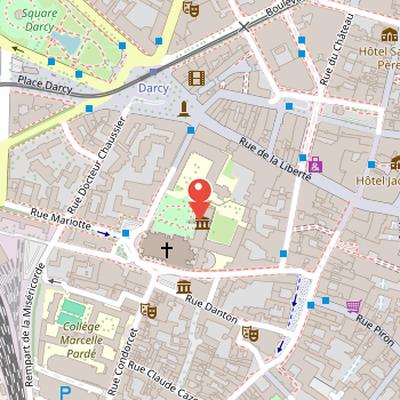
Nearby Objects
-
 Musée archéologique de Dijon 20 m away
 -
 Dijon Cathedral 70 m away
 -
 Saint-Philibert Church 100 m away
 -
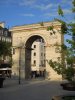 Guillaume's Gate 150 m away
 -
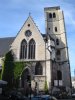 Église Saint-Jean de Dijon 200 m away
Abbey Church and Later Uses
The Abbaye de Saint-Benigne is an ancient Benedictine monks abbey founded in the 6th century in the center of Dijon, in Cote-d'Or, Bourgogne-Franche-Comte. Its abbey church, Saint-Benigne, dedicated to Benigne de Dijon, became the cathedral of the Dijon diocese in 1792. The abbey was partly destroyed, but it still retains remains of a Romanesque wing built in the 11th century. Since 1930, it has housed the Dijon archaeological museum, adding a cultural function to the historic site.
Early Monastic Development
The history of the Abbey of Saint-Benigne is closely linked to Saint Benigne of Dijon, who is said to have appeared to Bishop Gregoire de Langres. The abbey belonged directly to the bishops of Langres, and a monastic community is documented there from the 7th century. Around 870, it adopted the Benedictine rule, introduced by Bishop Isaac of Langres and King Charles the Bald. In 989, Abbot Mayeul of Cluny sent Guillaume de Volpiano to the abbey with twelve monks, and the community was reformed at the request of Brunon de Roucy, Bishop of Langres. Despite this reform, the abbey remained legally independent and was not affiliated with the ordo cluniacensis.
Construction and Later Transformations
Reconstruction of the abbey church began in 1001 under Brunon de Roucy and Guillaume de Volpiano. The work was completed in 1016, at which point the community numbered 80 monks, and the rotunda was finished two years later, in 1018. Brunon de Roucy also restored the abbey's temporal possessions, while Otte-Guillaume, Count of Macon, served as advocatus until 1016. Between 1030 and 1040, Abbot Halinard rebuilt the conventual buildings around the cloister north of the church.
A major fire in 1137 damaged the abbey and its church, leaving only the rotunda intact. After this destruction, Abbot Pierre de Geneve almost entirely rebuilt the abbey church in Romanesque architecture. Later, the Saint-Benigne church of Dijon was built in Gothic style on the site of the former basilica between 1280 and 1393. In December 1287, Abbot Hugues d'Arc also bought half the land of Ville-Comte for the abbey.
The complex was transformed again in the 18th century by the Benedictine Congregation of Saint-Maur, which gave it a classical architectural form. The last monks left in 1791 after the dissolution of religious orders during the French Revolution, and the abbey church became a cathedral after its consecration in 1792. In 1930, the archaeological museum of Dijon was transferred to the main wing of the abbey. The site also preserves several internal spaces, including the chapter house and scriptorium on level 0, the monks' dormitory in Gothic style on level 1, and rooms on level 2. The cellar was classified as a historic monument in 1949, and the former abbatial residence was inscribed as a historic monument later that same year.
Chapter House, Scriptorium, and Dormitory
The architecture of the Abbaye de Saint-Benigne is especially associated with the chapter house, which dates from the first half of the 11th century and is the oldest chapter house still standing in France. It served as a burial place until the 18th century, and its burials included 72 individuals, 13 infants, and 17 children. In the 17th century, monks of the Congregation of Saint-Maur transformed the chapter house into a cellar, and according to the 1670 Maurist plan, the chapter was transferred to the first floor in the Gothic dormitory.
The abbey is also connected to an adjacent 30-meter-long hall from the first half of the 11th century, thought to have been the scriptorium. Over time, the scriptorium became a crypt as the floor level rose over more than a thousand years, and its exterior accesses to the cloister were sealed. Built in the 11th century, it now houses antique pieces of the Dijon Archaeological Museum.
Another important part of the complex is the dormitory, built at the end of the 13th century above the Romanesque scriptorium. It was constructed with ribbed vaults in Gothic style. In 1652, Maurist monks added another level to create cells, enlarged the windows, and covered the roof with flat tiles in white, black, red, and green. Today, the dormitory contains medieval pieces of the Dijon Archaeological Museum and the Ecole nationale superieure des beaux-arts de Dijon. The abbey entrance building also hosted pilgrims and travelers, and the complex includes a Romanesque cloister with four wings serving the main abbey buildings.
Cloister Layout and Burial Spaces
The cloister of the Abbaye de Saint-Benigne contained burials of 63 individuals distributed among its galleries. The eastern gallery formed a right angle with the church and was linked to several monastic functions: the chapter house, the scriptorium on the ground floor, and the dormitory on the first floor. It also housed the kitchen, refectory, library, and abbot's lodging, although these elements no longer survive. The eastern gallery contained burials of 10 individuals, the western gallery 12, and the northern gallery 2, while the southern gallery contained burials of multiple individuals. The abbey's lower gardens are crossed by the Raisne river, a tributary of the Ouche. The medieval abbey cemetery also served as a civic setting, where mayors and aldermen were invested facing the portal of Saint-Philibert church.
Sculpted Tympana of the Abbey
Several richly sculpted tympana once adorned different buildings of the abbey. One tympanum belonged to the western facade of the abbey church and is known from an engraving; some of its elements are now conserved at the Musee Archeologique. The martyrdom of Benigne was also recorded in engravings by dom Plancher, and the sculptures of this martyrdom tympanum were sometimes thought to come from the western facade, although its original location remains unknown. Another tympanum was discovered in 1833 in the masonry of the church. It was moved several times, which makes its original position difficult to determine, and it is unlikely to have come from the portal to the cloister. During the Maurist restoration, it was reused as decoration for the tomb niche of Cardinal de Givry. This second tympanum represents Christ in majesty surrounded by the four living beings.
Burials and the Abbey Crypt
The burials associated with Abbaye de Saint-Benigne are preserved in the crypt at the lower level of the rotunda. They were found in several places within the abbey, including those of two abbots, although the burial locations of these two abbots remain undetermined. The site is also linked to a death roll from 1439 to 1441, numbered LXXXII, preserved in Bibliotheque de Troyes manuscript 2256. This death roll was the subject of an article in Bibliotheque de l'Ecole des Chartes in 1867.
Sacred Art and the Status of the Treasure
Under the terms of the 1913 law, the Tresor is not considered a treasure. The law defines a treasure as works in peril within the Diocese, and the Diocese was established in 1730. To compensate for the absence of a treasure, a sacred art museum was created in 1980. This museum provided a place for sacred objects and helped address the gap left by the lack of an officially recognized treasure.
Archival Records of the Abbey
Archives relating to the Abbaye de Saint-Benigne are preserved in several institutions. Ancient documents concerning the abbey are kept at the Bibliotheque municipale de Dijon, while archives from the period since the Revolution are conserved at the Archives departementales de la Cote-d'Or. The Archives departementales also maintain nearly fonds religieux connected with the abbey. These materials mainly concern the management of abbey property, providing evidence of its administrative and economic history.
Ancient Bibliographic Sources
The section Sources et bibliographie ancienne includes bibliography numbers 12347 to 12360. It is inscribed in Bibliotheque historique de la France, a work authored by Jacques Lelong, a priest of the Oratory. The Bibliotheque historique de la France also appeared in a new edition by Fevret de Fontette, who was a Counselor to the Parliament. This edition was published in Paris in 1778. These references show that the abbey was documented within an established historical bibliographic tradition, with older sources grouped under a specific numbered sequence.