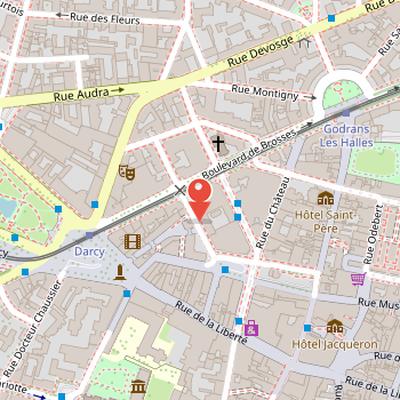
The Château Royal de Dijon was an ancient fortress castle located at the current Place Grangier in the city center of Dijon. It has no visible remains today. The castle was part of a broader royal program begun after the death of Charles le Téméraire in 1477, when the king undertook the reconquest of the Burgundian State, which had remained independent for over a century under the dukes of Valois Burgundy. Duchess Marie de Bourgogne inherited the Burgundian State, and from 1478 the king ordered the construction of fortified castles in Dijon, Beaune, and Auxonne. These works were intended to impose military control on the Duchy of Burgundy and protect the kingdom from the German empire. Entrusted to Vauzy de Saint-Martin, the Dijon castle was completed around 1510. It had a square plan, four massive corner towers, curtains over moats, two boulevards, and drawbridge gates, and it included early firearm embrasures known as "à la française."
Nearby Objects
-
 Guillaume's Gate 130 m away
 -
 Place Grangier 140 m away
 -
 Place Darcy 150 m away
 -
 Abbaye de Saint-Bénigne 250 m away
 -
 Musée archéologique de Dijon 250 m away
The Former Royal Fortress in Central Dijon
The Château Royal de Dijon was an ancient fortress castle located at the present-day Place Grangier in the city center of Dijon. It is identified as a former royal castle, but no visible remains survive today. Its historical presence is tied to this central urban site, even though the structure itself is no longer visible.
The Burgundian State After 1477
According to the historical account, Charles le Temoeraire died at the battle of Nancy in 1477. After his death, the king undertook the reconquest of the Burgundian State. The state had remained independent for more than a century under the dukes of Valois Burgundy, and Duchess Marie de Bourgogne inherited it.
Royal Fortress and Later Prison
From 1478, the king ordered the construction of fortified castles in Dijon, Beaune, and Auxonne in order to impose military control on the Duchy of Burgundy and protect the kingdom from the German empire. The master work of the castles was entrusted to Vauzy de Saint-Martin, and the royal castle of Dijon was completed around 1510 under the king's reign. Its design followed a square plan with four massive corner towers connected by curtains over moats, two boulevards, and drawbridge gates. Around 1483, it already had embrasures for firearms called "a la francaise," considered the oldest recorded. The castle straddled the rampart with eighteen towers and twelve city gates, and it was located between Porte Guillaume of place Darcy, tour Poinsard Bourgeoise, and the current Hotel des Postes.
The castle did not prevent the siege of Dijon in 1513, and it was besieged again during the wars of the Catholic League and under the Fronde. In the 18th century, it became a state prison, where chevalier d'Eon and Mirabeau were incarcerated; Mirabeau escaped from it. After the French Revolution, the castle was converted into a gendarmerie barracks. In the 19th century, intellectuals including architect Charles Suisse obtained its classification as a historical monument, but public opinion in Dijon strongly opposed it as a Burgundian Bastille. It was declassified and demolished in parts from 1891 to 1897. Underground remains, including the countermine gallery of Louis XII's large horseshoe, were rediscovered in 1923 and 1936, then protected as historical monuments by a decree in 1949. No visible remains exist at place Grangier today, although rare remains and representations are exhibited at the archaeological museum of Dijon.