Founded in 1832 in Dijon, Côte-d'Or, the Musée archéologique de Dijon is a Museum of France dedicated to Burgundian archaeology. Its collections present material evidence for human life in Burgundy from Prehistory and Protohistory through Roman Gaul and the Middle Ages. The museum also includes collections of Paleochristian art, sacred art, and Christian architecture.
The museum's origins are linked to scholars and societies such as the Académie de Dijon and the Commission des Antiquités de la Côte-d'Or. It was first installed in the former hôtel Rolin in 1832, then occupied several rooms in the palais des États during the Second Empire. Since 1934, it has been housed in the main wing of the former Saint-Bénigne Abbey in Dijon. Its holdings have been enriched by archaeological operations, the preservation of historic monuments, and acquisitions from sites including Alésia, Vertault, Les Bolards, and the sanctuary of the sources of the Seine. The collections include ex-voto, steles, bas-reliefs, sculpture from the castrum of Dijon, Romanesque and Gothic sculpture, and works associated with Claus Sluter, including the Crowned Christ of Thorns.
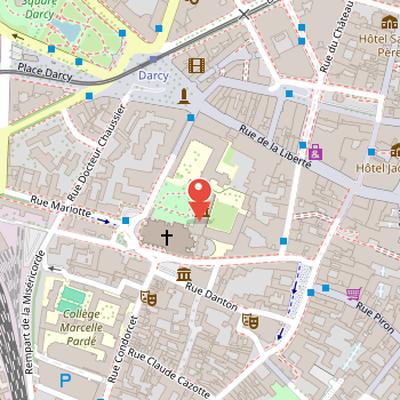
Nearby Objects
-
 Abbaye de Saint-Bénigne 20 m away
 -
 Dijon Cathedral 50 m away
 -
 Saint-Philibert Church 90 m away
 -
 Église Saint-Jean de Dijon 150 m away
 -
 Théâtre Dijon-Bourgogne 150 m away
Location and Collections
The Musee archeologique de Dijon is a museum of Burgundian archaeology founded in 1832 in Dijon, Cote-d'Or. It is designated as a Museum of France. Since 1934, it has been housed in the main wing of the former Saint-Benigne Abbey in Dijon. Its collections focus on humans in Burgundy during Prehistory, Protohistory, Roman Gaul, and the Middle Ages, and also include Paleochristian art, sacred art, and Christian architecture.
From Scholarly Collections to a Municipal Museum
The museum's collections grew out of the work of scholars and learned societies, including the Academie de Dijon and the Commission des Antiquites de la Cote-d'Or, created in 1832. Its history is tied to archaeological operations, the preservation of historic monuments, and the conservation of objects from sites such as Alesia, Vertault, and Les Bolards. In 1832, the museum of the CACO was installed in the former hotel Rolin, where it first displayed sculpted elements from the antique castrum and from demolished Dijon monuments such as Saint-Benigne and Sainte-Chapelle. During the Second Empire, the Musee des Antiquites occupied several rooms in the palais des Etats, near the Musee municipal de peintures et de sculptures, now the Musee des Beaux-Arts. The collection was later enriched by excavations at the sanctuary of the sources of the Seine. In 1934, the museum moved to the dormitory of the Benedictins in the abbaye Saint-Benigne, and in 1955 it was municipalized under successive curators. Archaeological enrichments and acquisitions expanded the museum across different levels of the building. It presents material evidence of cultures from Cote-d'Or and Burgundy from Prehistory to the Middle Ages.
Collections and Key Works
The museum collections bring together material from Dijon, Alese, Source-Seine, Vertault, Mlain, Moutiers-Saint-Jean, Curtil-Saint-Seine, Blanot, La Rochepot, Chaume-les-Baigneux, Etaules, and Selongey in Burgundy. In the chapter house and scriptorium, the displays include ex-voto, steles, bas-reliefs, and sculptures from the castrum of Dijon. The monks dormitory contains Romanesque and Gothic sculptures from Moutiers-Saint-Jean, Curtil-Saint-Seine, and the Chartreuse de Champmol, as well as a bust of Christ sculpted by Claus Sluter in 1399. Another major object is the Crowned Christ of Thorns by Claus Sluter, a limestone crucifix fragment erected in 1399 in the Champmol monastery courtyard. Removed from the monastery at the end of the 18th century, it was rediscovered in the 19th century in a wall in Dijon and then transferred to the archaeological museum. The original crucifix also included statues of Mary, John, and Mary Magdalene, which are now lost. In some rooms, the museum also presents remains from several periods, ranging from the Paleolithic to the Merovingian period.