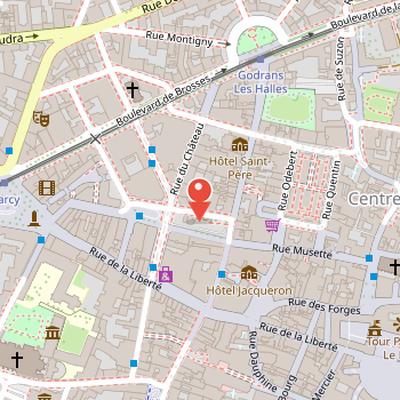
Place Grangier is a square in Dijon whose site was occupied from the end of the Middle Ages until the end of the 19th century. The former castle of Dijon, built between 1478 and 1510, was demolished between 1891 and 1897, and the area was progressively developed in the early 20th century. The square received its name in honor of Henri Grangier and Sophie Villeneuve, who bequeathed their collections and fortune to the city of Dijon and the General Hospital of Dijon.
The site brings together buildings and works from several periods. It includes the Hôtel des Postes, built from 1907 to 1909 by architect Louis Perreau in Louis XVI style, with a monumental clock and sculptures by Paul Gasq, Le Jour and la Nuit. Nearby are Art Nouveau buildings, including one built in 1907 and others at 1 and 3 place Grangier built from 1906 to 1908, all by Louis Perreau. The square also contains a monument honoring the Grangier spouses, with sculptures and a decorated fountain base. Later additions include the hôtel Central, built from 1926 to 1927 in Art Deco style, a twelve-story tower from 1966 to 1967, an underground parking structure inaugurated in 1969, the GRAMA building, and the contemporary sculpture Le compteur du temps, installed in 2020 opposite the poste Grangier.
Nearby Objects
-
 Place François-Rude 140 m away
 -
 Château Royal de Dijon 140 m away
 -
 Halles de Dijon 160 m away
 -
 Hôtel Aubriot 200 m away
 -
 Guillaume's Gate 250 m away
Name and Dedication
Place Grangier received its name in honor of Henri Grangier and Sophie Villeneuve. Henri Grangier lived from 1842 to 1902, and Sophie Villeneuve lived from 1851 to 1905. The two were also remembered for having bequeathed their collections and fortune to the city of Dijon and the General Hospital of Dijon.
Historical Development of Place Grangier
From the end of the Middle Ages until the end of the 19th century, the site of Place Grangier was occupied by a historic castle of Dijon. This castle was built between 1478 and 1510. It was demolished from 1891 to 1897, after which the site was progressively developed in the early 20th century. The present place therefore reflects a long process of transformation from a fortified historical structure to an urban public space.
Architectural Layers Around Place Grangier
Place Grangier is marked by a succession of buildings and interventions from the early 20th century to the present. The site of the Historique once hosted the Hotel des Postes, built from 1907 to 1909 by architect Louis Perreau in Louis XVI style. This building includes a monumental clock and sculptures by Paul Gasq, Le Jour and la Nuit. Nearby, Perreau also designed an Art Nouveau building in 1907, as well as other Art Nouveau buildings at 1 and 3 place Grangier, built from 1906 to 1908.
The square also includes a monument inaugurated in honor of the Grangier spouses, with sculptures and a decorated fountain base. Later additions changed the character of the site further, including the Hotel Central, built from 1926 to 1927 by Gaston Paris in Art Deco style, and restored in 2024 with painted decorations and a snail frieze. On the west side, a twelve-story tower was built from 1966 to 1967, while the central square received an underground parking built from 1967 to 1968 and inaugurated in 1969.
More recent constructions include the GRAMA building at 15 place Grangier and 5-9 rue Mably, built from 1973 to 1975 by Jean-Louis Ducruet, and the Grangier bookstore at 14 rue du Chateau, built in the early 2000s. The site was also the subject of a redevelopment project selected in 2013 by Francois Rebsamen with artist Bertrand Lavier. In 2020, the contemporary sculpture Le compteur du temps by Gloria Friedmann was installed opposite the poste Grangier, adding a new artistic layer to the square.
Bibliography on Place Grangier
The documentation on Place Grangier includes a bibliographie associated with Claudine Hugonnet-Berger and illustrated with photographs by Jean-Luc Duthu. It is related to the broader reference work Dijon architectures civiles 1800-1940, published in Dijon in 1994 by the Association pour la connaissance du patrimoine de Bourgogne. Relevant references appear on pages 10, 18, and 24.