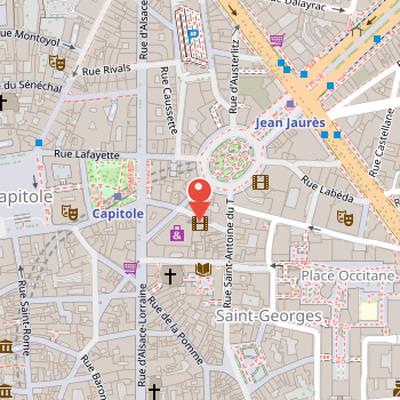
Utopia Toulouse was an arthouse cinema and movie theater located at 24 rue Montardy, near place du Capitole in Toulouse. The site occupied a building with a long and varied history. It was originally a jeu de paume room and became the first opera house in Toulouse in 1687. After a new spectacle room was built at the Capitole in 1737, it was forced to host lesser performances. The building was destroyed by fire in 1748 and rebuilt as the salle du Concert.
In the following decades, it served as a venue for noble festivities, a learned society called Musée, the Lycée, and the Athénée. During the 19th century it also functioned as a political meeting place, performance hall, hotel, and café-restaurant. Around 1890 it became the Skating-Palais, then one of the first permanent cinemas in Toulouse under the name American Cosmograph in 1907. It later became an officers' club, was acquired by the clergy, returned to cinema as Le Rio in 1949, and became Utopia Toulouse in 1993.
Nearby Objects
-
 Saint Jerome Church 90 m away
 -
 Wilson Square 130 m away
 -
 Théâtre du Capitole 200 m away
 -
 Place Saint-Georges 250 m away
 -
 Place du Capitole 300 m away
From Performance Hall to Athenee
Utopia Toulouse, identified in these facts as Intro, is located at 24 rue Montardy near Place du Capitole in Toulouse. The building began as a jeu de paume room and later became the first opera house in Toulouse in 1687. In 1737, a new jeu de spectacle room was built at the Capitole for lyrical art, and Intro was then forced to present lesser performances. It was destroyed by fire in 1748 and rebuilt afterward under the name salle du Concert. For several decades, it served as the seat of noble festivities until 1781. That same year, Archbishop Lomenie de Brienne founded a learned society called Musee there. The building later took on new educational roles, becoming the Lycee in 1797 and the Athenee in 1802, although the Athenee dissolved after a controversy in 1805 and the building remained closed until 1818. After reopening, it continued under the name Athenee and in the 19th century was used as a political meeting place, a performance hall, a hotel, and a cafe-restaurant.
From Skating-Palais to Utopia Toulouse
Around 1890, the building was transformed into the Skating-Palais. In 1907, it became one of the first permanent cinemas in Toulouse, under the name American Cosmograph. Its later uses included an officers' club in 1927 and ownership by the clergy in 1931. The building returned to cinema use in 1949 as Le Rio. In 1993, after another change of owner, it became Utopia Toulouse. In 2016, it changed owner again and reverted to the name American Cosmograph.
The Early Performance Space at Rue du Pre-Montardy
In 1687, Francine, the successor of Lully and director of the Academie royale de musique, decided to establish operas in the provinces modeled on the Parisian operas. At that time, he noted that Toulouse had only one modest performance hall, located at the Auberge du Logis de L'ecu, and that the building was already in a state of disrepair. He therefore created a lyrical art hall in the former Salle du Jeu-de-Paume on rue du Pre-Montardy. Only the entrance of the hall faced rue du Pre-Montardy, while a long corridor led to the main hall, which was backed by rue Romenguiere.
The choice of location reflected the differing qualities of the surrounding streets. Rue Romenguiere was described as narrow and disreputable under the ramparts, whereas rue Pre-Montardy was better suited to carriage traffic and had a better reputation. The hall also had decorative elements of note. A fine terracotta bas-relief of Apollon and the Muses by Marc Arcis survived a fire, while the painted ceiling by Pierre Subleyras no longer remains. The walls survived the fire and were rebuilt some years later. The site is also associated with grand festivities held publicly by Parliament decree on an unspecified date.
From Musuee de Monsieur to Historique
The institution described here began as Musee de Monsieur, a society of scholars devoted to technical education. Its sessions were held regularly in the Salle du Concert and included public readings, musical interpretations, and physics demonstrations. In 1786, Musee de Monsieur changed its name to Lyccee. Lyccee continued to offer conferences and was not banned during the Terror. It was formed with four classes covering sciences, belles-lettres, art, agriculture, and commerce, and it started with seventy members before increasing to one hundred. Women were admitted only as associates, with the right to attend public meetings.
Historique now operates in the Salle du Concert, where its public sessions mix music, theater, and scholarly readings. However, it faces attendance problems inherited from the end of Lyccee, and some members do not pay their fees. It also struggles to find funds for the annual prizes awarded to distinguished members. An order prohibits any private society from using the name Lyccee, reserving it for secondary education institutions. The historical record also notes that its last session was followed by members dispersing to reform Ancien Regime academies.
Later Uses of the Venue
The venue became a popular theater presenting concerts, operettas, comic acts, and other performances. In 1848, the building was known as the Hotel de l'Athenee and offered the Salle des Concerts for rent three times a week. It later changed its name to the Cafe-restaurant de l'Athenee in 1876. Around 1890, the hall was converted into the Skating-Palais, which included a skating rink and orchestra. The Skating-Palais also hosted masked balls on Saturday evenings.
Early Cinema in Toulouse
Toulouse was among the early cities to receive public film screenings. The first public kinetograph session took place five months after the Lumiere brothers' first public screening in Paris, and the city also hosted its first public cinematograph session at an unspecified date. At first, cinema was offered by fairground entertainers as an attraction, before becoming more established in 1900 through public sessions organized at place du Capitole and place Lafayette.
These early screenings were projected from the first floor of a building, and cinema then spread into cafes such as Cafe des Americains and Cafe Barrie. From 1903 to 1914, these venues showed films daily with piano accompaniment by M. Luzan-Faget. Programmes changed twice weekly, on Tuesdays and Fridays, and ticket prices could be reduced by half on presentation of Chocolat Poulain favor tickets. Unlike Royal-Pathe, which closed in August because of public vacations, these venues remained open during the summer.
The programmes featured films from Vitagraph, Itala, Pasquali, Cinetograph, and mainly Gaumont. They also included Gaumont news, Jean Durand series, Leonce Perret series, Louis Feuillade series, and Victorin Jasset's Nick Carter police short films. In 1913, the American Cosmograph gained popularity with Louis Feuillade's Fantomas series, including three parts of Fantomas, four episodes of Juve against Fantomas, Le Mort qui tue, Fantomas contre Fantomas, and Le Faux Magistrat.
Cinema History and Renovation
The building was taken over in 1949 by the owner of the Trianon cinema in Toulouse and renamed Le Rio cinema. The Rio and Trianon cinemas then operated in tandem, with Rio showing Trianon exclusives. In 1950, the cinema was modernized under the leadership of Georges Peynet, and its facade was completely renovated. In 1980, Michel Deschamps took over the building and installed the bas-relief of Marc Arcis in the cinema hall.
Cinema Model and Programming at Utopia Toulouse
Utopia Toulouse, known as Historique, was divided by Michel Deschamps from a single 600-seat room into three smaller rooms. It was bought by the Utopia network in 1993, when it was close to bankruptcy, and became the third cinema in the network after Avignon in 1973 and Saint-Ouen-l'Aumone in 1987. Although it was built according to the Utopia network model, it is legally independent and later became independent from the network.
The cinema is classified as art et essai and carries the labels Jeune public, Recherche et decouverte, and Patrimoine et repertoire. Its programming is devoted exclusively to art house and experimental films, mostly European, shown in original version. Tickets are priced below those of large multiplexes, and the cinema follows the values of no advertisements, no ancillary revenues, and no popcorn. It does not sell snacks.
Its communication is limited to a free monthly publication, La Gazette, which includes film programs and critiques. The cinema has received the trophy for best attendance rate in France four times from Le Film francais. It also hosts debates, thematic evenings, youth sessions, cine-concerts, and series B evenings, and it partners with festivals including Fifigrot, Cinelatino, Cinespa a, and Printemps lesbien. Through La Gazette and invitations to debate evenings, it also takes social positions, including a symbolic boycott of A 5h de Paris by Leon Prudovsky in reaction to the Gaza flotilla raid. In 2015, the original founders Anne-Marie Faucon and Michel Malacarnet planned to gradually withdraw from management, but the planned transformation into a SCOP failed because of internal dissensions led by employees Annie Mahot and Jeremy Breta. Tickets are mutually accepted with the American Cosmograph.