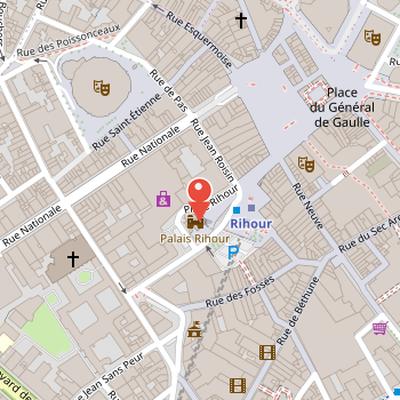
Palais Rihour is located at Rihour in Lille, in the Nord department of France. It is the surviving part of a palace built in the 15th century by the Dukes of Valois-Bourgogne, sovereigns of the Burgundian State. The building was classified as a historical monument in 1875. Today, the guard room houses the city’s tourist office.
Construction of the palace began after Philippe le Bon negotiated subsidies for a new palace in 1450 and obtained funds over four years from the Magistrat. In 1453, land from the old Rihout manor was acquired for the project on a swampy site between the canal des Poissonceaux and the city walls. The work started under architect Evrard de Mazières and was completed twenty years later under Charles le Téméraire. The palace originally had four wings around a courtyard. It was later damaged by the ground conditions and by the poor quality of the stone used, and most of the building was executed in brick. Over time, it also served as Lille’s town hall.
Nearby Objects
-
 Place Rihour 70 m away
 -
 Théâtre du Nord 150 m away
 -
 Saint-Étienne Church 150 m away
 -
 Grand'Place 200 m away
 -
 Column of the Goddess 200 m away
Palais Rihour in Lille
Palais Rihour is located at Place Rihour in Lille, in the Nord department of France. It is the remaining part of a palace built in the 15th century by the Dukes of Valois-Bourgogne, the sovereigns of the Burgundian State. The site preserves this historical legacy in the city center, and its guard room now houses Lille's tourist office. Palais Rihour was classified as a historical monument in 1875, reflecting its recognized heritage value.
Construction and Early Use of Palais Rihour
In 1450, Philippe le Bon began negotiations for subsidies to build a new palace, and over the next four years he obtained funds granted by the Magistrat. In 1453, land from the old Rihout manor on part of the Rihour block was acquired for the project. The site was swampy and uninhabited, lying between the canal des Poissonceaux and the city walls. Construction started on plans by the architect Evrard de Mazières and was completed twenty years later under Charles le Temeraire.
The palace was designed as a quadrilateral around a courtyard, with four wings of different proportions. Most of the building was made in brick, contrary to the wishes of Duke Philippe le Bon. The swampy ground caused early damage, and the following century major repairs were needed because of the poor quality stone from the Lezennes quarry. For several decades, the palace was preceded by a wooden barrier bearing eleven heraldic lion and griffin statues.
Palais Rihour also had an important civic role. Emperor Charles Quint stayed there, and in 1664 the city bought the palace from the King of Spain for 32000 florins. It then served as the town hall, replacing the previous Lille halle echevinale, which had stood on the Grand'Place, later replaced by the Theatre square and rue Faidherbe.
Fire, Repairs, and Royal Visits
After its acquisition, modifications were made to the north facade of the palace. In 1700, the north wing was damaged by fire during a nighttime ball and was rebuilt in the style of the period. The palace also received royal attention when King Louis XV stayed there for several days in 1744, before moving to the Governor's hotel eleven days after his arrival. Later, the west wing was destroyed by fire in 1756 and restored in the Louis XIV style. A further fire damaged the southeast part of the palace, which was left in its damaged state.
Reconstruction and Survival of Palais Rihour
Before 1846, the municipal buildings of Palais Rihour were disparate in composition. The palace was destroyed in 1846 and then completely rebuilt until 1857 in a neo-Renaissance style by Charles Benvignat. A belfry had been built in 1826, but it was demolished during the reconstruction completed in 1857. The chapel from the 15th century was conserved at the rear of the building, and the central courtyard staircase was moved stone by stone in front of the chapel, turned 90 degrees from its original orientation. The site also hosted the first performance of Hector Berlioz's cantata Le Chant des chemins de fer in 1846.
The building was classified as a historic monument in 1875. It later suffered an accidental fire that started on the second floor during the night of December 23 to 24, 1907, when it housed the city hall. Firefighters arrived late because of a curfew, and low water pressure made firefighting difficult. The financial services and conclave room were saved, but the 17th-century city archives and part of the municipal library collections were destroyed. After the fire, municipal services moved to Boulevard de la Liberte and to the Prefecture, then in 1912 to Rue Gambetta and to premises of a Catholic educational institution at Parvis de la Treille. Palais Rihour was later demolished except for the chapel, the 15th-century staircase, and some brick arcades.
The Monument in Front of the Palace Remains
In 1929, a Monument aux Morts by Edgar Boutry and Jacques Alleman was erected in front of the palace remnants. The monument commemorates the destructions and sufferings of Lille during the First World War. From the adjacent main square, it partially obscures the remains of the Palais of the Dukes of Valois-Burgundy, linking the memorial directly to the historic site while also affecting how the palace ruins are seen in the public space.
Architectural Remains and Current Uses
The remaining parts of Palais Rihour include the grand staircase, the chapel, and the guard room, all in late Gothic style. These elements preserve details such as windows with mullions and an octagonal turret containing a spiral staircase. The guard room is vaulted with slender ribbed vaults, while the old chapel, known as the Salle du Conclave, has a unique nave and ribbed vaulting. The Salle du Conclave also served as a place of justice and, from 1684, as a meeting room for the Magistrate. It was decorated with five monumental paintings by Arnould de Vuez, although the original works have disappeared; their painted sketches are now kept and exhibited at the Musee de l'Hospice Comtesse. The former guard room now hosts the Lille tourism office.
The site also includes several large rib-vaulted cellars under the square belonging to the palace. During Lille's role as European Capital of Culture in 2004, the building housed an exhibition of works by painter Victor Vasarely, and its small bell tower was reconstructed in the same year. Today, the Salle du Conclave hosts temporary exhibitions, continuing the public use of one of the palace's most distinctive surviving spaces.