Antiquaille Hospital is an ancient hospital in Lyon, located on the site of l’Antiquaille. It occupies a former convent of Visitandines and includes parts built in the 18th century. The complex is registered as a historical monument, reflecting its architectural and historical interest. Since 1803, the hospital functioned in the former convent of the Visitation de l’Antiquaille, where it mainly received mendicants and the insane, while also admitting some common law convicts. The institution always recruited doctors through competitive examination and took part in the transition of medicine toward experimental science, including through the work of Claude Bernard. From 1830 to 1876, it underwent many expansions and modernizations, most of them directed by Louis Cécile Flacheron. The hospital also played a role in later medical developments, with figures such as Paul Diday, Joseph Rollet, Antoine Gailleton, Jean-Victor Augagneur, and Victor Rochet associated with its history.
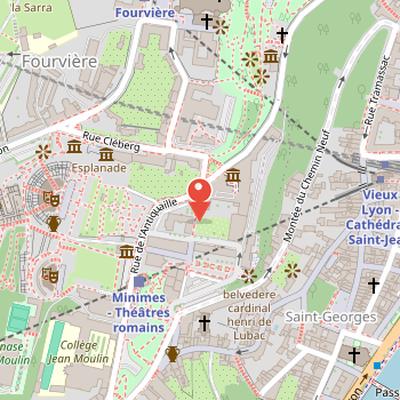
Nearby Objects
-
 Montée du Chemin-Neuf 110 m away
 -
Conservatoire de Lyon 200 m away
-
 Ancient Theatre of Lyon 200 m away
 -
 Lugdunum Musée et théâtres romains 250 m away
 -
 Odeon of Lyon 250 m away
Antiquaille Hospital Site and History
Antiquaille Hospital is an ancient hospital located on the site of l Antiquaille in the city of Lyon. It occupies a former convent of Visitandines, and its historic fabric includes both the former convent and parts built in the 18th century. The building is registered as a historical monument, reflecting its recognized heritage value.
Hospital Use and 19th-Century Development
The Antiquaille Hospital has operated since 1803 in the former convent of the Visitation de l'Antiquaille. Its early role was shaped by a mixed population of patients, including mendicants, the insane, and, in some cases, common law convicts. Over time, it hospitalised mainly mendicants and the insane, with care functions remaining secondary. The institution always recruited doctors through competitive examination, and it took part in the transition of medicine toward experimental science with Claude Bernard. Budget difficulties led to its union with the Hospices Civils de Lyon in 1846. Between 1830 and 1876, the hospital underwent many expansions and modernizations, most of them directed by Louis Cecile Flacheron.
Medical Leadership and the Shift to Urology
At Histoire, Paul Diday (1813-1895) began working in 1843 and devoted his scientific work to venereal diseases and syphilis. He is noted for clinically distinguishing gonorrhea from syphilis before Albert Neisser isolated the gonococcus, and his final medical work dealt with regulation of nocturnal urination in prostatic patients. After Diday, Joseph Rollet succeeded him, followed by Antoine Gailleton.
A later generation continued this line of medical study. Jean-Victor Augagneur became intern and surgical clinic chief at Histoire in 1881, studied venereal diseases, and coauthored Précis des maladies veneriennes in 1906. In 1900, Victor Rochet (1860-1934) converted the venereal and skin disease service into a urology service, marking a clear institutional shift in the hospital's medical orientation.
History of the Hospital Site
Histoire describes Antiquaille Hospital as a site with a layered history of medical, wartime, and later redevelopment uses. In medical terms, the hospital evolved from syphilography to dermatology under doctors Jean Gate and Thiers, and later specialized in nephrology through the influence of Jules Traeger, coming from urology. It also carried out some renal allograft transplants with the urological surgery department. According to Histoire, transplant results remained uncertain until the mid-1960s, when an effective immunosuppressive drug appeared: serum anti-lymphocyte, prepared by the Institut Pasteur de Lyon. This development elevated the hospital of l Antiquaille to a leading position in global organ transplantation.
The site also played a role during World War II, when Histoire identifies it as the place of a Resistance operation that freed prisoners from Germans. This operation was led by the franc group of the Liberation-Sud movement. Histoire further notes that the hospital hosted prisoners from Lyon prisons until 1985. The site also housed a neurology service until its closure.
The hospital of l Antiquaille closed in 2003. The site was then acquired by Societe anonyme de construction de la ville de Lyon for redevelopment. A preventive archaeological excavation was carried out by the Service archeologique de la ville de Lyon, and the excavations uncovered an ancient private dwelling from the period before its destruction. The Villa Maia hotel later opened on the hospital site in 2018.