Montée du Chemin-Neuf is a street in the Vieux Lyon district of Lyon and one of the two main communication routes between the Saint-Jean and Saint-Just districts. It rises from 175 meters to 248 meters, with an elevation difference of 69 meters and a slope of 11.5 percent. The name Chemin Neuf dates from its creation by ordinance consulaire. According to the historical record, Baron des Adrets entered Lyon on the night of 29 and traced Chemin Neuf, which connected the upper and lower parts of the city. The route also reflects periods of conflict, when Protestants in power sought rapid access to the Saint-Just chapter and later when the street became a main access point for national troops to the Vieux-Lyon bastion. The street is also associated with workshop and lodge activity, including a stained-glass workshop founded there in 1845 and the lodging of Louis-Claude de Saint-Martin in 1775 and 1776.
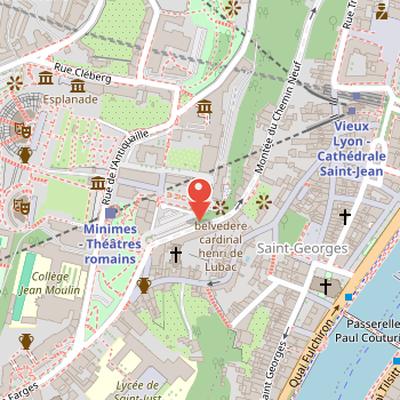
Nearby Objects
-
 Antiquaille Hospital 110 m away
 -
 Église Saint-Georges 200 m away
 -
 Lycée de Saint-Just 250 m away
 -
 Odeon of Lyon 250 m away
 -
Conservatoire de Lyon 300 m away
Street Profile and Urban Role
The mounted Chemin-Neuf is a street in the Vieux Lyon district of Lyon. It is one of the two main communication routes between the Saint-Jean and Saint-Just districts, giving it an important local urban role. The street rises from an altitude of 175 meters to 248 meters, with an elevation difference of 69 meters. Its slope is 11.5 percent, reflecting the steep profile of the route.
History and craft along Mont cee du Chemin-Neuf
The name Chemin Neuf dates from its creation by ordinance consulaire. According to the historical account, the route was traced by Baron des Adrets, commander of the Protestant armies, when he entered Lyon on the night of 29. At that time, Chemin Neuf connected the upper and lower parts of Lyon. Protestant authorities feared a Catholic attack from the Saint-Just chapter, and they wanted rapid access to it, which helps explain the importance of this route.
The street also appears in the history of Lyon's religious and intellectual circles. Maison Renon, or Puylata, was a Masonic lodge, also called Loge Egyptienne and later Sagesse Triomphante. Among its initiates were Joseph Balsamo, Giacomo Casanova, and Martines de Pasqually. Jean-Baptiste Willermoz was venerable of the lodge de la Bienfaisance, and lodges practiced mysticism and magnetism experiments initiated by Franz-Anton Mesmer. Louis-Claude de Saint-Martin lodged at montée du Chemin-Neuf in 1775 and 1776.
During the revolutionary period, the street took on military significance. After revolutionary troops took Fort de Sainte-Foy and bombed Lyon with red-hot cannonballs, municipal authorities lit all first floors of streets in June to fight fires. Chemin Neuf was darkened because it was visible to the enemy and was placed under curfew. From late September, the montée became the main access for national troops to the Vieux-Lyon bastion.
In the nineteenth century, the street was also associated with crafts and industry. Alexis Brun Bastenaire founded a stained-glass workshop there in 1845. The workshop produced stained-glass for the churches of Saint-Louis de la Guillotiere and Notre-Dame-Saint-Vincent, and it was the first place of experimentation for the glassmaker Lucien Begule starting in 1880. Jean Louis Auguste Dousselin installed a molding workshop for candles and wax in 1860. The company had existed since 1792, had been headquartered on rue de la Bombarde, and was later moved by Auguste Dousselin to larger premises on quai Arloing, with its headquarters now at Couzon-au-Mont-d'Or.
Disaster, Warnings, and Aftermath
According to the history of the montée du Chemin-Neuf, the area was marked by warnings before the disaster. A steamroller had already sunk into the roadbed, and a local roadman alerted his superiors about the dangers in the week before the event, but without results. Professor Desperet had also submitted conclusions on the risks of the sector after being requested to report by Mayor Edouard Herriot, although he died before the catastrophe. The estimated cost of stabilization works was 6 million francs, yet the authorities chose to ban heavy vehicle traffic instead of carrying out the works.
Following heavy rains on the night of the 12th, around 1 a.m., a landslide destroyed several buildings on the montée du Chemin-Neuf and rue Tramassac and caused a power outage in the neighborhood. A second, larger landslide killed nineteen firefighters and four police officers, and a final collapse completed the destruction of the zone. The destroyed area was never rebuilt and is now vegetated. In 1963, Louis Pradel inaugurated a fountain-cascade above the disaster site, but it is now out of service.
The montée was also a place of wartime memory and repression: the bar l Alcazar on the site was a meeting place for militiamen and the Gestapo during the war, and a plaque in front of the montée commemorates Guy Bernard, who was killed by the militia while escaping.
The Chemin Neuf Community at the Mont ee
According to Histoire, Laurent Fabre and Bertrand Lepesant discovered the Renouveau charismatique in 1971. A prayer group was then created in a house located under one of the three garden terraces of the montée. From this group, seven people founded the communaut e du Chemin Neuf, which Histoire describes as corresponding to the spirituality of the new community. The community is still present in its original house-mother. It also manages the Marie-Thérèse student residence at 22 montée, a residence entrusted to it by the Sisters of Marie-Thérèse.
Traffic Changes and Cycling Use
In 2025, after an experimental phase, the Montree du Chemin-Neuf was closed to most motor vehicles, with access by car or other vehicles limited to authorized persons. The route was also designated as a velo-rue for circuits 8, 11, and 12 of Lyon's cycling network, reflecting a stronger emphasis on cycling use. On May 12, 2026, Lyon Metropole installed signage to warn cyclists of the steep slope, following a request from the mairie after a serious cycling accident on April 26. The route also became a subject of political debate after the March 2026 elections, with Veronique Sarselli and Thomas Rudigoz favoring the reopening of the axis to through automobile traffic, while Gregory Doucet opposed it.
Transport, Services, and Public Facilities
La montee du Chemin-Neuf is shaped by its steep slope, which affects local access and services. It is not served by any bus, and no Veilo'v station is located directly on the street for the same reason. However, several Veilo'v stations are placed near its two ends. The street is bordered by two stations of the Saint-Jean - Saint-Just funicular line, Vieux Lyon - Cathedrale Saint-Jean and Minimes - Theatres Romains, giving it direct links to this transport system.
The street also hosts several institutions. A youth hostel was inaugurated there in 1998. It received a quality label and is described as the seventh certified French hostel. The hostel has 180 beds and hosts an average of 65 percent foreigners. In addition, the honorary consulate of Finland is located on La montee du Chemin-Neuf.