The Regional Conservatory of Lyon, officially named Le Conservatoire à rayonnement régional de Lyon and commonly called the Conservatoire de Lyon, is an artistic education institution based in Lyon, Rhône, France. It is approved and controlled by the French State and is overseen by the Direction générale de la Création artistique of the Ministry of Culture and Communication, with representation by the regional direction of cultural affairs (DRAC). The conservatory offers three specializations: music, choreography, and dramatic art.
Founded by municipal decree in Lyon through the initiative of Édouard Mangin, who was appointed director at the time of its founding, the institution originally trained musicians through the Académie Royale des Beaux Arts and the opera in Lyon. It was officially recognized by the state in 1874 and later grew in reputation, reaching around 700 students by 1889. Originally dedicated to classical music education, it gradually expanded its departments, adding dance in 1980, jazz in 1988, world music in 2001, current and amplified music in 2003, and reopening its theater department in 2006 after twelve years of interruption. The conservatory later became an independent public institution under a mixed management syndicate involving Lyon and the Lyon Metropolis.
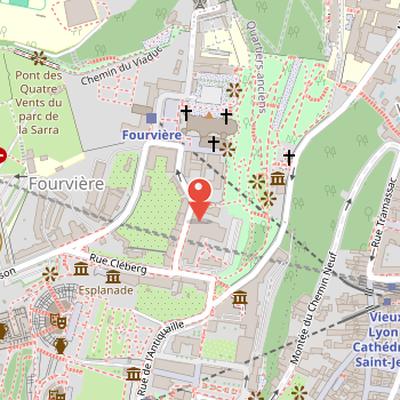
Nearby Objects
-
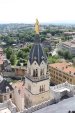 Chapelle Saint-Thomas 120 m away
 -
 Montée Saint-Barthélemy 140 m away
 -
 Notre-Dame de Fourvière 150 m away
 -
 Antiquaille Hospital 200 m away
 -
 Lugdunum Musée et théâtres romains 200 m away
Institutional Role and Location
Le Conservatoire a rayonnement regional de Lyon, commonly called Conservatoire de Lyon, is an artistic education institution approved and controlled by the French State. It is overseen by the Direction generale de la Creation artistique of the Ministry of Culture and Communication, and it is represented by the regional direction of cultural affairs (DRAC). The institution is headquartered in Lyon, in the departement of Rhone, France. It offers three specializations: music, choreography, and dramatic art.
History and Expansion of the Conservatory
The Regional Conservatory of Lyon was founded by municipal decree in Lyon on the initiative of Edouard Mangin, who was appointed director on the same founding date. In its early years, it trained musicians through the Academie Royale des Beaux Arts and the opera in Lyon, and it was originally dedicated to classical music education. The state officially recognized the institution in 1874 and granted it a specific title, while its reputation continued to grow through successive prominent musical directors. By around 1889, attendance had reached 700 students, indicating the scale of its activity.
Over time, the conservatory broadened its teaching to include a wider range of artistic disciplines. It added a dance department in 1980, created a jazz department in 1988, and established a world music department in 2001. In 2003, it started departments for current and amplified music. The theater department, after twelve years of interruption, reopened in 2006. These changes reflect a gradual expansion from a classical foundation toward a more diverse range of musical and performing arts education.
Governance of the Conservatory
The institution was separated from the city of Lyon to form an independent entity on an unspecified date. It later became a public institution under a mixed management syndicate shared between Lyon and the Rhone Department. In 2015, the Rhone Department was replaced by the Lyon Metropolis in its governance. The mixed syndicate includes a committee of twelve elected officials from Lyon and the Lyon Metropolis. At first, the Mayor of Lyon served as President of the syndicate, while the representative of the Rhone Department served as Vice-President. Today, the President is an elected representative from the City of Lyon, usually the Culture Deputy, and the Vice-President is an elected representative from the Lyon Metropolis.
Current Role and Site
Today, the Conservatoire de Lyon holds the status of conservatoire a rayonnement regional. It is organized around seven decentralized branches in the arrondissements and offers a complete pedagogical curriculum covering initiation, amateur practice, and pre-professional training. Its educational activity also extends beyond the conservatory itself through an active awareness policy in Lyon primary schools, supported by more than 30 musician and dancer instructors. These initiatives are carried out in cooperation with the Education Nationale and the education service of the City of Lyon, and they reach more than twelve thousand young people in Lyon each year.
The institution is described as the largest in the national territory by missions and publics. It employs over 240 permanent teachers, enrolls 2700 students, and has an administrative team of 60 agents. Since 1978, it has been located near the Basilique de Fourviere, after moving from the Palais de Bondy. The current site occupies a former Jesuit property that housed the theologat de Fourviere and was acquired by the city of Lyon. The conservatory spans four buildings at the Fourviere site.
Current Training Structure
The Conservatoire de Lyon aujourd'hui is organized around a Cycle Decouverte in music and dance, which currently hosts 300 children. This initial two-year cycle is followed by four further learning cycles. The second cycle ends with a brevet de fin de cycle, while the final cycle concludes with diplomas in musical, choreographic, or theatrical studies. A fourth cycle of perfectionnement is available for about one hundred students who are preparing for European higher education competitions. Since 2012, cycles 2 and 3 have included a personalized modular a la carte system designed to adapt training to different student profiles and motivations. The conservatory has also recently opened three bachelor's degree programs in partnership with Lyon universities, in theater and in music, with specializations in Interprete and Mediation culturelle.
Teaching, research, and international partnerships
Since 2017, the conservatory has hosted the CLUSTER research laboratory, where it organizes meetings between teachers and external personalities. It also conducts pedagogical experiments, including the AICO program with children from the Etats-Unis school district, with a team of teachers working around collective instrumental practice. The institution has obtained accreditation from the Ministry of Culture and Communication and opened the Parcours preparatoire a l'enseignement Superieur (PPES) in Dance, Music, and Theater. Through this program, it prepares approximately 200 students for higher education admissions and professional integration in artistic fields.
The conservatory maintains active partnerships with local cultural actors and with numerous French and foreign institutions. It co-founded the CEPIA network in 2001 with the CRR de Paris and has relations with institutions in Germany, Italy, Sweden, Canada, the United States, Israel, and Lebanon. In 2017 it signed a partnership agreement with the National University of Arts in Taipei, and in 2019 with the Lyccee musical de Saint-Petersbourg. It also established initial contacts with the Conservatoire de Guanhzhou in Canton, China. These partnerships facilitate student and teacher exchanges and joint concert projects.
The conservatory also works with the National Education system through CHAM musical and CHAD dance programs, including the Ecole primaire Albert-Camus and the colleges Saint-Exupery and Jean-Moulin. Since 2016, it has operated two bachelor degree courses with Universite Lyon 2: Parcours Interprete de la Musique and Parcours mediation culturelle.
Public Performance and Cultural Activity
Vie culturelle organizes nearly 300 events each year, creating a close link between teaching and artistic diffusion. Public performances by students are an integral part of studies at the Conservatoire de Lyon, and they help young musicians, dancers, and actors understand their relationship with an audience. In personalized cycles, these performances are also part of the evaluation process. The cultural season places particular emphasis on collective practice and includes forty permanent ensembles, among them three symphony orchestras and one chamber orchestra. For students, this season is an important asset in musical training and a major part of the curriculum. It is also a primary pedagogical tool for teachers at Vie culturelle, while serving as a significant musical resource center for amateur and professional musicians in the region and beyond.
Library and Discotheque Collections
The Regional Conservatory of Lyon includes a library that provides consultation and loan services for music scores, books, and periodicals. Its holdings offer access to scores and encyclopedias on music and the arts, together with specialized press periodicals. Nearly a specified number of scores are available for direct loan, and the library also preserves a valuable collection of instrumental and vocal scores from the 19th and early 20th centuries.
The conservatory also has a discotheque with an on-site listening space where vinyl records and CDs can be consulted. A specified number of vinyl records and CDs are currently available for listening. The collection has been enriched by several important donations and legacies, including classical music CDs from critic Ferruccio Nuzzo, jazz CDs and 450 jazz books donated by Lyon jazz enthusiast Alain Fournier, and vinyl records from Roger Accart, an enthusiast of contemporary music. In total, the discotheque holds nearly a specified number of sound documents, including these donations and legacies.
Access to the Regional Conservatory of Lyon
The Regional Conservatory of Lyon is served by the Fourviere funicular station (F2), which connects from Vieux Lyon - Cathedrale St Jean metro station on line D. From the Fourviere funicular station, the conservatory is located approximately two minutes on foot away.