Lugdunum Musée et théâtres romains is an archaeological museum in Lyon, France. Its official name has been used since 2017; it was formerly known as musée gallo-romain de Fourvière and musée de la Civilisation romaine. The institution includes an indoor museum space and, since November 2017, Roman theaters on Fourvière hill. Managed by the métropole de Lyon, it regularly hosts temporary exhibitions.
The museum is linked to the archaeological history of Lugdunum, described as an important and prosperous Gallo-Roman city. Fourvière hill was once the center of the Roman city. According to Histoire des collections antiques à Lyon, numerous vestiges from Lugdunum were discovered over the centuries and were first presented at the Musée des Beaux-Arts and the Antiquarium. The same source traces the development of the collections through the transformation of the ancient abbey of the Dames de Saint-Pierre into a museum by decree, as well as later storage and display arrangements connected to the theater excavations.
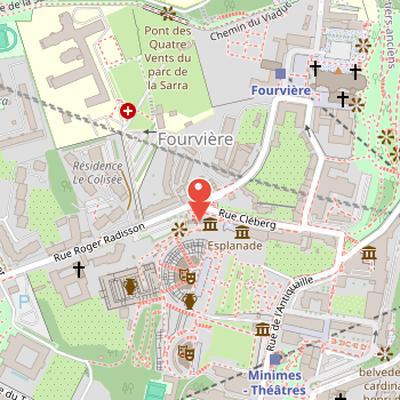
Nearby Objects
-
 Ancient Theatre of Lyon 80 m away
 -
Conservatoire de Lyon 200 m away
-
 Odeon of Lyon 200 m away
 -
 Antiquaille Hospital 250 m away
 -
 Parc des Hauteurs 250 m away
Lugdunum Musee et Theatres Romains
Lugdunum Musee et Theatres Romains is an archaeological museum in Lyon, France, managed by the metropole de Lyon. Since 2017, it has been the official name of the institution, which was formerly known as the musee gallo-romain de Fourviere and the musee de la Civilisation romaine. The site includes an indoor museum space and, since November 2017, the Roman theaters on Fourviere hill. This hill was once the center of the Roman city of Lugdunum. The museum regularly hosts temporary exhibitions, adding a changing cultural program to its permanent archaeological setting.
From the Antiquarium to the Archaeological Museum
Lugdunum was an important and prosperous Gallo-Roman city, and numerous vestiges from the site were discovered over the centuries. At first, these remains were presented at the Musee des Beaux-Arts and in the Antiquarium, a name later given to the deposit of archaeological material stored near the theater site. The ancient abbey of the Dames de Saint-Pierre had been transformed into a museum by decree, and from 1806 to 1830 the curator Francois Artaud gathered many ancient objects under the cloister arcades. Among the collected works were the Claudian Table and the Circus Games mosaic. In 1810, Artaud also recovered the two largest pre-Revolution monetary collections, those of the college de la Trinite and the city cabinet, helping to build up the museum's coin collection with ancient and medieval coins through later discoveries and acquisitions.
After the archaeological work at Fourviere hill began in 1933, the amount of excavated material exceeded the capacity of the Musee des beaux-arts de Lyon. Most of the archaeological furniture from the theater excavations after 1937 was stored near the site, in the former ND de la Compassion convent and the Magneval house at 3 rue Kleberg, both belonging to the City of Lyon. Paul Gelis proposed a lapidary museum and archaeological center in 1938, and by 1940 he had developed a museum plan for the old Compassion Sisters convent along rue de l'Antiquaille. The project included four gallery groups for major pieces, and in 1943 it was expanded to include a Jardin Magneval extension, a study center, and a library. The municipal government abandoned the project in April 1944 because of wartime difficulties, and priority was then given to clearing the ground for storage of discoveries.
A room in the Magneval house was opened to the public between 1952 and 1954 under Pierre Wuilleumier's direction. In 1957 the Antiquarium received important pieces from the Musee des Beaux-Arts, including the Claudian Table, the Coligny calendar, and the char of La-Cote-Saint-Andre; the Louvre also lent a bust of Caracalla because he was born in Lugdunum. Around 1960, explanatory models of theaters and a curtain-raising mechanism model were made. Even so, the Antiquarium remained a small museum with three rooms in old buildings. In 1967, it was replaced by a large archaeological museum, built on the same site because of its proximity to the theaters. The Antiquarium closed permanently in 1969 and was demolished, after which the collections were packed and stored near rue Roger-Radisson. During the construction of the new museum, artworks were restored or cleaned until 1975, although several notable mosaics were destroyed in a fire at a restorer's workshop. The new museum was built in 1971 by architect Bernard Zehrfuss and later inaugurated.
From Early Museum Plans to the Final Underground Design
The museum project known as Histoire des collections antiques a Lyon was revived by the city of Lyon in 1957, with architect Andre Donzet involved in the design. Donzet said that the design was inspired by Paul Gelis's work. His first plan placed the museum site along rue de l Antiquaille and called for a discreet stone building with a hollow tile roof. The exhibition spaces were to include large windows facing the odeon, while a lower section would be set at the level of an unfound Roman road. The planned display route was intended to present Gallo Roman civilization in fourteen sections, and mosaics were to be shown on the floor to improve visibility. The building also included annex areas such as a conference room, library, offices, a drawing room, and a photographic lab.
The project was delayed for financial reasons because the building site had not yet been excavated. Opposition arose over the location, with criticism that it would block the view of ancient monuments. Charles Delfante, director of the municipal urban planning workshop, felt that the museum proportions were too large in relation to the theaters. In 1966, Bernard Zehrfuss, inspector general of civil buildings and national palaces, rejected the project, which was then abandoned in July of that year. Zehrfuss also proposed a museum on the hillside side. City engineers and geologists asked for expert assessments to prevent landslides, and Amable Audin carried out archaeological probes in anticipation of major discoveries during earthworks.
Zehrfuss later finalized a buried museum project with three levels and fifteen themed rooms. The plan included a stone deposit, conference room, library, offices, two service apartments, and visitor parking. The French museums director supported the project and provided museography specialist Claude Poinssot, who coordinated conservators, Amable Audin, Jacques Lafargues, and the architectural teams. The city council approved Zehrfuss's project on January 27, 1969, for 12,610,000 francs, with cost overruns increasing the funding and 40 percent financed by the State. Preliminary excavations affected a small southern sector of the Antiquarium site.
Archaeological Remains and Room Decoration
Archaeological probes uncovered four parallel north-south wall sections and one perpendicular corner wall, defining four rooms. In the westernmost room, the floor contained two kitchen blocks and two hearths, while amphora shards supporting the floor slab may date from the 1st century BC. The third room preserved highly damaged frescoes and a normalized floor with a central panel measuring 1.40 meters square. Its decoration included circles inscribed in tangent octagons, and several mosaic fragments were found near the central panel, including one showing a man treading grapes over two jars. The fourth room contained a 40 cm black and red mosaic fragment depicting a duck and trident motif.
Museum Building and Institutional History
Opened in 1975, Histoire des collections antiques a Lyon originally belonged to the city of Lyon. In 1991, it was transferred to the department of Rhone, which associated it with the Gallo-Roman museum of Saint-Romain-en-Gal. The institution was transferred again in 2015, this time to the Metropole de Lyon, and was renamed Lugdunum on November 8, 2017.
The building is located on the edge of the antique site, partly buried in the slope of the hill. Its interior is organized around a raw concrete ramp descending in a spiral, with branches leading to landings used for displaying the museum's collections.
The Visitor Route and Museum Design
The Parcours du visiteur at Lugdunum Musee et Theatres brings together discoveries from the ancient site of Lyon and the surrounding region, while also including some pieces from outside the region. It offers views of the remains of the Theatre and the Odeon, linking the museum experience to the archaeological site. Designed by Zehrfuss, the visitor route was intended to highlight artworks and to break away from traditional museographic construction. Its layout emphasizes the readability of the itinerary through the museum and avoids an unreadable accumulation of artworks by presenting only a selection of the most interesting pieces. The museum also includes sections specifically designed to house major works, and the architecture is open to the outside so that it can adapt to the pieces on display.
Prehistoric and Bronze Age Finds
The Parcours du visiteur presents evidence for very early occupation of the city through objects abandoned by hunter-gatherers from earlier periods. Its prehistoric holdings include weapons and tools collected mainly from the Vaise district along the Saone, as well as small flint points or microliths dating to about 10,000 years ago. Among the oldest items is a reindeer antler tool sheath from around 8,000 years ago. The collection also includes material recovered during preventive excavations carried out between 1994 and 1997 for the northern ring road in Lyon's 9th arrondissement.
The section then moves into later prehistoric periods with objects such as a four-handled earthenware jar for food storage dating from 1900 to 1800 BC, together with items from the Celtic period before Roman occupation. A major part of the display is formed by two bronze deposits from the Feuilly site in Saint-Priest. One deposit was found inside an earthenware vase, while the other is described as one of the most important ensembles found in France for that period. These deposits include ornaments such as pendants, bracelets, and pins, as well as various tools.
The Parcours du visiteur also includes a small and a large final Bronze Age deposit of resin dated 1050 to 950 BC, discovered during the preventive survey of the ZAC de Feuilly in Saint-Priest, Rhone, in 2001. Various objects from the large deposit are identified in the collection.
The Bronze Processional Chariot
Parcours du visiteur documents a bronze processional chariot discovered by chance in 1888 during stone collection in a tumulus at La Cote-Saint-Andre. The object was purchased and conserved at the Musee de Lyon in 1889. It is composed of four wheels, a bucket or situla, and a basin, with the alloy of the different pieces identified as mainly copper and tin, with slight variations between elements.
The wheels were cast in a single piece using the lost-wax technique. Their diameters vary, with one recorded at 495 mm, and their weight ranges from 10 kg upward according to the documentation. Parcours du visiteur notes that their small diameter and heavy weight suggest they served as a mobile support for a vase. The bucket and basin survive as fragments of bronze sheets from which their original forms could be reconstructed. The bucket, shaped like an inverted truncated cone, is 200 mm high. The basin, shaped like a spherical cap, measures 370 mm in diameter and a little more than 130 mm in depth.
The bucket is identified as unique among cult chariots used during processions in this period, while the bucket and basin are linked to a solar cult associated with water. On the basis of similar dated objects and dendrochronological studies of wood pieces, the chariot is dated between the Late Bronze Age and Hallstatt culture.
The Federal Sanctuary and Roman Lugdunum
The visitor route presents Lugdunum as a Roman colony founded in 43 BC by Lucius Munatius Plancus, as indicated by his funerary epitaph. The epitaph identifies the colony as Lugudunum, a form of the name that appears in some modern documents. The museum also displays a model of the mausoleum of Gaete, where the epitaph was found, and offers a possible reconstruction of a complex built on the hill around 20 BC. This reconstruction is presented as a possible governor's palace of the colony.
A major focus of the displays is the Federal Sanctuary of the Three Gauls, located on the outskirts of Lugdunum. According to the visitor route, the sanctuary gathered representatives of sixty nations from the three Gallic provinces. It is described as consisting of two monuments: the Altar of the Three Gauls and the Amphitheatre of the Three Gauls. The exact location of the altar remains uncertain, but its general form is reconstructed from reverse coins as a square enclosure with columns at each corner topped by Victory statues. A Victory statuette found in the Saone River in 1886 is presented as a possible miniature representation of these statues. The museum also shows a fragment of a monumental inscription in bronze letters, a decorative plaque possibly coming from the altar, an Augustan sesterce related to the altar at the Musee des Beaux-Arts de Lyon, and a statuette of Victory identified as Winged Victory Lugdunum inv.X654 n3.
The Amphitheatre of the Three Gauls is shown through archaeological remains and related objects. It was partially excavated between the Saone River and the Croix-Rousse hill, and its foundation dedication was discovered in 1958. The dedication names Caius Julius Rufus as the builder, for the health of Emperor Tiberius Caesar Augustus, and identifies him as the son of Caius, priest of Rome and Augustus, and a descendant of the Santons nation. Fragments of the dedication mentioning Emperor Tiberius Caesar Augustus are displayed, along with marble blocks from amphitheater seats marked with the names of Gallic peoples. To illustrate the amphitheater games, the museum exhibits many oil lamps showing gladiator combats and a large graffiti drawing of two gladiators.
The visitor route also explains the political role of the Council of the Gauls, formed by representatives of Gallic nations gathered annually in the sanctuary of the Trois Gaules. The council elected the sacerdos, or priest of Rome and Augustus, as its head, and could intervene with the emperor. The most notable imperial response to a request by the council was published in the federal sanctuary as the Claudian table, a transcription of Emperor Claudius's speech proposing Senate access for citizens of the three Gauls.
Lugdunum as a Roman Administrative Center
Parcours du visiteur presents Lugdunum as a city with a dual status: it was autonomous and governed by local elites, while also serving as the capital of the province of Gaule lyonnaise under a legate of Augustus as propraetor. The local elite included wealthy owners, traders, and business patrons, and because Lugdunum held Roman colony status, these elites received Roman citizenship. They formed the order of decurions, who appointed local magistrates, called duumviri, and public cult priests, the flamines. Some of these prominent citizens are known through honorary statues whose bases preserve dedications summarizing their public careers. One example is Ti. Aquius Apollinaris, identified as a duumvir, judge, and flamen of Mars. Another is C. Aucius Macrinus, whose funerary inscription reveals promotion to all honors of his colony and admission as judge in Rome; his inscription was discovered in 1864 at Vaise.
Religious life in the colony was closely linked to civic status. The imperial cult was maintained by aristocratic decurions organized in colleges of flamines attached to the cult of a deified emperor. It was also supported by the seviri augustales, wealthy freedmen at the peak of their career. Archaeology records more than seventy seviri in Lugdunum, identified through the funerary inscriptions of their sarcophagi.
The city also concentrated imperial power and economic administration. It hosted officials of the imperial administration, including holders managing the financial administration of Gaule lyonnaise and Gaule Aquitaine under an equestrian procurator. Tax collection, including the twentieth of inheritances and the fortieth of the Gauls, was carried out by imperial slaves or freedmen. Lugdunum was also a center for the management of iron mines and the seat of a mint workshop, described as the most important issuer after the Rome workshop. Between 15 BC and AD 64, it held the monopoly on minting gold and silver coins, and many of its coins feature the altar of the Sanctuary of the Three Gauls on the reverse. A permanent military presence was ensured by an urban cohort during the first two centuries, illustrated by a bronze military diploma discovered in 1913 showing the release of Sextus Egnatius Paulus, a soldier of the 13th urban cohort, demobilized by Emperor Commodus.
Parcours du Visiteur and Military Finds
The Parcours du visiteur presents a group of military finds in display cases, bringing together objects and remains associated with Roman soldiers. Among the items on display are the remains of a legionnaire discovered in 1950 at 10 rue des Fantasques in the Croix-Rousse quarter. The soldier's body was found with fragments of military gear and a dozen denier coins, and the exhibit states that he was thrown into a well, probably after the battle of Lugdunum in 197 AD.
The parcours also shows other equipment from Fourviere hill, identified with Lugdunum, including a chainmail shirt found at Clos du Verbe incarnate, an umbo shield boss found at rue des Farges, a military diploma of Sextus Egnatius Paulus, a belt decoration ornament found at rue des Fantasques, and an iron sword with a copper guard found at the same site. It further exhibits Roman chainmail, an umbo shield boss, and spear points.
Religious Life and Spectacles in Lugdunum
The Parcours du visiteur emphasizes that religious elements were omnipresent in both public and private life in Roman Lugdunum. It presents Roman polytheism as abundant and open, while also showing how Roman deities mixed with numerous Gaulish gods, a blending visible in many representations from the period after Roman presence. The display offers a broad overview of the pantheon honored in Lugdunum, beginning with a religious landing centered on a bronze Neptune statue, accompanied by a colossal Jupiter head. It also includes a bronze Mars statue discovered at Coligny in 1897, an altar dedicated to Jupiter, all gods and goddesses, and the local Genius, and an altar dedicated to Mars by a gladiator, found near the amphitheater and dated 197 AD.
Several exhibits highlight the persistence of Gaulish religious traditions within the Roman setting. Sucellos appears in figurations carrying a hammer and retaining his Gaulish name. The Mothers are shown as symbols of fertility, while indigenous gods are represented with traits of Mercury, associated with commerce and craftsmanship. The section also presents votive statuettes and miniature altars of Sucellus, votive reliefs of the August Mothers, and a votive relief of Mercury with a goat.
The collection further illustrates wider cult practices and contacts. Six altars commemorate taurobolic sacrifices to Cybele at Lugdunum, and related objects include an altar dedicated to Mithra, a column bearing an inscription to the Egyptian Isis, an altar of Mithra at the Gallo-Roman Museum of Fourviere, a head of Zeus Sarapis, and a bas-relief of Sol discovered in 1967. The Coligny calendar, discovered in fragments in 1887 near Lugdunum in the Ain department and dating from the 2nd century AD, is shown as a reconstructed partial calendar of religious festivals written in the Gaulish language and presented as the longest known text in that language.
The Parcours du visiteur also connects religion with the theater and wider urban spectacle. A large bay of the museum opens onto the theater and odeon site, and two models show a reconstruction of these monuments. An animation illustrates a curtain lifting mechanism imagined in 1960, explained as a system using ropes to lift the curtain posts, completed by winding and counterweight mechanisms. Other exhibits include terracotta masks that decorated a garden of an ancient house found on rue des Farges, an oval mask from the House of Masks, and a decorative mask of Maccus, a character from the Atellana.
Public entertainments are represented as part of Roman urban life as well. The museum notes that Lugdunum had a circus for chariot races like all important Roman cities, although its location remains uncertain and its existence is proven only by donor inscriptions. Indirect evidence of enthusiasm for races in Lyon includes a circus games mosaic found on rue Jarente in 1806 and a bas-relief showing two bigae discovered in the Saint-Paul district in 1874.
Craft Production in Lugdunum
The Parcours du visiteur presents several forms of craft production that were active in ancient Lugdunum. It notes that ceramic workshops developed on rue de la Muette because of concerns about furnace pollution, and that these workshops were established by Italian artisans. Their molds are said to have come from Arezzo between about 50 BCE and 0 CE. The visitor route also explains that later workshops replaced the earlier ones between the 1st and 2nd centuries CE in the area between the Saone and the foot of the Croix-Rousse hill. These later workshops produced domestic wares such as plates, cups, oil lamps, and amphorae. A reconstructed potter's kiln is displayed in the museum to represent this essential activity, and oil lamps decorated with race motifs are also mentioned.
Glass production is another major theme. The museum includes many glass objects, some of them on display, and it shows that glass production is known from several workshops discovered during archaeological digs, including at Monttee de la Butte. In 2000, fourteen glassmaker furnaces were uncovered there. Nearby pits contained imported raw glass and broken glass intended for recycling. The museum also presents failed glass products as evidence of local production, including perfume bottles, flasks, jugs, and cosmetic sticks. Among the glass pieces are molds made of marble for square bottles and square molded glass pots, as well as Roman glass fragments intended for recycling found in workshops. A blue glass object showing gladiators fighting, identified by Latin inscriptions and dated to the 1st to 2nd century AD, is also displayed.
The Parcours du visiteur further includes tabletterie, the craft of making small objects from bone, which was active in Lugdunum and other large cities. A catalog published in 1983 lists 1345 tabletterie objects from excavations at Monttee de la Butte, the Roman theaters, the Trion necropolis, place Tolozan, and Place Charles-Marie-Widor. The museum displays wooden artifacts including a wooden pump found in 1975 in the Presqu'ile, iron work such as keys and shackles, bone-cut items used in tabletterie including statuettes, dice, and pins, and bronze works including a miniature bronze figurine of a cock.
Amphorae and River Transport
The Parcours du visiteur presents amphorae as cheap, non-reusable containers that nevertheless provide invaluable archaeological information. The display shows how the Vaise site at Lyon imported Italian wine amphorae from the 1st century BC onward, and how the foundation of the Lugdunum colony increased trade through large imports of wine, oil, and garum amphorae from Italy, Baetica, Lusitania, and Greek island wines. From the 2nd century AD, amphora imports also came from Africa Proconsularis and Mauretania Caesariensis, serving local consumption and redistribution to northern Gaul and Britain. The museum also contains dolia and Spanish amphorae, along with a series of Baetican oil amphorae at the entrance and models for oil, garum, and wine. These objects are linked to river transport: the nautes, organized in corporations such as the nautes du Rhone, nautes de la Saone, and nautes du Rhone et de la Saone, ensured navigation on the rivers. Preventive excavations in 2004 on the right bank of the Saone identified a river port with remains of six long flat-bottomed boats and a dock, while archaeological finds indicate the conveyance of dishes, raw materials, and amphora debris containing wine, oil, or garum.
Funerary Inscriptions and Urban Life
The Parcours du visiteur presents a wide group of funerary inscriptions and related objects that illustrate the social and geographic diversity of Lugdunum. Among the named monuments are the epitaph of Latinius Reginus, linked to the merchants of sayons corporation, and the sarcophagus of M. Primius Secundianus, identified as a sevir augustal, boatman, member of the carpenters' corporation, and salt merchant. Another inscription is dedicated to the patron of the nautes du Rhone et de la Saone and was found by the Saone river, while a wreck of a flat-bottomed boat found in 1989 at place Tolozan near the Rhone recalls the river setting of part of the archaeological record.
Several inscriptions emphasize the origin of the deceased, showing that Lugdunum attracted people from Gaul and from more distant provinces. A monumental epitaph commemorates the veterans Aurelius Primus, from the nation of the Remes, and Modestinius Peregrinus, from Colonia Agrippina, who chose Lugdunum for their retirement. The city also received newcomers for professional reasons, such as Iulius Alexander, who came from Carthage to establish a glassmaker workshop. Other funerary texts include the epitaph of this glassmaker, Thaim Ioulianos, born in Canotha in Syria and writing his epitaph in Greek and Latin, and Ioulianos Eutecnios of Laodicea in Syria, who composed his epitaph as a Greek poem.
The visitor route also places these inscriptions in the broader context of Gallo-Roman domestic and funerary archaeology. Habitat discoveries on Fourviere hill and the Presqu ile, together with excavations at rue des Farges from 1974 to 1980, Clos du Verbe incarne from 1977 to 1984, and Gorge de Loup, show the extent of archaeological research in the city. Houses followed Italic plans centered on an atrium, with porticoes and Pompeian mural decorations, while mosaic floors were rare before the 3rd century and appear mainly in the richest houses.
Lyonese necropolises brought together modest tombs, massive sarcophagi, and monumental mausoleums. Funerary practice changed from cremation, dominant in the 1st century, to inhumation thereafter. The museum displays broken ceramic funerary urns, lead funerary urns, glass funerary urns, common terracotta urns, and melted glass balsamaria, as well as the funerary plaque of Iulius Seleucus, a freedman, dating from the 1st century. Funerary epitaphs make up most of the stone inscriptions discovered in Lyon, and from the late 1st century they often appear on the bases of small funerary altars. Several hundred end with the formula dedicated under the ascia, a frequent but still unexplained sign on funerary monuments in Lugdunum and the western Roman Empire. The route also notes rare funerary monuments such as the Primilla funerary cippus, the funerary altar of Aufidia Antiochis, and the sarcophagus of Kaninia Galatia, a Greek by birth, dedicated under the ascia.
Graves could be accompanied by offerings such as dishes, personal objects, jewelry, toiletry instruments, and tools. With the emergence of Christianity, Christian altars are no longer used, and Christian epitaphs become systematic from the beginning of the 4th century AD. Their wording changes with the disappearance of the mention Dis Manibus and the reference to the ascia, and epitaphs begin to include the date of passage into the other world and the age of the deceased.
Roman and Gallo-Roman Collections
The collections at Lugdunum Musee et Theatres cover the period from the beginning of the Roman era to the abandonment of the Lugdunum quarters before Christianity. They are made up mainly of objects found in Lyon, especially materials recovered at the ancient site of Fourviere and in the antique suburbs of the city. A significant part of the displays is devoted to Gallo-Roman crafts, including ceramics, mosaics, metalwork, and glasswork.
A notable feature of the collections is their epigraphic material. Preserved in Lyon since the 1st century, this corpus includes nearly 700 inscriptions carved in stone or marble on statues, sarcophagi, funerary steles, altars, and cippi. Among the most important pieces are the Table Claudienne, a bronze plaque measuring 120 cm by 75 cm, the Calendrier de Coligny, a Gallic calendar from the end of the 2nd century, several taurobolic altars, fragments of the dedication of the amphitheater of the Three Gauls of Lugdunum, and the epitaph of the military prison guard from 16 AD.
The collections also present a large and varied group of mosaics, notable for both quantity and quality. These include mosaics with geometric motifs, braids, and interlacings attributed to the Lugdunum mosaic school, as well as mosaics with geometric and floral designs from the workshops of Vienne. Named examples include the Mosaique aux Poissons, the Mosaique a decor geometrique multiple, dite aux Svastikas, the Mosaique de Bacchus, dite des Saisons, and the Mosaique des jeux du cirque, partie gauche. In addition, the museum displays large wall covering sections with painted decoration, several large sarcophagi, including the Sarcophage du triomphe de Bacchus, the Sarcophage de Balazuc, a paleochristian sarcophagus from the 5th century, and the Sarcophage dionysiaque de la famille des Acceptii.
Numismatic Collections
The collections preserve 2410 coins and 79 coin molds, with mostly archaeological provenance. Their largest coin groups come from excavations at Clos du Verbe Incarnate, rue des Farges, and the Vaise district. Among the most notable holdings are the Vaise and Adolphe Max treasures, which together include 263 silver and billon coins. The collections also contain numismatic rarities, including a bronze coin of Lucius Munatius Plancus known in only four copies, two aurei of Quintus Cornuficius found on rue des Farges, and a Nero sesterce from Portus in mint condition. An aureus mounted as a medallion from the Vaise treasure jewelry is also preserved. Only a small part of the medal collection is currently on display.
Temporary Exhibitions and Public Programming
Since the museum space was created in 1975, Lugdunum Musee et Theatres has organized numerous temporary exhibitions covering a wide range of subjects in archaeology, history, and art. Its programming has included a painting exhibition, a contemporary art exhibition by Luce Skaer, and an exhibition proposing a poetic reflection on ruins through the juxtaposition of engravings by Piranese and photographs by Ferrante Ferranti. The museum has also hosted traveling and collaborative projects, including a Louvre Museum exhibition on objects from Nineveh and Babylon, and a joint exhibition with the Museum of Saint-Romain-en-Gal on the peplum film genre.
Several exhibitions have focused directly on the ancient city and its archaeological remains. These include presentations on funerary rites in Lugdunum and Roman Gaul, the evolution of funerary practices at Lugdunum, the Battle of Lyon in 197 and the conflict between Septimius Severus and Clodius Albinus, and the discovery of the amphitheater, circus, and theater. Other exhibitions presented the results of excavations at Antiquaille, preventive excavations at the OL stadium site in Decines, and archaeological work on Fourviere hill in 2010, including evidence of human occupation, an urban quarter, Roman house architecture, and domestic and artisanal space distribution.
The museum has also developed thematic exhibitions on broader ancient and technical subjects. These included a preview exhibition for the Museum of Confluences, a show from the Roman Museum of Nyon on ancient medical practice, diseases, remedies, and invoked gods, and the ARCHETERRA exhibition on raw earth as a construction material, with attention to technical aspects, conservation, restoration, and architectural enhancement. Another exhibition was dedicated to water, Roman techniques for access and redistribution, and the archaeological reality of Lugdunum, using models, archaeological remains, and videos to trace water into the city and explain the technical challenges of supply. In addition, the museum has presented the original exhibition Veni, Vidi, Ludique, based on the Roman Museum of Nyon and developed in connection with the ERC project Locus Ludi and the Swiss Museum of Games, exploring play in antiquity through more than 300 archaeological and ethnological objects.
Visitor Numbers at the Museum
During the 2000s and 2010s, the museum's annual attendance ranged between 70,000 and 125,000 visitors. Visitor numbers then dropped sharply in 2020 and 2021, when the Covid crisis led to only partial museum opening. By 2024, attendance had risen to a record level of nearly 170,000 visitors.
Museum Management and Visitor Policy
The Gestion et politique culturelle department manages a museum animated by about fifteen people and coordinates staff mainly in the areas of reception and collections. It is directed by Claire Iselin and is assisted by a secretary and four services. The department also established an observatory to better understand visitor motivations. As part of its work, it planned to adapt the museum to the public by 2012.