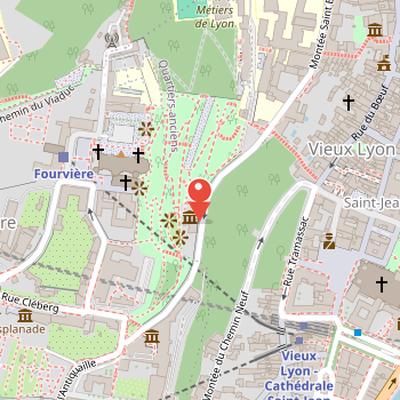
Montée Saint-Barthélemy is a street in the Vieux Lyon district of Lyon, France. It is one of the two main communication routes between Vieux Lyon and Fourvière hill. The street rises from 175 metres to 270 metres, for an elevation difference of 95 metres and a slope gradient of 12.6 percent.
According to its history, the montée is of Gallo-Roman origin and was once the main route connecting the upper city of Lugdunum, including the ancient theaters and the temple of Lug, with Condate, a commercial city located on the former confluence now backfilled. In the Middle Ages, the bottom of the street was barred by a city gate known as the porte de Bourg-Neuf or porte de Confort. Over time, religious congregations established houses along the street. Notable sites mentioned include Antiquaille at the top of the montée, later integrated into the convent of the Visitandines and then becoming the Hôpital de l'Antiquaille in 1872, as well as houses and convents linked to the Recollects, the Propagation of the Faith, Saint-Lazare, and the Marist Fathers.
Nearby Objects
-
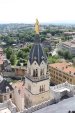 Chapelle Saint-Thomas 140 m away
 -
Conservatoire de Lyon 140 m away
-
 Notre-Dame de Fourvière 140 m away
 -
 Villa Florentine 200 m away
 -
 Manécanterie 250 m away
Route and Topography of Monttee Saint-Barthlemy
La montee Saint-Barthlemy is a street in the Vieux Lyon district of Lyon, France. It is one of the two main communication routes between Vieux Lyon and Fourviere hill. The street runs from an altitude of 175 meters to 270 meters, creating an elevation difference of 95 meters. Its slope gradient is 12.6 percent, which reflects the steep connection it provides between the lower district and the hill above.
Historic Role of the Monte9e Saint-Barthe9lemy
The monte9e Saint-Barthe9lemy is described as being of Gallo-Roman origin. According to the historical account, it was the main route connecting two cities that were later replaced by Lyon: the upper city of Lugdunum and Condate. The upper city of Lugdunum included ancient theaters and the temple of Lug, while Condate was a commercial city situated on the former confluence, now backfilled. In the Middle Ages, the bottom of the street was blocked by a city gate known as the porte de Bourg-Neuf or porte de Confort.
Religious Houses and Institutions
Histoire notes that many religious congregations established houses in montée Saint-Barthelemy over the centuries. At the top of the road, Pierre Sala built a house called Antiquaille at the beginning of the 16th century; it was later integrated into the convent of the Visitandines, which became the HOpital de l'Antiquaille in 1872. In 1618, after the destruction of the royal abbey of Chazeaux by the baron des Adrets, remaining monks settled in a house in the montée. In 1623, the Order of Friars Minor Recollects founded a convent in the house of Belle-Greve, which had been bought by Marie de Medici, and this convent was transformed into housing in 1988.
Other religious initiatives also left their mark on the street. In 1659, the Propagation of the Faith community created a house to host Protestant women converting to Catholicism. In 1673, priests of Saint-Lazare established a house and chapel that later became the Lazarists school group. In 1822, Pauline Jaricot bought the house at No. 42, called de la Breda, a house built around 1520 by Pierre Burbenon, and made it the house of propagation of the faith; since 1975, it has belonged to the pontifical missionary work. At the bottom of the road, the school of Marist Fathers was established in the house called Puylata, which became the motherhouse of the Marist congregation after modifications and served as a hospital during the war in 1870. In 1940, the Christian Brothers founded the Ecole catholique d'arts et metiers (ECAM) in the street, where it remains today.
Accessibility and Urban Condition
Montree Saint-Barthelemy is affected by its steep slope, which has direct consequences for access and circulation. It is not served by any bus, and no Velov station is located on the street itself for the same reason. However, several Velov stations are available near its extremities. Gare Saint-Paul is located at the foot of the street. The gardens of Rosaire, Saint Jean, and ECAM border the street on both sides.
The street also experienced degradation during the 20th century, affecting both the street and the surrounding buildings. Paul-Jacques Bonzon later reflected this condition in the 1960s in a Six Compagnons adventure. Montree Saint-Barthelemy is fully included within a World Heritage site, and heavy rehabilitation work has been carried out since the inscription.