Chapelle Saint-Thomas is the oldest part of the Fourvière sanctuary, known as La chapelle Saint-Thomas de Lyon. According to the historical account, a chapel was built at Fourvière in the 1180s by dean Olivier de Chavannes, canon of Saint-Jean, on the ruins of the Roman forum. Its original dedication is uncertain, but it was later associated with Saint Thomas of Canterbury and the Virgin. The site was entrusted to the chapter of Saint-Jean, and a separate chapter was created in 1192. Over time, the chapel was destroyed and rebuilt multiple times. The church was also affected by the attack by Huguenots in 1562. The bell tower was built by Alphonse-Constance Duboys and carries the golden Virgin statue. During the construction of the Notre-Dame de Fourvière basilica, plans were made for a fifth tower dedicated to this statue, and there was also a plan to remove the old building.
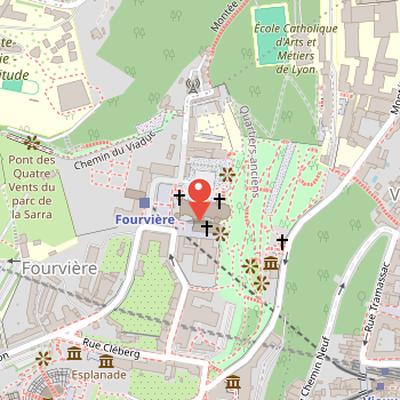
Nearby Objects
-
 Notre-Dame de Fourvière 20 m away
 -
Conservatoire de Lyon 120 m away
-
 Montée Saint-Barthélemy 140 m away
 -
 Parc des Hauteurs 200 m away
 -
 Villa Florentine 250 m away
The Oldest Part of the Fourviere Sanctuary
Chapelle Saint-Thomas, also known as Intro, is the oldest part of the Fourviere sanctuary called La chapelle Saint-Thomas de Lyon. It was first consecrated to Saint Thomas and later to the Virgin. Over time, it was destroyed and rebuilt multiple times, reflecting a long and interrupted history. The bell tower of Intro was built by Alphonse-Constance Duboys, and the golden Virgin statue stands on this tower. During the construction of the Notre-Dame de Fourviere basilica, plans were made for a fifth tower dedicated to the golden statue, and there was also a plan to remove the old building.
Origins and Early Devotion at Fourviere
According to Histoire, Chapelle Saint-Thomas was probably built in the 1180s at Fourviere by dean Olivier de Chavannes, canon of Saint-Jean. The chapel stood on the ruins of the Roman forum, and its original dedication remains unknown, possibly linked either to the forum of Venus or to the old forum. The same source also records the foundation of a collegiate church by Jean Belles-mains, archbishop of Lyon from 1182, dedicated to Saint Thomas of Canterbury and the Virgin. This church was entrusted to the chapter of Saint-Jean, and in 1192 Jean Belles-mains created a separate chapter with an unspecified number of canons.
The early history of the site is closely tied to the reuse of ancient material. Histoire notes that the archbishop and chapter offered some ancient stones for reuse, while reserving the best pieces for construction of the cathedral. The chapter was reformed in 1263, but the site remains poorly documented before the 14th century, apart from publications by Emile Longin. Over time, the place became associated more strongly with devotion to Thomas Becket than to the Virgin until the 17th century.
The chapel and church also experienced periods of conflict and devotion. Histoire reports that the church suffered during the Huguenot attack in 1562. Later, King Louis XI made many donations to the collegiate church, especially in favor of the Virgin. In the 17th century, the site was connected with a series of civic and religious vows during plague epidemics in Lyon in 1628, 1631, 1637, 1639, and 1642. The consulate aldermen, probably inspired by provost Alexandre de Mascrany, called on the Virgin, leading to a vow on August 10, 1643, to hold a procession to Notre-Dame at Fourviere for relief from the plague. After the procession took place on August 12, 1643, the pilgrimage was established annually, and another vote on September 8, 1643, devoted the entire city to Mary and fixed the annual pilgrimage on that date.
Histoire adds that this aldermen's vow later made possible the installation of a stained glass window by Lucien Begule in 1882. By the middle of the century, the church of Fourviere was described as dilapidated.
Rebuilding the Bell Tower
Andr6 Flacheron revealed the dilapidated state of the old bell tower, and Histoire states that its replacement was entrusted in April to the diocesan architect Alphonse-Constance Duboys. The rebuilt bell tower has a square base, with a medieval first floor and two floors dating from 1849. Its third floor has an octagonal plan and ends with a dome. In 1851, Cardinal Louis-Jacques-Maurice de Bonald authorized the construction of a statue of the Virgin to dominate the rebuilt bell tower, and a Virgin statue made by Joseph-Hugues Fabisch was placed on the dome in 1852.
Inauguration and Structural Reinforcement
The inauguration of the statue was first planned for December 8, but flooding caused by bad weather and delayed delivery postponed the event. It was then rescheduled for December 8, an unofficial date for the feast of the Immaculate Conception. Although bad weather briefly led to a proposal to move the feast to December 12, it was ultimately held on December 8 after the weather cleared. This date also corresponded with a local tradition in which Lyon residents lit small lights and placed them on window sills as a sign of piety.
The Lantern Tower supporting the statue of Mary was already identified as fragile in 1923. It was reinforced under Louis Sainte-Marie Perrin and engineer Mauvernay with eight reinforced concrete ribs. By 2006, however, the tower was again in poor condition, with cracked concrete ribs, oxidized metal ribs, a crumbling dome intrados, and a cracked staircase. Its deterioration was attributed to aging structures accelerated by Storm Martin.
Following engineer Bernard Babinot's advice, the bronze statue gilded in 1991 was removed to the parvis of Fourviere Basilica so that structural reinforcement could be carried out. The work included replacing degraded stones, protecting protruding elements with lead covers, cleaning facades, renewing carpentry and locks, and installing new lighting. While the statue was removed and protected under a glass shelter, it was also restored through bolt and guardrail replacement and base reinforcement.