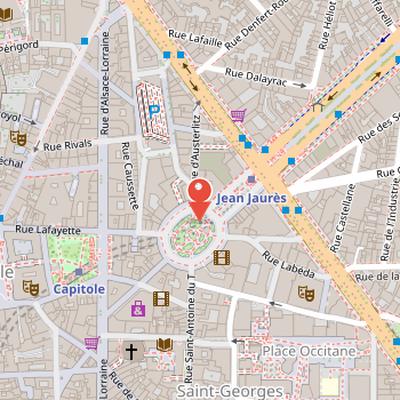
Wilson Square, also called Wilson and in Occitan plaça del President Thomas Woodrow Wilson, is a public place in Toulouse, the capital of the Occitanie region in southern France. It is located in the heart of the Saint-Georges district and extends the allées Jean-Jaurès, linking the city center to the canal du Midi. The area is surrounded by cafés and cinemas and is noted for its lively atmosphere, especially for student nightlife. It is also described as one of the lively places of Toulouse, alongside place Saint-Pierre.
The square intersects several streets, including allées du Président-Franklin-Roosevelt, rue d’Austerlitz, rue Lafayette, rue Lapeyrouse, rue Saint-Antoine-du-T, and rue des Trois-Journées. It is served by a shuttle between rue Saint-Antoine-du-T and rue des Trois-Journées. Nearby transport connections include the Capitole metro station on line A and Jean-Jaurès station on lines A and B, as well as nearby Linéo and bus stops. VélôToulouse bike stations are also located nearby. The place was first named place Villeneuve during its early 20th-century development and was later named in honor of Thomas Woodrow Wilson, president of the United States and honorary citizen of Toulouse.
Nearby Objects
-
 Utopia Toulouse 130 m away
 -
 Saint Jerome Church 200 m away
 -
 Théâtre du Capitole 250 m away
 -
 Place Saint-Georges 350 m away
 -
 Place du Capitole 350 m away
Wilson in Toulouse
Place Wilson, also known as Intro, is a street in Toulouse, the capital of the Occitanie region in the Midi of France. It is also referred to as Wilson. In Occitan, its name is plaça del President Thomas Woodrow Wilson. The available facts identify it as part of the urban fabric of Toulouse and note its multilingual naming in French and Occitan.
Location and Access
Place Wilson is a public road located in the heart of the Saint-Georges district. It extends the allees Jean-Jaures, linking the city center to the canal du Midi. The area is known for its active urban atmosphere: it is surrounded by cafes and cinemas that concentrate student nightlife activity, and it is described as one of the lively places of Toulouse, together with place Saint-Pierre.
The road intersects several streets in order of increasing numbers, including allees du President-Franklin-Roosevelt, rue d'Austerlitz, rue Lafayette, rue Lapeyrouse, rue Saint-Antoine-du-T, and rue des Trois-Journees. It is traversed and served by a shuttle service between rue Saint-Antoine-du-T and rue des Trois-Journees.
Public transport access is also important. Nearby metro stations include Capitole on line A and Jean-Jaures on lines A and B. The site is close to stops of Lineo lines and bus lines. For cycling, nearby VeloToulouse self-service bike stations are located at 12 rue du Poids-de-l'Huile, 21 rue Lafayette, 62 rue de la Pomme, 6 rue du Rempart-Villeneuve, 62 boulevard Lazare-Carnot, and 60 boulevard Lazare-Carnot.
Naming and Dedication
Odonymie states that the place is named after Thomas Woodrow Wilson, who served as President of the United States from 1912 to 1920. It also notes that he engaged the United States in the First World War alongside the Allies. According to the same source, the municipality of Toulouse, led by Jean Rieux, named Wilson an honorary citizen and gave his name to the place in his honor.
Naming History
According to Odonymie, the square was first named place Villeneuve during its early 20th century development. This earlier name was shared with the street leading east, now rue Lafayette. The name Villeneuve is linked to the Vilanova family, an important urban noble family in Toulouse in the 12th and 13th centuries. Odonymie notes that the family guarded a tower near the current rue Lafayette, close to Saint-Sernin abbey, and mentions Pons de Vilanova, who was viguier of Toulouse and one of the first capitouls in 1147.
The municipality of Toulouse renamed the place in 1816 in honor of Louis-Antoine d'Artois, Duke of Angouleme, son of Charles d'Artois and nephew of Louis XVIII. Odonymie states that he entered Toulouse with British troops after the battle of April 18. In 1835, the place was renamed again for Gilbert du Motier, Marquis de La Fayette, who lived from 1757 to 1834 and was nicknamed the hero of two worlds. The name La Fayette was presented as a symbol of reconciliation and moderation during the July Monarchy. In 1850, the municipality wished to honor President Louis-Napoleon Bonaparte after the establishment of the Second Republic. The place regained the name La Fayette in 1870 after the fall of the Second Empire, and lost that name again in 1918.
The Villeneuve Gate and Its Historical Role
According to Histoire, the site was a meadow outside the ramparts, closed by the Villeneuve gate. It is linked to Simon de Montfort meeting the consuls at the siege of 1216. The gate later became significant in the events of 1562, when Protestants were expelled from the city after the Dlivrance battles and left through the Villeneuve gate. Their stronghold was the nearby Capitole. In response, Toulouse Catholics sealed the gate and installed the Notre-Dame du Rempart statue, with the sealing intended to symbolically prevent the exiles' return. In 1778, the Capitouls decided to reopen the gate because accidents caused by hauliers had become a concern.
Design and Construction History
In 1783, Jacques-Pascal Virebent designed Place Wilson with double inner and outer squares and a monumental gate. Construction did not begin until 1788, when a workforce became available because of famine. Work then stopped at the start of the Revolution and resumed in 1806, following Virebent's insistence. About 100 meters of walls were destroyed to create the inner square and its bordering buildings. The outer side was built later, between 1817 and 1834.
Early Monument Proposals for Place Wilson
According to Histoire, the municipality first planned a monument for the Dauphin and Duke of Angouleme at the center of the square. A municipal credit for this project was approved in 1824 after the Spanish expedition. The monument competition became contested when Jacques-Pascal Virebent tried to promote his son Auguste's project, but the municipal council rejected it and chose four other submissions. These four projects were sent to the central administration in February 1825, and in May 1825 the project by Garnaud and Valois was selected. Valois was the official sculptor of the Duchess of Angouleme from 1815, which gave the choice additional political resonance. However, a conflict between the administration and the municipality delayed construction, and the monument was symbolically launched during the Duchess of Berry's visit to the city. The project was then cancelled following the downfall of the Bourbon regime. Garnaud and Valois later proposed a more liberal version that replaced the Duke with France. The municipality, however, preferred a cast iron column designed by Vitry to commemorate restoration events. That column was never built, although a full scale model was erected in 1831. Histoire also notes that municipal authorities had refused the architect's decoration plans for reasons of economy.
Monument and square history
The history of place Wilson is linked to a sequence of monument projects and later alterations to the square. In 1876, square Lafayette was constructed with an iron grille and the sculpture Moise brisant ses fers. A later monument project began in 1882 for a statue of Clemence Isaure crowning the poet, intended for the middle of place du Capitole. The project involved Alexandre Falguiere, Antonin Mercie, Raymond Barthelemy, Jules Jacques Labatut, and Pierre Esquie. In 1894, it was transformed into a simpler monument to Goudouli at place Matabiau, designed by Falguiere, Mercie, and architect Paul Pujol. Falguiere died in 1900 before the monument was completed, and the work was finished in 1907 and inaugurated in 1908.
Paul Pujol later suggested transferring the monument to the basin of square Lafayette, noting that Alexandre Falguiere had wished to place a marble statue there. The municipality approved the transfer and adapted the monument to its new location. The inauguration date was not specified in the available account. During World War II, in 1943, the municipality planned to move the monument again, this time to the basin of Jardin des plantes, but withdrew the plan after public outcry. More recently, pedestrianization work in 2005-2006 reduced car lanes from two to one and repaved the area with porphyry and pink marble. In 2007, the Toulouse carousel, previously located at place Saint-Georges, was relocated to place Wilson.