Théâtre du Capitole is an opera house in Toulouse, housed in the Hôtel de ville on place du Capitole. It originated as the Salle du Jeu de spectacle, integrated into the municipal building in 1736 by Guillaume Cammas. The theatre later gained a reputation as the most beautiful and modern theater in the kingdom at the time. Its history includes periods of abandonment, rebuilding and redesign in 1818, destruction by fire in 1917, and revival in 1923 through works by Paul Pujol in a neobaroque style. Further renovations took place in 1996, when architects Jean-Louis Roubert and decorator Richard Peduzzi worked on the building, with contemporary foyers and a commedia dell’arte-style auditorium. Today, the theatre includes a choir, a maîtrise, and a ballet, and presents both operatic and choreographic seasons under the artistic direction of Christophe Ghristi since 2017.
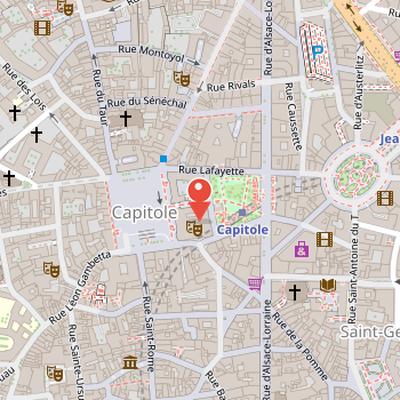
Nearby Objects
-
 Place du Capitole 90 m away
 -
 Saint Jerome Church 200 m away
 -
 Utopia Toulouse 200 m away
 -
 Notre-Dame du Taur 200 m away
 -
 Wilson Square 250 m away
Theatre, Company, and Cultural Role
The Theatre du Capitole is housed in a building constructed in 1736 in the Hotel de ville on place du Capitole de Toulouse. Its auditorium is designed in the Italian style and has a seating capacity of places. The institution includes a choir, a maitrise, and a ballet, and it stages 7 to 9 operatic productions each season, along with 3 to 5 choreographic programs. Since 2017, it has been under the artistic direction of Christophe Ghristi.
The Theatre du Capitole obtained the label Opera national en region and became Opera national du Capitole in . It and the Orchestre national du Capitole de Toulouse have been united within Etablissement Public du Capitole under Toulouse Metropole since . The institution is also a member of ROF, RESEO, and Opera Europa.
History and Architectural Transformations
Theatre du Capitole originated as the Salle du Jeu de spectacle, integrated into the municipal building in 1736 by Guillaume Cammas. It soon acquired a reputation as the most beautiful and modern theater in the kingdom at that time. Over the years, the building fell into neglect, but it was rebuilt and redesigned in 1818. The theater was destroyed by fire in 1917, then revived in 1923 through works by Paul Pujol in a neobaroque style. Further renovations took place in 1996 by architects Jean-Louis Roubert and decorator Richard Peduzzi. These later works introduced a contemporary style in the foyers and a commedia dell'arte style in the auditorium.
Artistic Team and Choir
The Theatre du Capitole has a permanent artistic team of more than 225 people. Within this structure, the mixed choir includes 45 singers. The choir has had a long succession of directors: Guy Lhomme led it from 1957 to 1986, followed by Marcel Seminara from 1986 to 1990, Gunther Wagner from 1990 to 1991, Pierre Iodice from 1991 to 2003, Patrick Marie Aubert from 2003 to 2009, and Alfonso Caiani from 2009 to 2022. The choir is currently directed by Gabrial Bourgoin. This continuity of leadership reflects the central role of the choir in the theatre's artistic life.
Ballet and Artistic Direction
The Théâtre du Capitole is closely associated with a ballet company of 35 internationally level dancers, known as the Ballet du Capitole. Its lyrical and choreographic season is ensured by the Orchestre national du Capitole. The theatre developed classical ballet by recruiting Nanette Glushak in 1993 and appointing her as director of dance in 1994. Under this period, the Ballet du Capitole was trained in Balanchine and neoclassical repertoire, and it was regarded as one of the best classical and neoclassical companies in France before Glushak's departure.
The theatre's artistic direction changed several times over the following decades. Michel Plasson began directing artistically in 1973, followed by Jacques Doucet in 1981, Nicolas Joel in 1991, Frédéric Chambert in 2009, and Christophe Ghristi in 2017. These successive appointments reflect the continued importance of artistic leadership in the theatre's identity and programming.
Recent Reorganization and Artistic Leadership
From September 2009, the Theatre du Capitole closed its historical hall to the public during the 2009-2010 season because of necessary administrative building work. During this period, performances were redistributed outside the walls to the Halle aux grains, the Theatre national de Toulouse Midi-Pyrenees, and the Casino-theatre Barriere. The theatre reopened for the 2010-2011 season with the Toulouse International Lyrical Singing Competition.
In the same period, the institution adjusted both its artistic organization and its performance venues. Its show program was shared between the theatre itself, the Halle aux grains, and the Casino-theatre Barriere in order to diversify its offer and meet artistic and logistical needs. The theatre also announced its intention to maintain artistic quality while diversifying and intensifying its workshops and artistic activities, especially in Toulouse cultural centers.
Leadership changes marked these years as well. Frederic Chambert was appointed artistic director following Nicolas Joel. Kader Belarbi became dance director at the start of the 2012-2013 season, succeeding Nanette Glushak, and Beate Vollack was appointed dance director at the Opera national du Capitole in 2013. In 2014, Jean-Jacques Groleau was called to dramaturgy, and he later served as interim artistic director during the 2016 recruitment period, when Toulouse Metropole launched recruitment for the artistic director position. Christophe Ghristi was then appointed designated director and took office in 2016.
Stage Accident During Tristan et Isolde
A faits divers report described a serious stage incident after a performance of Tristan et Isolde at the Theatre du Capitole. A 210-kilogram fake rock, which was supposed to stop above Tristan's body on stage, continued its course unexpectedly. Tenor Robert Dean Smith narrowly avoided being crushed by rolling to the side. Investigators suspected sabotage by an opera machinist.