Place Graslin is a square in the city center of Nantes, France, and is described as one of the main streets of the city. Its layout is shaped like a rectangle adjoining a semicircle rounded to the south. The square is served by eight streets: Crébillon, Molière, Corneille, Racine, Voltaire, Piron, Regnard, and Jean-Jacques-Rousseau. It is entirely pedestrian and largely paved.
The most notable monument on Place Graslin is the Théâtre Graslin, located on its north side. On the south side stands the brasserie La Cigale. The place developed from a real estate operation begun by Jean-Joseph-Louis Graslin, who bought large lands west of the city from 1777, obtained municipal approval by donating land for streets and squares, and financed leveling works. In 1783, plans were proposed by Mathurin Crucy and by Jean-Joseph-Louis Graslin with architect Robert II Seheult, though the latter plan was not implemented. The square was later associated with a reading room opened in 1818 and with La Cigale, opened in 1895 in Art Nouveau style.
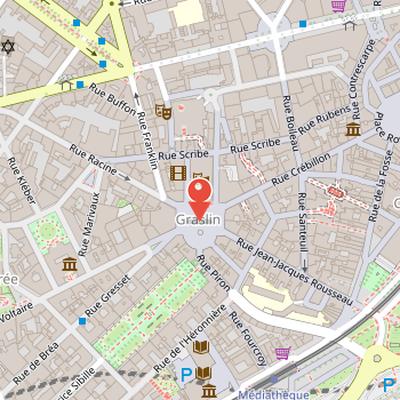
Nearby Objects
-
 Théâtre Graslin 60 m away
 -
 Cours Cambronne 140 m away
 -
 Passage Pommeraye 200 m away
 -
 Natural History Museum of Nantes 200 m away
 -
 Place Royale 350 m away
Place Graslin in Nantes
La place Graslin is one of the main streets of Nantes, France. Its most notable monument is the theater Graslin, which gives the place a clear cultural association within the city.
Location and Layout
Place Graslin is located in the city center of Nantes. Its plan is shaped like a rectangle adjoining a semicircle rounded to the south. The square is entirely pedestrian and is largely paved. It is served by eight streets: Crebillon, Moliere, Corneille, Racine, Voltaire, Piron, Regnard, and Jean-Jacques-Rousseau. Two notable buildings define its edges: the Graslin theater stands on the north side, while the brasserie La Cigale is located on the south side.
Planning and Origins of Place Graslin
From 1777, Jean-Joseph-Louis Graslin acquired large lands west of the city and decided to develop a real estate operation on a rocky hill. To obtain municipal approval, he donated land for streets and squares in Nantes, financed leveling works, and lent money to the city at low interest. In 1783, Mathurin Crucy presented a rectangular plan with the theater on the largest side. Graslin and architect Robert II Seheult also planned a semicircular square inspired by Paris's Odeon. However, Graslin and Crucy later entered into conflict and stopped direct communication, and the plan by Graslin and Crucy was not implemented.
Place Graslin: Reading Room, Theater, and Urban Redesign
Place Graslin has long been associated with cultural life in Nantes. In 1818, Pierre Michelet opened a reading room on rue Dauphine, and it was frequented by people including Ange Guepin and Emile Souvestre. Charles Monselet was born in the building of the reading room in 1825, and he later observed street performers and circus riders on Place Graslin, reflecting the square's role as a lively public setting.
The square also gained early modern urban features. In 1852, Place Graslin was one of the first streets in Nantes equipped with gas lanterns. Its theatrical surroundings were reinforced by later establishments, especially La Cigale brasserie, which opened opposite the theater in 1895. Designed in Art Nouveau style, La Cigale became popular among actors after theater performances, and Jean-Louis Trintignant described it as probably the most beautiful brasserie in the world.
Place Graslin also appears in cultural memory through film: it was used as an exterior set during the filming of Lola by Jacques Demy in 1960. More recently, the square has undergone major changes. In March 2022, Nantes city hall began one-year works to make Place Graslin partially pedestrian. The theater on the square was fully renovated and equipped with LED lighting in 2022. On July 15, 2022, Place Graslin was slightly excavated to improve perspectives and inaugurated with a fountain. The current design includes 7-meter tall candelabra imitating theater chandeliers and sixteen mobile plant containers, while the municipality plans to make the square fully pedestrian in coming years.
Architecture and Surroundings of Place Graslin
The principal building at Place Graslin was constructed in 1788 from plans by Mathurin Crucy. Its design includes twelve steps leading to the vestibule, eight Corinthian columns supporting the pediment, and a bas-relief of buoys, anchors, and tangled ropes above the entrance. The facade was further enriched by Dominique Molknecht, who sculpted eight antique-style muses above the columns and created statues of Moliere and Corneille facing the honor staircase. The building was damaged by fire in 1796 and reconstructed starting in 1811 under the direction of Mathurin Crucy.
Place Graslin is also associated with several notable neighboring structures. The art nouveau brasserie La Cigale faces the building and was designed by the architect and ceramist Emile Libaudiere. La Cigale was inaugurated on an unspecified date and classified as a historical monument in 1964. On the corner of Voltaire and Racine streets, another building on the square once housed a hotel garni, first called the Hotel Henri-IV and later the Hotel de France. Arthur Young mentioned it in 1787, and Don Pedro, former king of Portugal and emperor of Brazil, stayed there while traveling to Le Palais at Belle-Ile-en-Mer.
Place Graslin and the General Transatlantic Company
Place Graslin is associated with the General Transatlantic Company, which was housed in Bâtiments remarquables et lieux de memoire. The company was created in 1861, following the General Maritime Company founded in 1855. It established its Nantes headquarters at 1 Quai de la Fosse in 1911 and moved to Place Graslin after World War II. The company ceased operations in 1970. The esplanade at Place Graslin also includes three buildings listed as historical monuments, underlining the area's heritage value.