Théâtre Graslin is the opera house of Nantes, in Loire-Atlantique. Located on Place Graslin, between Molière, Scribe, and Corneille streets, it is one of the two residency venues of the mixed syndicate Angers-Nantes Opéra, alongside the Grand Théâtre d'Angers. The building was erected at the end of the 18th century and has been listed as a historical monument since 1975.
The theatre is part of the urban and historical context of Nantes in the 18th century, a period marked by commercial growth, the enrichment of merchants and shipowners, and major real estate operations. This transformation included the development of private mansions and public buildings, as well as projects such as Île Feydeau. In this broader setting of urban expansion and land speculation, the Théâtre Graslin reflects the architectural and civic ambitions associated with the city’s late-18th-century development.
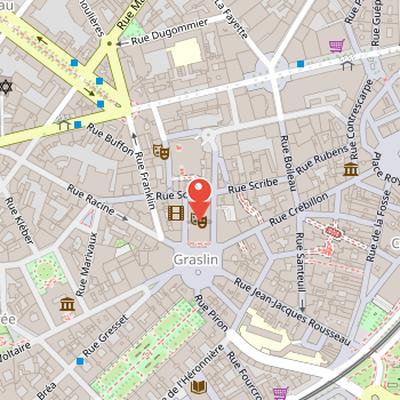
Nearby Objects
-
 Place Graslin 60 m away
 -
 Passage Pommeraye 200 m away
 -
 Cours Cambronne 200 m away
 -
 Natural History Museum of Nantes 250 m away
 -
 Place Royale 300 m away
Thétre Graslin in Nantes
Theatre Graslin is the opera house of Nantes, in Loire-Atlantique. It is operated by Angers-Nantes Opéra. The building was constructed at the end of the 18th century, placing it among the city's historic cultural landmarks. Since 1975, it has been listed as a historical monument, reflecting its recognized heritage value and long-standing public importance.
Location and Cultural Role
Theatre Graslin is located on Place Graslin, between Moliere, Scribe, and Corneille streets. It has a seating capacity of assises. The theatre is also one of the two residency venues of the mixed syndicate Angers-Nantes Opera, alongside the Grand Theatre d'Angers. This gives it an important place in the cultural network shared by Angers and Nantes.
Place Graslin and the Theatre Project
In the late 18th century, Nantes was undergoing rapid change driven by flourishing trade and the growing wealth of its merchants and shipowners. This enrichment led to the construction of private mansions and public buildings, supported by real estate operations that sought to profit from new urban developments. The transformation of the city was accelerated after Jean-Baptiste Ceineray became architect-surveyor in 1760, at a time when the main obstacle remained a lack of space. Quai de la Fosse was already saturated with activity and lined with the residences of shipowners and merchants, while the steep hill overlooking it had long discouraged urbanization. Other attempts also faced difficulties, including the unstable terrain of the Ile Feydeau and the Loire islands now known as Rue du Couedic.
Against this background, Jean-Joseph-Louis Graslin, who had served as the king's general farm receiver in Nantes for about ten years by the late 1770s, chose to finance a large speculative private real estate operation. He bought the agricultural lands called tenue Bouvet and tenue La Cagassais with the aim of building mansions and rental properties, then selling them after construction. He also planned to serve the area with quality public roads and to place prestigious public buildings along them in order to attract wealthy residents. The list of planned buildings included a theater, the Hotel des Fermes, a museum, a furnished hotel, a new Saint-Nicolas church, and the Stock Exchange.
The project met resistance. Merchants objected that the Stock Exchange would be too far from the center of activity, while the clergy opposed the construction of a theater near a place of worship. Even so, Graslin succeeded in building the Hotel de France on the esplanade named Place Graslin.
Planning and Architectural Design
In 1780, Jean-Joseph-Louis Graslin entrusted Mathurin Crucy with the planning of the performance hall that would become Theatre Graslin. Histoire describes the building as part of a prestigious venue whose attraction shifted the city's center of gravity toward the new district around the Grand Theatre. Crucy approached the project with a modern outlook, differing from his predecessor Jean-Baptiste Ceineray, and his design responded to new architectural constraints for public venues, especially access and fire safety.
These constraints had a direct impact on the site layout. They prevented the realization of earlier projects and led to the decision to isolate the building between three streets and Place Graslin, with only the Goineau property to the northeast preventing complete isolation. The interior layout was also carefully organized around visibility and acoustics. Crucy drew on Italian references, including the Teatro Olimpico by Andrea Palladio and the theater of Turin, while adapting those models to local needs.
His solution differed from fully enclosed Italian theaters through the use of a dome ceiling and half-height dividing walls for the boxes. Acoustic design was influenced by the different repertory expected in French and Italian theaters, and the circulation of sound was considered particularly suited to works by Jean-Baptiste Lully and Jean-Philippe Rameau. Histoire also places the project within a broader period of theater construction, alongside major new venues such as the Grand Theatre de Bordeaux, the Odeon theater, the Palais-Royal theater, and the Besancon theater.
Construction, budget, and stage equipment
In 1783, excavations and leveling were commissioned to prepare the foundations of Theatre Graslin, after the project received construction approval from the city office and the Royal Academy of Architecture. The construction agreement was also obtained in 1783, and the work was planned to last four years. From the outset, the project was marked by disagreements between Graslin, Crucy, the city office, and contractors, especially over costs and responsibilities. To address concerns about the city economy, architect Robert Seheult was called in to provide a counter-expertise on the use of materials.
The estimated budget, established by Crucy, was 500,000 livres, but additional expenses for decoration, sculptures, stage decor, and machinery were later required. These added costs led to overruns, tensions, and delays. Financial disputes also arose over reimbursement for expenses intended to accelerate progress. To help finance the work, a loan authorized by the King in 1784 was secured, and donations were solicited.
The construction relied on cut stones and included stonework and carpentry carried out by Antoine Peccot pere, Louis Crucy, and Antoine Crucy. The theater also received a significant decorative program: nine stage sets designed by Crucy were decorated, and the sets were painted by Jean Bougon and Charles Robinot-Bertrand, with Jean-Baptiste Coste assisting Bougon. The stage used complex machinery, and after the first machinery chief failed, he was replaced by Barton, formerly machinist of the Theatre-Francais.
Construction, Fire, and Rebuilding of Theatre Graslin
The history of Theatre Graslin began with its inauguration on 14 February 1788. The building later suffered a major fire on 7 fructidor an IV, during a performance of Zemire et Azor by Andre Gretry. The fire started at about 20:00, when a decorative frieze touched a candle flame. Strong wind helped the flames spread quickly to the roof, causing the dome and chandelier to collapse. The response was ineffective because of the severity of the blaze, and the disaster caused seven deaths, including four female spectators and three staff members. The clothing store in the building was spared.
After this early period, the theatre continued to play a role in the citys cultural life. In 1805, it housed the Ecole de dessin, the predecessor of the Nantes School of Fine Arts. In 1806, Napoleon authorized the theatre to maintain a permanent troupe. Following Napoleons visit in 1808, reconstruction began in 1811 under architect Mathurin Crucy. The new theatre was inaugurated on Easter day in 1813.
In later decades, Theatre Graslin faced competition from the new Theatre de la Renaissance, which opened in 1868 with over 1400 seats. After the sale of the theatre to the city in 1875, the two theatres were merged under one director. During renovations at Graslin in 1879 and 1880, the Theatre de la Renaissance temporarily replaced it. That second theatre was later destroyed by fire in 1912.
The theatre also had moments of wider cultural significance. On 16 March 1919, it hosted the first European jazz concert by the Harlem Hellfighters. During the events following the 1940 defeat, the theatre closed briefly and announced no season on 21 May 1940, but it reopened after the occupation authority ordered it to do so on 22 June 1940. Large audiences attended soon after the reopening, with interruptions only from conflict events.
Architecture and Urban Setting
Theatre Graslin was designed from drawings by Mathurin Crucy, architect-voyer of Nantes from 1782 to 1800, who also planned the urban layout of the district that includes both the theatre and Place Graslin. The building was placed on the north side of the square and approached by a granite staircase of thirteen steps made from stone from the Crac'h quarry. Its facade was inspired by the Odeon theatre facade, inaugurated in 1782, and was executed in a neo-classical style.
The exterior composition includes a peristyle with eight Corinthian columns supporting a ceiling with an overhanging cornice. Behind it, a small vestibule opens onto the peristyle and is formed by four columns supporting a coffered barrel vault. This vestibule was originally closed by grilles rather than glass, and an honored staircase was placed at its center, leading to the auditorium. The auditorium itself was shaped as a truncated oval, a form characteristic of Italian-style theatres.
The building also has a history of continued alteration and upkeep. Work included reconstruction after the fire of 1796, as well as later technological upgrades such as electricity and heating installations. Maintenance works were also carried out on the theatre over time.
Interior Decoration and Symbolic Ornament
The interior decor of Theatre Graslin combines sculptural and painted elements with strong classical references. Eight antique-style statues of the Muses were created by Dominique Molknecht in Nantes between 1818 and 1825, and were placed above the columns in 1825. These statues had been proposed in competition with works offered by Jean-Baptiste Joseph Debay pere in 1813. The balconies are finished with golden woodwork decorated with vegetal motifs, and garlands linking medallions that include composer busts. On the second balcony, the medallions feature sculpted busts of composers such as Mozart. Above, the dome ceiling fresco was painted by Hippolyte Berteaux in 1881 and shows mythological figures including Oreste, the god Momos, and allegories of music and theater.
Artistic Life and Performance at the Graslin Theatre
The artistic program at the Graslin Theatre reflects a long sequence of performances and notable appearances by major figures of the stage and concert hall. Among the works presented there was Richard Wagner's Lohengrin, and Franz Liszt gave a concert in two parts on an unspecified date. The theatre also welcomed singers and performers including Antoinette Saint-Huberty, who appeared simultaneously with her rival, Laure Cinti-Damoreau around 1845, Charles Bataille in 1852, and Fanny Tacchinardi-Persiani in Nantes in 1855 to 1856.
Several well known artists are also recorded in connection with the theatre's history. Talma performed Oreste in Andromaque after the theatre reconstruction, played roles in three classics until an unspecified date, and returned to perform in 1818. Mademoiselle Mars appeared in 1816 and again in 1826, while François-Joseph Regnier joined the theatre troupe in 1829. The theatre also attracted composers and musicians to rehearsals and performances: François-Adrien Boieldieu attended rehearsals of Le Calife de Bagdad and Le Petit Chaperon rouge in 1819, and Esprit Auber attended a performance of Emma in 1821. Later, Jules Massenet directed the orchestra for Manon and H?rodiade in 1885, and Vincent d'Indy directed Fervaal in 1897.
The theatre's artistic life was also shaped by its internal procedures. Around 1840, the rules were changed to prohibit protest during artist performances. The spectator voting system used random selection and secret voting, and attendance at voting sessions declined among subscribers in early 1883. In response, universal suffrage was introduced among subscribers present at recruitment sessions in the 1883 to 1884 season, although the resulting votes were considered too generous.