Cours Cambronne is a garden square in the city center of Nantes. It is entered through wrought iron gates at both ends, on rue Piron to the east and rue des Cadeniers to the west; the western gate is flanked by two stone guardhouses. The square is bordered by identical buildings on the north side facing rue Gresset and on the south side facing rue de l'Héronnière. At its center stands a statue of Pierre Cambronne by Nantes sculptor Jean Debay, resting on a pedestal designed by Henri-Théodore Driollet. The site also includes one of the five Wallace fountains in Nantes, sculpted by Charles-Auguste Lebourg. The square is planted with silver lindens and large-flowered magnolias, and it is decorated with bowling greens and flower beds. Its history is linked to the former Capuchin convent grounds, later acquired by the city and developed according to plans by Mathurin Crucy.
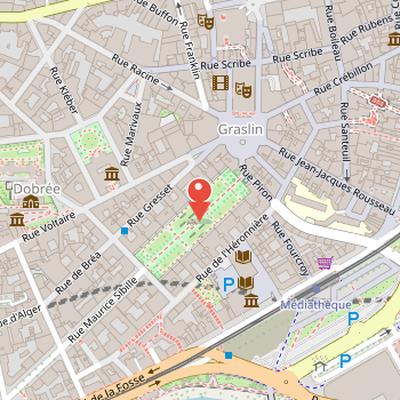
Nearby Objects
-
 Place Graslin 140 m away
 -
 Natural History Museum of Nantes 200 m away
 -
 Théâtre Graslin 200 m away
 -
 Musée Dobrée 300 m away
 -
 Passage Pommeraye 300 m away
Layout and Features of Cours Cambronne
Cours Cambronne is located in the city center of Nantes. It is accessible through wrought iron gates at both ends, on rue Piron to the east and rue des Cadeniers to the west. The west gate is flanked by two stone guardhouses. The space is bordered by identical buildings on the north side facing rue Gresset and on the south side facing rue de l'Hernonniere.
At the center stands a statue of Pierre Cambronne, created by the Nantes sculptor Jean Debay and placed on a pedestal designed by Henri-Theodore Driollet. The site also includes one of the five Wallace fountains in Nantes, sculpted by Charles-Auguste Lebourg. Its planting includes silver lindens and large-flowered magnolias, and it is decorated with bowling greens and flower beds.
From Capuchin Convent to Urban Esplanade
The history of cours Cambronne begins with the arrival of the Capuchin religious congregation in Nantes in 1593. Installed by the Duke of Mercoeur in the faubourg du Marchix, now part of the place de Bretagne neighborhood, the Capuchins later founded a new convent above the quai de la Fosse in 1629. Its chapel stood at the level of the current rue Piron, while the cloister was located at the level of the current rue de l Heronniere. A small wood extended toward the present rues Voltaire and Gresset, and the current esplanade was then occupied by the convent gardens and orchard.
From 1777, a new district was created under the impulse of Jean-Joseph-Louis Graslin. The development of place de la Comedie proved difficult because negotiations were needed with the Capuchins to obtain the cession of a small part of their land. The convent became national property in 1791, and the city hall of Nantes bought the land the same year. The site was then developed according to plans by Nantes architect Mathurin Crucy, who established construction standards for the area. Parcels were sold in lots, with the first transaction in 1792 concerning the old convent chapel.
Name Changes Over Time
At its opening, the promenade was named cours du Peuple. It was later renamed cours de la Republique, then cours Imperial under the First Empire. After 1815, it was called simply cours, and at an unspecified date it took the name cours Napoleon. After 1871, the promenade again used the name cours de la Republique. It has been known as cours Cambronne since an unspecified date.
Notable Buildings Along Cours Cambronne
Sixteen buildings facing Cours Cambronne are inscribed on the inventory of Historical Monuments. Among them, the Hotel Scheult, also called the Hotel des Cariatides, is listed as a notable building. The buildings are described as having a basement that is the only access from Cours Cambronne, a first level on a terrace, and two floors of Ionic columns. Their top floor is set behind a balustrade. The main entrances are located on Rue Gresset to the north and on Rue de l Heronniere to the south.
Cours Cambronne also appears in contemporary cultural references. It serves as the setting for a scene in the 2017 film Cessez-le-feu by Emmanuel Courcol. The site is also connected to the work of photographer Patrick Garcon, who exhibited the series Nantes, Cite des Artistes in 2023 and 2024.