The Natural History Museum of Nantes traces its origins to the first natural history cabinet established in Nantes in 1799 by François-René Dubuisson, an amateur of natural history. Located on rue Caylus, the cabinet’s collections were purchased by the municipality of Nantes in 1806 and installed in the old Saint-Côme surgery school on rue du Port-Communeau. The Saint-Côme building, designed by Jean-Baptiste Ceineray in 1765, required four years of work before opening as a museum. It opened with geology, mineralogy, and botany collections, and Dubuisson remained conservator until his death in 1836. A building on rue Voltaire was later considered for the collections, while another near place Graslin, formerly used as a courthouse and later as a science school and commerce school, was also associated with this history. Construction of a new building designed by architect Gustave Bourgerel began in 1868, with the first stone laid that same year. In 2023, the Metropolitan Council voted for renovation, and the museum closed before works planned from 2026, which will address energy efficiency, accessibility, and expanded exhibition space.
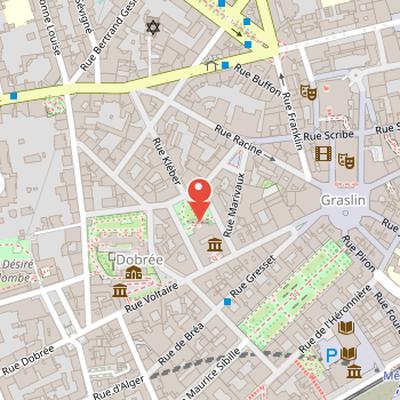
Nearby Objects
-
 Musée Dobrée 150 m away
 -
 Cours Cambronne 200 m away
 -
 Place Graslin 200 m away
 -
 Théâtre Graslin 250 m away
 -
 Memorial to the Abolition of Slavery 400 m away
From Private Cabinet to Municipal Museum
The history of the Natural History Museum of Nantes began in 1799, when Francois-Rene Dubuisson, described as an amateur of natural history, created the first natural history cabinet in the city. This cabinet was located on rue Caylus in Nantes. In 1806, the municipality of Nantes purchased the collections and installed them in the old Saint-Come surgery school on rue du Port-Communeau. The Saint-Come building had been built by Jean-Baptiste Ceineray in 1765, and it underwent four years of work before opening as a museum.
When it opened, the museum presented geology, mineralogy, and botany collections. Dubuisson remained conservator until his death in 1836, linking the early municipal phase of the museum to its original founder. Later plans also considered other possible sites for the collections, including a building on rue Voltaire and a building near place Graslin that had become unused after coin minting ended in Nantes. That building had also housed the courthouse, a science school, and a commerce school. In 1868, construction began on a new building designed by architect Gustave Bourgerel, and the first stone was laid that same year.
Planned Renovation and Future Role
In 2023, the Metropolitan Council voted to renovate the Natural History Museum of Nantes. The museum closed before renovation works began in 2026. The project is intended to rethink the museum's role in climate, biodiversity, and ecological transition. It will also make the building energy efficient and fully accessible. In addition, the renovation will increase space for the display of collections dating from the late 18th century.
Renovation and New Visitor Spaces
Historique will close the Natural History Museum of Nantes for four years of renovations, with the aim of greatly expanding and reorganizing the site. The project will remove the grilles at the entrance on rue Voltaire and restore the original facade at the garden entrance, without wooden railings. It will also create a covered public passage called the Nef inside the building, allowing free access to the shop and auditorium. From this passage, a wooden staircase will lead to the second floor.
The renovation will introduce new spaces for both visitors and scientific exchange. Historique will create the Agora des sciences, a media library designed to facilitate access to sciences and to support dialogue with sciences, researchers, scientific mediators, and associations of popular education. On the second floor, under the building's glass roof, a large wooden salle des origines will be arranged, focusing on the themes Habiter la terre and Comparer les crises. The museographic route will alternate open and closed spaces, galleries, and alcoves at the start of the hall.
The new permanent exhibition will present a journey through time from the origin of the Universe to the Anthropocene. The museum's space will be increased to nearly double its current size, allowing twice as many objects and specimens to be shown. These will include insect collections, herbariums, wood samples, ceramic fungi, minerals, gems, fossils, and new taxidermy animals.
Collections and Exhibition Spaces
The museum's collections were largely assembled by conservators who succeeded one another until the mid-20th century. They cover all domains of natural history and include shells, mollusks, botany, and three hundred thousand herbarium sheets. The institution is also part of the national naturalist collections network RECOLNAT.
The museum's exhibition spaces are organized by subject and include two temporary exhibition rooms. On the first floor, the zoology gallery presents phylogenetic classification and displays more than one thousand vertebrate animal specimens. One of its most notable objects is the skeleton of a common rorqual, Balaenoptera physalus, more than 18 meters long. This specimen was collected through the initiative of museum director Catherine Cuenca, brought with professor Costiou from the Veterinary School of Nantes, and recovered after the whale was rammed in 1991 by the methane carrier Edouard LD coming from Algeria. It was found in Donges near the Montoir-de-Bretagne methane terminal and prepared for four years in the anatomy unit of the National Veterinary School of Nantes.
On the ground floor, the Earth and Universe Sciences gallery contains minerals, rocks, fossils, and a meteorite collection. Until 2025, the museum also had a vivarium with about twenty local living species, including insects, small mammals, turtles, crocodiles, snakes, and lizards.
Libraries and the Future Science Agora
Until 2025, the museum's scientific library offered free access to about 30,000 books dating from the 16th century to the present. It also held nearly 3,000 scientific and popular journals and other documents. The media library provided more than 8,000 references for young visitors, including books, DVDs, and board games. In the future museum, the media and scientific libraries are planned to be merged into a science Agora. This Agora will function as a third-place media library open to the public for access to scientific information, and it will also make it possible to meet museum scientists, university staff, and research organizations. Its purpose is to facilitate access to science for all audiences.