Passage Pommeraye is a shopping arcade in the city center of Nantes, France. Built from the end of 1840 and put into service on an unspecified date, it extends across a steep site and is organized on three levels around a central monumental staircase. The passage connects rue de la Fosse to rue Santeuil, near rue Crébillon, and also links the quartier de la place du Commerce with the place Graslin. It includes shops and housing and is a private space closed at night by gates.
The passage has been classified as a historical monument since an unspecified date and is considered both an architectural success and a tourist attraction. It has remained a flourishing place of commerce, despite the financial ruin of its promoter, Louis Pommeraye (1806–1850), during construction. Renovation work was completed in 2015. The name “Passage Pommeraye” became a registered trademark with INPI on an unspecified date.
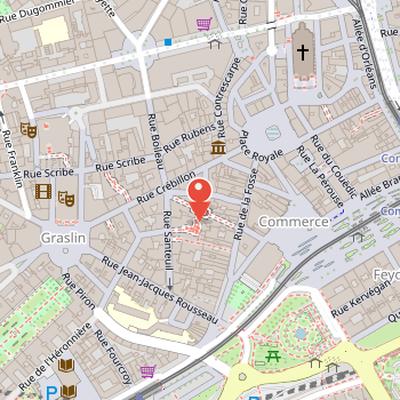
Nearby Objects
-
 Place du Commerce 150 m away
 -
 Place Royale 150 m away
 -
 Théâtre Graslin 200 m away
 -
 Place Graslin 200 m away
 -
 Basilique Saint-Nicolas 300 m away
Passage Pommeraye in Nantes
Passage Pommeraye is a shopping arcade in Nantes, France, built on terrain with a steep slope. Construction began at the end of 1840, and the passage was later put into service on an unspecified date. Its design extends over three levels linked by a central staircase, a layout that is part of its architectural identity. The arcade has been classified as a historical monument since an unspecified date and is also a tourist attraction in the city of Nantes.
The passage is considered an architectural success and has remained a flourishing place of commerce. At the same time, its construction caused the financial ruin of its promoter, Louis Pommeraye (1806-1850). The site underwent renovation, completed in 2015, which reflects its continued role in the city. The name Passage Pommeraye also became a registered trademark with INPI on an unspecified date.
Layout and Urban Role
Located in the city center of Nantes, the Passage Pommeraye is a private covered space that combines shops and housing. It connects rue de la Fosse to rue Santeuil near rue Cribillon, and also links to rue du Puits-d'Argent, thereby joining the quartier de la place du Commerce and the place Graslin. The passage is organized on three levels around a central monumental staircase, with a vertical drop of ten meters. It is closed at night by gates. Its maintenance is financed by a coproperty of about sixty members, supported by the State and the Region. According to Patrice de Moncan, it is considered one of the five most beautiful and the most original covered passages built in the 19th century.
From Early Passage Plans to the Pommeraye Project
The Passage Pommeraye belongs to a broader history of covered passages and urban change in Nantes. The first passage in the city was the Passage d'Orleans, dating from 1827 and about 150 meters long, connecting rue d'Orleans to place Felix-Fournier. In the same period, architect Arnaud Guillemet proposed a covered gallery to replace the passage du Commerce and link the palais de la Bourse with the Poste centrale on rue Santeuil, but the project did not succeed. Doctors Ange Guepin and Eugene Bonamy also requested the creation of a covered passage in Nantes.
These proposals developed in a city already shaped by major urban modifications between 1760 and the Revolution under Jean-Baptiste Ceineray and Mathurin Crucy. After 1830, Nantes also adopted a hygienist trend aimed at improving housing conditions for low-income classes, including the removal of narrow or winding streets and interior courtyards that formed labyrinths in some neighborhoods. At the same time, urban change was linked to the need to facilitate communication for commerce, and it was driven by profit-oriented real estate operations. Jean-Joseph-Louis Graslin had already developed a model district around the square and theater named after him by buying land cheaply, creating amenities, and reselling plots or buildings at higher prices.
Louis Pommeraye launched his own real estate projects during this period of increasing operations. In the first half of the 19th century, the block bordered by rues de la Fosse, Santeuil and Jean-Jacques Rousseau consisted of dilapidated buildings, with only rue du Puits-d'Argent and passage du Commerce crossing it. Architect Jean-Baptiste Buron then led plans for a restaurant and revived the idea of a covered passage in the area. Municipal authorization for construction was granted on July 10, 1840, and work began late that same year.
Financing, Construction, and Later Fate
The Passage Pommeraye was created through the limited partnership Societe en commandite par actions Pommeraye, formed to meet financing needs. Louis Pommeraye acted as manager, and 31 additional shareholders joined him to raise the necessary capital of 2,500,000 francs. Among the main financiers were the sugar refiners Barre, Saint-Omer, and Soubzmain.
Its construction involved several technical and architectural challenges. One major difficulty was handling a change in elevation while keeping the passage easy to walk through. The promoters also chose gas lighting, then a novelty, but this made the installation more complicated because the level difference caused flow regulation problems inside the passage and on quai de la Fosse. The gas system was entrusted to the Societe du Gaz. Pommeraye also had to work with the city architect Henri Driollet, who required reinforcements linked to columns or metal in order to strengthen the wooden landings and stairs. Pommeraye chose metal as the construction material, a decision that allowed the ateliers Voruz to produce what was described as a masterpiece.
An opening authorization was granted on an unspecified date, and the inauguration took place in June of the same year under mayor Ferdinand Favre and prefect Achille Chaper. Despite these efforts, the operation failed because of the economic crisis of 1848, and the company was liquidated in 1849. Pommeraye invested all his assets and mortgaged his wife's inheritance, was ruined, and later died in Saint-Pere-en-Retz after hiding at Cellier. His associate Guilloux also invested an unspecified amount and was forced to leave the luxurious restaurant at the passage to establish himself at rue de Gigant.
Like other covered passages, it later fell into disuse with the arrival of department stores in the last third of the 19th century. The passage was subsequently classified as a historical monument, and the Societe archeologique et historique de Nantes placed two commemorative plaques honoring Louis Pommeraye at its two main entrances. On an unspecified date, the joint owners' council also registered 'Passage Pommeraye' as a trademark with the Institut national de la propriete industrielle.
Architecture and circulation
The architecture of the passage Pommeraye is attributed to Jean-Baptiste Buron and Hippolyte Durand-Gasselin. The building has an irregular shape and three facades facing the surrounding streets. Since the opening of the galerie Regnier, the passage has been described as Y-shaped, and its design also reflects the slope and length of the site through two transverse buildings. The four galleries have substantially the same configuration, although the central gallery is the only one with four-story buildings and contains the monumental staircase. The other galleries have different width-to-height ratios: 1/3.5 for galerie Regnier, 1/3 for galerie de la Fosse, and 1/2.5 for galerie Santeuil. The passage is divided into two parts separated by a large landing at the level of the galerie Regnier, with an intermediate landing in each part and metal support posts. Three intervals are covered by different skylights.
The entrances are designed on the model of a classical triumphal arch, with pediment, pillars, and a molded keystone. They are described as relatively discreet and integrated into the surrounding street architecture. Only the entrances on rue de la Fosse and rue Santeuil carry the sign Visitez le passage Pommeraye. The first floor of these two entrances is adorned with wrought iron balconies, and the rue Santeuil entrance is identified as the main entrance, close to the commercial rue Crebillon.
Access to the different levels is organized by stairwells outside the public circulation areas. There are four stairwells in the central gallery and five facing the surrounding streets: one on rue Santeuil, one on rue du Puits-d'Argent, and three on rue de la Fosse. Four shops also have private staircases leading to the mezzanine. The stairs and landing floors are made of wood, while the railings, support posts, and decorated risers are made of wrought iron. The railings include vegetal motifs and parrot heads, and the risers have openwork, lace-like elements.
The facades also vary in their arrangement from bottom to top. In galerie Santeuil, they consist of shops, mezzanine, band, apartments, cornice, and glass roof, while in galerie de la Fosse they run from shops to band, apartment, band, apartment, cornice, and glass roof. All this contributes to the passage's layered internal structure and its combination of commercial, residential, and circulation spaces.
Bas-Reliefs in the Passage Pommeraye
The architecture and decor of the Passage Pommeraye include a series of bas-reliefs featuring historical figures. Among those represented are Charles Louis du Coue dic, Pierre Abelard, Louis Rousseau de Saint-Aignan, Pierre Dumoustier, Olivier de Clisson, Captain Delaville, Eon Le Roger or Francois Rabelais, and Jacques Cassard. These decorative elements form part of the passage's visual identity and contribute to its architectural character.
Architecture and Decorative Program
The Passage Pommeraye is distinguished by a rich decorative program spread across its galleries, staircase, and shopfronts. The glass decoration of the Galerie Santeuil skylight was crafted by Louis Grootaers the elder and combines elegant arches with stucco ornament showing paradise birds and intertwined vines. The arcade ornaments include acanthus leaf motifs by Leopold Hergault, while the storefronts in operation at the opening were decorated by the painter-decorator Achille Legier.
Several sculptural elements were produced by the Parisian sculptor Jean Debay. He made bronze busts of Jean-Baptiste Ceineray and Mathurin Crucy, as well as the bronze bust of Pierre Haudaudine placed on the inner side of the south entrance door. Debay also created terracotta statues on the second and third levels around the staircase. These figures represent Commerce, Industry, Agriculture, Fine Arts, Spectacle, Sciences, and Maritime Commerce. He framed the clock with two child statues named Day and Night.
The floors of the Fosse, Santeuil, and Regnier galleries are tiled. A band of dark tiles set back from the edge marks a fictive sidewalk that separates the shopfronts. The passage also includes original luminaires designed to work with gas. During a later restoration carried out in connection with the creation of a new gallery, the passage was returned to its state at the 1843 opening, excluding the shop interiors. The renovation covered all passage elements, including the facades, staircase, glass roof, columns, paintings, joinery, and corridors, and it also brought the site up to safety standards. New versions of the original luminaires were made using LED technology, some by molding with electrical cables installed inside. Luminaires above shop windows from the 1930s were preserved and adapted for LED lighting, while the cherub paintings beneath them were not restored. After two and a half years of work, the renovated passage was inaugurated on a specific date, and a special postage stamp was issued for the occasion.
Louis-Ange-Hyacinthe Pommeraye and the Passage
Louis-Ange-Hyacinthe Pommeraye was born and died in Saint-Pere-en-Retz, in Loire-Inférieure. He began his career as a notary clerk in Saint-Pere-en-Retz at the age of seventeen, then worked later in Frossay and, in 1829, in Nantes. At an unspecified date, he succeeded to 16 rue Crebillon, married Marie-Louise Besnier, the daughter of a rich Nantes merchant, and received a dowry through his wife. He later abandoned his notary office and entered business.
Pommeraye bought the forest of Cellier with his father-in-law and Nantes merchants, and he settled in the main house of the hamlet La Pegerie. In 1840, he created the company Societe Pommeraye et . His business activities ended in financial failure: the civil court of Nantes convicted him personally, as manager, to repay creditors, and his assets were sold at a loss. His family took refuge at La Pegerie du Cellier, and his last child was born there. Pommeraye died suddenly at his brother-in-law Etienne Flandrin's home, at the age of forty-four, leaving a widow and seven orphans. His widow later received charge of a post office to support the family, and she renounced his inheritance because debts remained unpaid.
Pommeraye is identified with the Passage Pommeraye, described as his masterpiece. A bronze bust of him was made by the artist Jean-Baptiste Joseph Debay and has been held by the Nantes Museum of Fine Arts since 2013. The facts also attribute other projects to him, including plans for Hotel Levesque in Nantes in 1871, seaside houses on the Atlantic coast, and the old presbytery of Blain in 1869, which was demolished in 2013.
Later Ownership and Access
Henri Baillardel de Lareinty, born in 1824, became closely associated with the Passage Pommeraye through later financial and ownership changes. After his father died in 1826, baron Baillardel de Lareinty later became the main creditor of the Societe Pommeraye et. The passage was mortgaged, and the Societe Pommeraye et was eventually dissolved. At an unspecified date, the baron ordered the auction of the Passage Pommeraye and bought it himself. In 1852, he obtained permission to open galerie Regnier, which provided access to the Passage Pommeraye via rue du Puits-d'Argent. Henri Baillardel de Lareinty later died, and his widow sold the Passage Pommeraye immediately after his death.
Commerce in the Passage Pommeraye
Commerce was located in the gallery Santeuil, above the staircase on the west side of the Passage Pommeraye, with shop numbers 18, 19, and 20. It was known for advertising that used shocking slogans and humorous visuals, and its owner Hidalgo was remembered above all for selling joke and prank items. The shop's offer also included dentistry, alongside jokes, perfumes, and gas masks during World War II. According to the record, a dentist from Paris came once a week to work in a shop room, while Hidalgo himself did not practice dentistry.
One of Commerce's best known promotional ideas was a joke sale of walls: Hidalgo proposed selling walls starting with a base amount that doubled every day for thirty days. A calculation given for the tenth day reached 5120 francs, while the stock was presented as worth one million francs. The offer was described as a joke because the total for thirty days would have reached 536,870,912 francs.
A former employee stated in 2013 that Andre Hidalgo was actually Eugene Andre Philipeault (1888-1944). The business was continued by Hidalgo's wife, Madeleine Bailleul, until the early 1980s.
Commerce was linked to a neighboring bookstore occupying several premises on six levels from numbers 21 to 26. That bookstore was a place where young people from Nantes bought school books, and it also had a section devoted to Brittany documents, as well as stationery and a workshop for restoring and repairing old books. The bookstore closed in 1998.
The name Commerce also appears in connection with a family business that began with Articles de Paris in 1885. That business later included bookstore, stationery, framing, and photography activities, and the family art gallery was transformed by Norbert into a gallery showing Nantes painters. The gallery was later run by Alain Moyon-Avenard, who celebrated its centenary in 1985, retired in 2012 after 47 years, and sold the gallery, which led to access being made to Passage Coeur-de-Nantes at its location.
Tourist Appeal and Cultural Use
Tourism surveys conducted in reception offices with Voyage a Nantes place Passage Pommeraye alongside the cathedral at the top of visitation intentions. Nearly two-thirds of surveyed people regard it as a mandatory destination. Its appeal is maintained through frequent mentions in tourist guides, and recent tourism initiatives have used it to help dynamize tourism. Voyage a Nantes also includes Passage Pommeraye in its communication materials. Beyond tourism promotion, national prescribers rely on its aesthetic for events and visits, and participating artists integrate the passage into their performances.
Le Passage Pommeraye in Literature, Film, and Public Life
Le Passage Pommeraye appears repeatedly in literary and artistic works, where it is often used as a distinctive setting. Gustave Flaubert refers to a stay in Nantes in 1847 in Par les champs et par les greves, where he discovers the passage Pommeraye. Andre Pieyre de Mandiargues gives it a central place in his 1946 novella Le Passage Pommeraye in Le Musee noir, presenting it as set back and hidden by the activity on rue Crebillon. In that text, the gallery is described as dimly lit and in decline, while an aquarium effect is evoked, along with the narrator's confusion caused by the statues. After leaving the passage, the passerby is said to feel he has experienced a unique event. Yves Cosson also draws on the passage and its shops in the poem Chez Hidalgo in 1965, and later writes Pommeraye in 1982 under the same inspiration. Julien Gracq, in La Forme d'une ville in 1985, criticizes the glass panes and regrets the lack of poetic privacy caused by the abundance of light, while still recalling a sunset in the ambush of the passage from adolescence and acknowledging its literary evocation and decor. Other later references include a crime scene in Stephane Pajot's AztEcs Freaks from the Le Poulpe series in 2012. The passage has also been connected with film culture: according to Agnes Varda, it housed Jacques Demy's adolescent film club, and Demy exchanged a Meccano set for his first small camera in a shop there. The passage served as a set in three films directed by Demy, and films by other directors have also used it as a setting in at least one scene. Beyond literature and cinema, Yves Brayer painted the central gallery in 1977. The passage has also hosted public events, including an installation of hanging laundry during the 1993 festival les Allumees that gave it an Italian street look, a recital by the brass band of the Republican Guard cavalry band in the mid-1990s, a collective dance procession in 2011 closing an homage to Jacques Demy, and a secret dinner with tables organized in the galleries in 2012 as part of Voyage a Nantes.
Passage Coeur-de-Nantes
Passage Coeur-de-Nantes is an annex passage located southwest of the historic passage Pommeraye. It was built on the site of the former imprimerie du Commerce building, which had long been occupied by Presse-Ocean and was demolished in 2016. The passage officially opened in 2019.
Its entrance is on rue Santeuil, opposite the exit of rue Rameau, and it lies approximately fifty meters south of one of the two main entrances to passage Pommeraye. The new passage leads into the current passage Pommeraye at the site formerly occupied by the Moyon-Avenard art gallery, which was located on the intermediate level called galerie Regnier.
Passage Coeur-de-Nantes contains 20 boutiques on its three lower levels and offices covering 3,800 square meters on three upper levels. The new gallery hosts about fifteen boutiques, mainly offering mid- and high-end ready-to-wear fashion. It also enhances 19th century buildings in the surrounding city block, preserves vestiges of the maison de la Fontaine d'Heredie in the basements, and connects the extension with several courtyards. In addition, it connects with the passage du Commerce, which is currently closed and leads to place de la Bourse.