Place Royale is a square in the city center of Nantes, France, designed in 1786 by the architect Mathurin Crucy and developed in 1790 after the destruction of the medieval ramparts. It forms the central element of a homogeneous group of buildings that reflects classical architecture. The square was originally intended for commerce and hosted notable shops, and it continues to retain a commercial function. It also has symbolic value in the city and serves as a popular setting for artistic, festive, and political gatherings. The square includes a monumental fountain inaugurated in 1865, with statues symbolizing eight aspects of industry and commerce, along with figures blowing water through shells and perched on dolphins. Heavily damaged during World War II, it was restored almost identically between 1945 and 1961. Over time, it became a roundabout for automobile traffic, and after renovation between 2007 and 2011 it was included in the city center pedestrian zone.
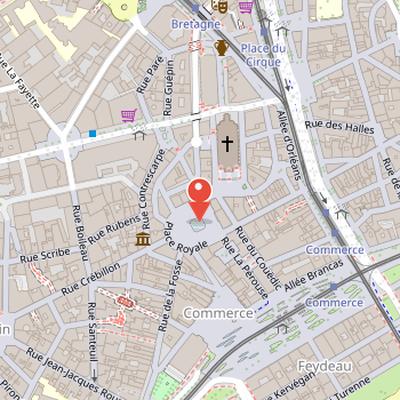
Nearby Objects
-
 Basilique Saint-Nicolas 120 m away
 -
 Place du Commerce 150 m away
 -
 Passage Pommeraye 150 m away
 -
 Marché de Feltre 200 m away
 -
 Théâtre Graslin 300 m away
Architecture and Civic Role of Place Royale
Place Royale was designed in 1786 by the Nantes architect Mathurin Crucy in the city center of Nantes, France, and was developed in 1790 after the destruction of the medieval ramparts. It forms the central element of a homogeneous group of buildings that respond to the classical architecture constructed at that time. The square features a monumental fountain, inaugurated in 1865, and it was originally intended for commerce, hosting notable shops. It still retains a commercial function today.
The site has never housed a statue of a monarch, yet it has acquired symbolic value in the city. It is also a popular location for artistic, festive, and political gatherings. Place Royale was heavily damaged during World War II and was restored almost identically between 1945 and 1961. Over time, it became a roundabout dedicated to automobile traffic, before undergoing renovation between 2007 and 2011. Since that renovation, it has been included in the pedestrian zone of the city center.
Classical Design and Decorative Program
The architecture at place Royale was designed by Mathurin Crucy to connect place Graslin to place Royale via rue Cribillon. Its design follows classical principles, with facade symmetry and a rigorous plan. The overall form combines an eastern rectangle with a western hemispherical part, and it has been described as a mirror de toilette. The decorative program includes statues symbolizing eight aspects of industry and commerce. Other statues blow water through shells, while figures perched on dolphins spout water through their nostrils. Together, these elements recall the major role of the Nantes port in the city's economy.
From Fortress Ground to Urban Square
The site of place Royale originally occupied a bastion built around 1500 to defend access to porte Saint-Nicolas. This bastion was surrounded by moats and was demolished in 1773, opening the way for a new urban project on the same ground. Pierre Vigne de Vigny proposed a scheme to cover the fortification, while Jean-Baptiste Ceineray developed several plans for a large public square in front of the new Saint-Nicolas church. In 1778, Ceineray presented a revised plan in which the square became a crossroads organized around a central statue. A major urban program launched by the municipality in 1786 was based on Ceineray's drafts, although Crucy's design later differed by combining a rectangle with an hemicycle for place Graslin. The buildings planned for the site were intended as rented investments, with austere facades designed by the architect. Their ground floors and mezzanines were arranged for shops, while the smaller top floor windows reflected a social hierarchy. At the time of the project launch, the existing esplanade was called place Saint-Nicolas. The future square was then named place between 1789 and 1792 in Crucy's project, but the French Revolution invalidated this name. It was called champ de la Liberte and champ de l'Egalite until 1806, then place Imperiale under the First Empire. At the Restoration it became place d'Armes, named after a Louis XVI statue, before becoming place Royale in 1814. After the 1848 Revolution, it was renamed place de l'Egalite in 1849, and received its definitive name, place Royale, in 1852. Notably, the square never housed a monarch statue.
From Abandoned Fountain Plans to a Monumental Square
The history of Place Royale was shaped by a long series of unrealized fountain projects. In 1567, Cardin Vallence exchanged with the mayor of Nantes about a public fountain, but he later abandoned the project because of work at Chenonceau castle. Other fountain proposals followed, yet none succeeded by the late 18th century. Mathurin Crucy then proposed a guardhouse and fountain with a statue of an antique draped woman, and a vote approved the construction of a guardhouse and fountain to replace a well at Saint-Nicolas church, but this project was also eventually abandoned.
A new phase began in January 1839, when the city launched a call for tenders. Engineer Auguste Jegou responded on 15 February 1839 with a plan for distributing Loire water through 27 fountains in Nantes, but the project was not retained. Another proposal envisioned a monumental fountain dominating a remodeled square called place de l Egalite. This design called for wide sidewalks with stone benches, renewed leveling of the esplanade, new paving, special attention to lighting, and a monumental cast iron fountain as the centerpiece. The municipal council appreciated the project, but it was postponed because there was no water service to feed the fountain.
Later, the bishop of Nantes expressed concerns about the project, and mayor Ferdinand Favre reassured him about the statue representation. Favre certified that Daniel Ducommun du Locle's statue represented a woman dressed. The project took its definitive form in 1861, with statues planned in bronze rather than cast iron, blue granite specified for the construction, and the bronze statuary from the works of Daniel Ducommun and Guillaume Grootaers assigned to founder Jean-Simon Voruz, who cast the bronze statues as they were created.
Place Royale as a Civic Stage
Place Royale appears in the historical record as a symbolic location in the city and as a setting for public ceremony and political display. A procession moved through the city to the place Egalite, where a temporary triumphal arch was built for Historique. The monument is described as presenting three statues, including one representing Egalite, and a procession later passed under its arch carrying emblems such as pikes bearing the names of French men. The route from La Fosse to rue de la Casserie also passed through newly widened streets, including rue Jean-Jacques-Rousseau, place Balanche, rue Crebillon, and place de l'Egalite.
The square also served as a site for civic commemoration in 1845, when a ceremony was held there for the departure of Poles from Nantes to fight for Poland's independence. Historique notes that the Polish cause was popular in progressive circles and the workers' movement, and that on the day of the ceremony the national workshops were empty as workers cheered Polish patriots and attended the inauguration of a tree of Liberty. The esplanade was surrounded by a building completed in 1845, reinforcing the square's defined urban setting.
The place is further linked to moments of political power in the city, including the public exposure of the defeated after Charette's capture during the War of Vendee, and the escorting of General Charette on foot to his judgment location.
From Damage to Pedestrian Square
At the start of the 20th century, the facades of the ground floor and mezzanine were authorized for modification. In 1903, Place Royale also served as the setting for the start of the first and last stage of the first Tour de France, held in front of the brasserie le Continental. The square later became closely linked with major social movements and events.
The Second World War caused severe destruction: a bombardment destroyed eight of the nine buildings surrounding the esplanade, and the esplanade itself, Rue du Calvaire, and the basilique Saint-Nicolas were ravaged. After the war, the decision was made to reconstruct the esplanade identically. The rebuilt buildings were made of concrete and set back slightly from their original alignments. Their design was also altered through enlarged windows and dormers, and access shifted to the rear, for example through Rue Du Couedic for the eastern buildings. The esplanade was widened with broad sidewalks to improve circulation. In 1961, restoration works were carried out on the granite basin, with funding obtained from the Commission regionale des dommages de guerre, while the city paid for the restoration of sculptural elements considered sumptuous.
The square changed again in later decades. In May 1968, Place Royale was renamed Place du Peuple. Under the urban policy led by Jean-Marc Ayrault from 1989, city center squares including Place Royale were increasingly valued. Authorities decided to transform them from places associated with car traffic and parking into spaces serving social and cultural functions. The square was modified to become more pedestrian-friendly, the fountain was renovated, and the transformation was inaugurated on an unspecified date. The changing layout also led to more bank agencies than other shops opening around the esplanade, prompting a 2007 charter to limit new bank agency installations in the commercial zone, where four bank agencies were present at the time. Place Royale became fully pedestrian in 2011, at the same time as the extension of Rue Crebillon.
Commercial Life on Place Royale
From its origin, Place Royale was dedicated to commerce, and Crucy adopted a ground floor and mezzanine structure to meet the needs of merchants. Its central position on the esplanade attracted well-known brands, giving the square a long-standing commercial role. At the north corner with rue d'Orleans, an establishment of the group A la grande maison was set up in 1870, then replaced in 1900 by Au Grand bon marche, a clothing store present in ten cities worldwide and represented by seven branches in the region. In the 1920s and 1930s, the same location was occupied by the florist Au Mimosa, which included a mezzanine and hosted an orchestra. The cafe was destroyed during the Second World War and rebuilt without the mezzanine; in 1960, a glassed terrace was added to the facade. The sign later disappeared and the establishment became a brasserie, while the company Cafe Continental had existed there since 1955. During renovation works in 2000, the inscription Cafe Continental was uncovered and then covered again.
Other corners of the square also reflected this commercial identity. At the corner with rue Saint-Julien, A la Renommee sold Nantes berlingots and was managed by the heirs of the first sellers of this candy in Nantes. The original sellers had proposed berlingots near Place Royale under a building porch at the rue Du Couedic corner, and the boutique was later created by the first seller's daughter on rue de la Fosse before returning to the square. Pharmacies on the square were also notable for their longevity. The Pharmacie de la place Royale, between rue des Vieilles-Douves and rue Saint-Julien, was founded in 1793 and closed in 2010. The Grande pharmacie de Paris, later Pharmacie de Paris, was founded in 1900 and remains the oldest business still active on Place Royale.
Public Gatherings and Temporary Installations
Place Royale, identified in the provided facts through its fountain and related temporary structures, was repeatedly used as a gathering place in the early 2010s. It served as the meeting point for the first apero geant organized in France in 2009, and further apero geant events took place there in 2010 and 2011. In 2012, however, it was prohibited as a venue for apero geant events. The site also hosted a range of political and social gatherings, including celebrations after the 2012 presidential election results, an intervention by Les Hommen during a protest against mariage pour tous, and gatherings against homophobia. Cultural and festive uses were also noted, such as a Greenpeace concert by Tryo in 2012 supporting Liberons l'energie and celebrations for FC Nantes promotion in 2013. Beyond assemblies, the fountain became part of temporary artistic and architectural arrangements. During Estuaire 2007 biennale d'art contemporain, it was incorporated into the creation of Hotel Nantes, where the fountain formed the center of a room open by day and rented by night. In 2012, the fountain was covered by the Mont Royale structure, allowing climbing and interior access. In 2020, the fountain monument was temporarily adorned with a sculpture by Elsa Sahal.