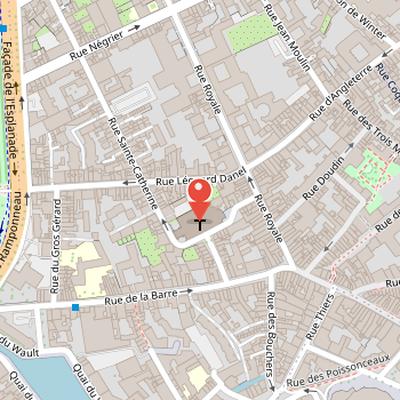
Église Sainte-Catherine de Lille stands on rue Sainte-Catherine in the Vieux-Lille neighborhood of Lille, in the Nord department of the Hauts-de-France region. Dedicated to Sainte Catherine of Alexandria, it is a three-nave hall church and has been classified as a Monument historique. The site is served by the Rihour metro station.
The church was built in flamboyant Gothic style from the end of the 15th century on the site of an earlier place of worship. Its parish had formed during the 14th century in the gardens of the canons of the collegiate Church of Saint-Pierre, in the ancient suburb of Weppes, and its existence is documented since 1273. The building developed in several stages: the nave was built between 1485 and 1487, the tower between 1500 and 1504, and the choir between 1539 and 1542. The side chapels were enlarged in the 18th century. The church underwent multiple renovations, was converted into a barn during the French Revolution, and returned to worship in 1797. Further refurnishing, plaster false ribbed vaults, and restoration campaigns followed in the 19th and 20th centuries.
Nearby Objects
-
 Temple maçonnique de Lille 200 m away
 -
 Place aux Oignons 350 m away
 -
 Place Gilleson 400 m away
 -
 Lille Cathedral 400 m away
 -
 Les Fusillés lillois 400 m away
Location and Status
The Church of Sainte-Catherine is located on rue Sainte-Catherine in the Vieux-Lille neighborhood of Lille, in the Nord department of the Hauts-de-France region. It is a three-nave hall church dedicated to Sainte Catherine of Alexandria. The building was classified as a Monument historique, reflecting its protected heritage status. The site is also served by the Rihour metro station, making it accessible within the city network.
History and Parish Origins
The church was built in the flamboyant Gothic style, with construction beginning at the end of the 15th century. It was erected on the site of an earlier place of worship. The parish itself formed during the 14th century on the gardens of the canons of the collegiate Church of Saint-Pierre, in the ancient suburb of Weppes, which was surrounded by an extension of the city wall. Its parish area followed the expansion that included the parishes of Saint-Maurice and Saint-Sauveur, and its existence has been documented since 1273.
Construction and later transformations
The historic fabric of the church reflects several building phases over several centuries. The oldest bell dates from 1403, while the nave was constructed between 1485 and 1487. The tower followed between 1500 and 1504, and the choir was built between 1539 and 1542. The side chapels were later enlarged on the north side in 1725 and on the south side between 1726 and 1727.
The church also underwent multiple renovations. During the French Revolution, it was converted into a barn and lost much of its woodwork and furniture, which had been confiscated and gathered at the former Recollets convent on Rue des Arts in Lille. It was returned to worship in 1797 and was refurnished throughout the 19th century. Between 1857 and 1862, it was decorated with plaster false ribbed vaults, and it was restored again in the 1960s.
The tower had uses beyond worship as well. From 1795 to 1846, it housed Claude Chappe's optical telegraph, and it served as a fire lookout post until 1891.
Architectural Form and Interior Changes
The Eglise Sainte-Catherine de Lille is a three-aisled hall church with four bays and a central nave preceded by a square tower. It has a single level, with all aisles of the same height and width. Between 1857 and 1862, false plaster rib vaults were installed on the ceilings. These were removed in the 1960s in order to restore the original wooden barrel vaults.
Stained Glass and Devotional Painting
The interior of the church includes a notable group of stained glass windows and paintings centered on the cult of Sainte Catherine and other Christian figures. The nave stained glass windows were made by Lille stained glass painter Henri Evaldre (1829-1900), while the axial bay window in the choir was created by Paris stained glass painter Felix Gaudin. This choir window represents the Triumph of Sainte Catherine and was executed following the instructions of architect Louis-Marie Cordonnier (1854-1940). A wooden sculpture of Sainte Catherine of German origin was added later.
The church also contains several painted works. These include four paintings of the Doctors of the Church, generally attributed to Gerard Seghers (1591-1651), and representations of Saint Matthew, Saint John the Evangelist, Saint Mark, and Saint Luke by Victor Mottez (1809-1897), placed in the choir and side chapels. Mottez is also represented by paintings including Christ in the Garden of Olives, the Denial of Saint Peter, and Christ at the Tomb. Above the wooden part of the Sacred Heart altarpiece is a painting titled The Last Supper, attributed to Flemish painter Pierre-Joseph Witdoeck.
The church also preserves a visible low-quality printed reproduction of Pierre Paul Rubens' Le martyre de sainte Catherine, a work originally presented in the church after being donated around 1615 by Jean de Seur and his wife. In 2010, the church received another painting of the martyrdom of Saint Catherine by Jean-Antoine-Raymond Balze as a donation.
Interior Woodwork and Furnishings
The interior of Eglise Sainte-Catherine contains a significant body of carved wooden furniture made by the Buisine workshops of Lille, a workshop tradition founded in the 17th century and passed from father to son. Several members of the Buisine family contributed to the church furnishings over time, including Desire Buisine, Charles Buisine-Rigot, and Edouard Buisine.
One of the earliest major pieces was the pulpit, designed around 1840 by architect Charles Benvignat and executed by sculptor Cesar Theodore Huidiez with carpenter Desire Buisine. The pulpit reused several 18th-century furniture elements. Charles Buisine-Rigot, who directed the workshop, later made the workbench facing the pulpit in 1850-1851. In 1855, he also provided statues of Saint Peter and Saint Paul placed in neo-Gothic niches.
The Buisine workshops continued to furnish the church throughout the second half of the 19th century. In 1857 they created the partitions separating the choir from the side chapels, followed by choir wood paneling around 1860 and nave wood paneling around 1870. Charles Buisine-Rigot also delivered an ensemble of 60 stalls with 72 saint figures designed by architect Charles Maillard-Desurmont. These stalls are arranged on two levels and include figures of Church doctors, religious order founders, French saints, and regional saints, while the coats of arms on the partitions are those of the Counts of Flanders.
After 1893, six confessionals along the nave were designed by Louis-Marie Cordonnier and made by the Buisine workshops under Edouard Buisine's direction. Four were delivered in 1895 and two more around 1900. The church also includes wooden altarpieces of side altars, the altar of Notre-Dame-de-Lourdes, and other fittings created by the same workshop tradition.