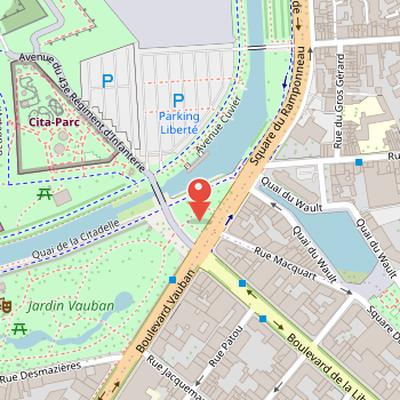
Les Fusillés lillois is a monument sculpted by Félix-Alexandre Desruelles and located in Lille, in Square Daubenton. It commemorates the execution by the Germans of five resistants during the First World War and is one of several Lille memorials related to the 1914–1918 war. The city of Lille was occupied for four years during World War I and was partially destroyed by combat and a munitions depot explosion. The monument’s figures, especially Eugène Jacquet and Léon Trulin, were discussed with relatives of the deceased. Initially conceived as part of a rejected Monument aux Morts project, the work was decided as a standalone monument in 1924 and commissioned in 1926. It was officially inaugurated in 1927. The monument was destroyed during the second German occupation of Lille in 1940 and later reconstructed identically by Germaine Oury-Desruelles, the sculptor’s widow, except for the mustaches. It was reinstalled in 1960 at the end of Boulevard de la Liberté in Square Daubenton.
Nearby Objects
-
 Palais Rameau 400 m away
 -
 Église Sainte-Catherine de Lille 400 m away
 -
 Chapelle Saint-Joseph 500 m away
 -
 Temple maçonnique de Lille 550 m away
 -
 Saint-Étienne Church 650 m away
Monument in Square Daubenton
Les Fusilles lillois is a sculpted monument located in Lille, in Square Daubenton. It commemorates the execution by the Germans of five resistants from the First World War. The monument serves as a public memorial tied to this specific wartime event, marking the memory of those who were killed.
History and relocation of Les Fusilles lillois
Les Fusilles lillois commemorates resistants and is one of several memorials in Lille connected to the 1914-1918 war. The monument was conceived in the context of a city that had been occupied for four years during World War I and was partly destroyed by combat and a munition depot explosion. It was originally part of a rejected Monument aux Morts project, but the decision to erect it as a separate monument was taken in 1924, and it was commissioned in 1926. The work is by the sculptor Felix-Alexandre Desruelles and was officially inaugurated in 1927.
The monument also reflects the citys effort to honor the five resistants individually: Eugene Jacquet received a street name in 1921, and the four others in 1924. Its character representations, especially those of Jacquet and Trulin, were discussed with the relatives of the deceased, showing the care taken in shaping their public image.
During the second German occupation of Lille in 1940, the monument was destroyed. It was then reconstructed identically by Germaine Oury-Desruelles, the sculptors widow, with the only difference being the mustaches. The monument was reinstalled in 1960 at the end of Boulevard de la Liberte in Square Daubenton.
Desruelles also created a statue of Leon Trulin, showing him standing against a wall with clenched fists and a resolute gaze. The statue carries the epitaph ...et je saurai mourir courageusement..., overlooks Trulins grave at the Cimetiere de lEst, and was inaugurated in 1928. It complements Les Fusilles lillois by presenting the resistant figure who had previously remained unseen.