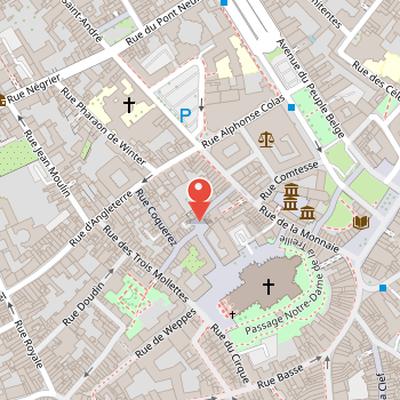
Place aux Oignons is a square in Lille, in the Nord department of France, located in one of the city’s oldest neighborhoods. It stands at the foot of the former motte castrale and is now situated at the parvis de Notre-Dame de la Treille. The name is described as a deformation of the Latin dominium, which changed into dominion and then to des oignons. The donjon belonged to the fortress of the counts of Flanders on the motte castrale, at the site of the current Notre-Dame de la Treille Cathedral, and no remains of the wooden construction survive.
Historically, the place was the center of a primitive castrum, possibly surrounded by a ditch and an embankment. Houses bordering the square date from the late 17th and early 18th centuries and reflect sober French architecture that replaced the earlier ornate Flemish style. They were originally occupied by artisan weavers called sayetteurs, whose looms were installed in attics or cellars. Later, with the decline of sayetterie and the rise of mechanized textile industry, factory workers and their families lived there.
Nearby Objects
-
 Musée de l'Hospice Comtesse 120 m away
 -
 Hospice Comtesse 120 m away
 -
 Lille Cathedral 120 m away
 -
 Place Gilleson 120 m away
 -
 Collégiale Saint-Pierre 120 m away
Location and Setting
Place aux Oignons is a public urban street in the commune of Lille, France. It is located in the department of Nord, in northern France. The available information identifies it primarily by its municipal and departmental setting, placing it within the urban fabric of Lille.
Location and Setting
Place aux Oignons is located in one of the oldest neighborhoods of Lille. It lies at the foot of the former motte castrale and is currently situated at the parvis de Notre-Dame de la Treille. This setting places the site within a historically layered part of the city, where its present location reflects both the older urban fabric and the current arrangement of the public space.
Origin of the Name
The name of Place aux Oignons is described as a deformation of the Latin word dominium. According to this explanation, dominium changed over time into dominion and then into des oignons. The reference is linked to the donjon that belonged to the fortress of the counts of Flanders on the motte castrale, located at the site of the current Notre-Dame de la Treille Cathedral. No remains survive of the wooden construction of the donjon.
Historical Origins of Place aux Oignons
Historical accounts describe Place aux Oignons as the center of a primitive castrum, possibly surrounded by a ditch and an embankment. No remains of this first enclosure survive, although the nearby Tour Ysembart, under rue des Trois-Mollettes, is dated to the middle of the 13th century. Historian Jean-Denis Clabaut has cited a road passing southwest of the Motte castrale near Place aux Oignons as the original north-south axis of the city. This axis is said to have extended from rue de Paris and rue Grande-Chausshee, before being diverted after 1055 by rue Saint-Pierre and rue de la Monnaie following the foundation of the Collegiale Saint-Pierre at place du Concert and the Palais de la Salle residence at Palais de Justice.
Historical Housing and Neighborhood Change
The houses bordering Place aux Oignons date from the late 17th century and early 18th century, and they reflect a sober French architecture that replaced an earlier ornated Flemish style. In the 18th century, the place stood at the heart of a very popular neighborhood. Alexandre Derousseaux called it l plachette and evoked it in several songs about youthful memories.
The houses were first occupied by artisan weavers known as sayetteurs, who installed looms in attics or cellars. The humidity of the cellars was favorable to processing raw material. During the 19th century, the decline of sayetterie and the rise of the mechanized textile industry changed the use of the houses, which then lodged factory workers and their families.
Several descriptions underline the character of the surrounding area. In 1945, Gerard d Orgeville described the surroundings of Place aux Oignons in rue au Peterinck as a neighborhood with narrow streets and a small square. Antoine Duquennoy later described Vieux Lille in the 1950s and 1960s as a lively small village with homogeneous workers and poor sanitary conditions, noting that courtyards had only one tap and one toilet for six or seven families. Between 1965 and 1970, the arrival of Maghrebi and Portuguese immigrants gave the area a casbah appearance.
Place aux Oignons was included in Lille s protected sector in June 1967, though opinions differed on the need for preservation. Interest in the place and in rue au Peterinck heritage began in 1974 with the discovery of tiles and gresseries. An unsanitary courtyard called cour a Fiens opened onto the place, and consolidation works were assigned in 1976 to prepare restoration. Between 1985 and 1990, the houses were partially or entirely rebuilt identically. Since the end of the 20th century, the place has been surrounded by restaurants in a pedestrian zone and has formed a highly touristic district.