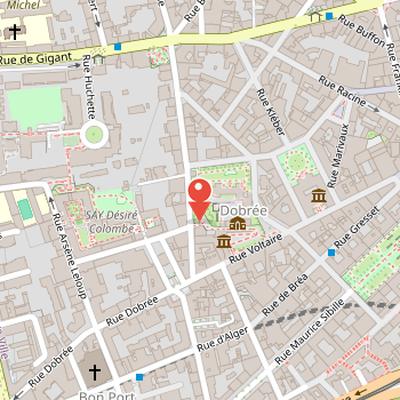
Musée Dobrée is a history museum located in the centre of Nantes, in the Graslin district, near the Muséum d'histoire naturelle and cours Cambronne. The site belongs to the Département de Loire-Atlantique, which inherited the collections and the entire site from Thomas Dobrée in 1894. It became a museum and opened to the public three years after his death.
The museum site developed around Thomas Dobrée’s neo-medieval building, constructed between 1862 and 1895 as both a residence and an exhibition space. Dobrée had begun collecting art objects in 1832, after training in Paris, and later assembled collections that were combined with those of the Société archéologique et historique de Nantes et Loire-Inférieure. The site also includes the former manoir épiscopal de la Touche and a third building, the bâtiment Voltaire, built in 1972 to house museum reserves.
Since 2013, the museum has been part of Grand Patrimoine de Loire-Atlantique, which gathers several collections and monuments in the department.
Nearby Objects
-
 Natural History Museum of Nantes 150 m away
 -
 Notre-Dame de Bon-Port 250 m away
 -
 Cours Cambronne 300 m away
 -
 Memorial to the Abolition of Slavery 350 m away
 -
 Place Graslin 350 m away
History and setting of Musee Dobree
Musee Dobree is located in the center of Nantes, in the Graslin district near the Musee d'histoire naturelle and cours Cambronne. It has belonged to the Departement de Loire-Atlantique since 1895 and is part of Grand Patrimoine de Loire-Atlantique, a collection created by the department in 2013 to bring together collections and monuments. Other sites in this group include the chateau de Chateaubriant, chateau de Clisson, chapelle du Vieux-Bourg de Saint-Sulpice-des-Landes, and domaine de la Garenne Lemot.
The site was shaped by Thomas Dobree (1810-1895), who built a neo-medieval structure between 1862 and 1895 to serve as both residence and exhibition space. He also purchased a parcel that contained the manoir episcopal de la Touche. In 1972, a third building, the batiment Voltaire, was added on the parcel to house museum reserves.
The museum was also the target of a theft during the night of 13 to 14 June, when Anne de Bretagne's heart case, a gilded Hindu statue, and fifty medieval gold coins with medals were stolen. The objects were recovered by police and returned to the museum a few days later.
Formation and Architectural Character of the Dobr ee Site
Thomas Dobr ee began collecting art objects in 1832, after completing artistic training in Paris, and in the 1830s he gave up an armateur career to devote himself to the arts. Between 1857 and 1862, he owned the entire block that included the manor of la Touche and the Saint Gabriel chapel in the western quarters of Nantes. The location was only a few minutes from his residence at place Graslin, and the historical interest of the medieval manor influenced his choice of site.
The manor was referred to by Thomas Dobr ee as a maison romane or manoir des Irlandais, but never as a palais. The press, however, described it as a palais and as folie Dobr ee, reflecting the extravagance of the project. He first commissioned Eugene Viollet le Duc for the plans, but rejected them as too close to the neo Gothic style. New plans were then drawn up by Simon, Boismen, Chenantais, and Le Diberder, who kept the interior layout from Viollet le Duc's design while giving the facades a neo Romanesque style. The building was completed in 1898, more than thirty years after the initial sketches.
The building was intended to house Dobr ee's collections and prevent their dispersion. He later bequeathed the site, its property, and its collections to the department of Loire Inferieure in 1894 so that they would remain preserved together. After his death, the site became a museum and opened to the public three years later. Its collections combined Dobr ee's holdings with those of the Societe archeologique et historique de Nantes et Loire Inferieure.
Architecture and Decorative Program
The Musee Dobree is arranged on a longitudinal east to west plan and built in solid granite, with schist used for the smaller masonry. It is organized on two levels, with the internal layout separating public spaces at the east from private spaces at the west. The entrance opens into a large hall dominated by a grand staircase, lit by large upper windows. Opposite this hall, at the west of the plot, a belvedere tower rises more than thirty meters above the ground. Its roof terrace provides views over the city and the Loire below.
The building, also known as the Manoir des Irlandais, is notable for its sculptural decoration. Bears, owls, and other animals form a bestiary that Thomas Dobree personally designed for the facades. The southern facade carries the family coat of arms, while the tower bears the collector's motto inscribed in Breton. The tower is also accompanied by a sculpted wyvern devouring a stone heart. The motto has been translated in several ways, including 'le doute me ronge le coeur', 'lincertitude me devore', and 'lincertitude me dechire'.
1970s Extension and Later Redesign Plans
Between 1972 and 1973, a third building was added to the Musee Dobre site on its plot, designed by Maurice Ferre and his son Paul. This extension, later known as the Voltaire building or batiment Ferre, was built in concrete and clad with pebble facing that echoed the color of Thomas Dobrees manor stones. Its new elements are described as exemplifying the brutalist architecture of the 1970s. The building housed conservation, documentation, a permanent regional archaeology exhibition, an auditorium, underground galleries, and some reserves.
A later museum restructuring and modernization project was adopted by the General Council and entrusted to architect Dominique Perrault. This project planned new underground exhibition spaces beneath the gardens, with reception areas, educational workshops, an auditorium, and temporary exhibition rooms. It also called for the full renovation and accessibility upgrades of the Palais Dobre and Manoir de la Touche. The 1974 Rue Voltaire extension was to be partly demolished, rebuilt, and clad in stone matching the historic buildings, while remaining devoted to conservation and research functions such as reserves, a museotheque, and a documentation center.
The plan also covered 10,000 square meters of gardens, to be reorganized with a medieval garden, an orchard, and a moorland area, even though this involved removing century-old classified linden trees. The project was not realized as initially planned after the building permit was canceled and later confirmed by the cour administrative d'appel de Nantes. The cancellation was based on issues including ground elevation, basement treatment in the UA.1 zone of the Nantes PLU, imprecision in setback-margin graphics, and an incorrect calculation of earth space percentage. A PLU modification was required to resolve the setback-margin definition. The Conseil general site still presents the Perrault project because the departmental assembly plans to appeal the judgment.
Collections and Provenance
The collections of Musee Dobrees have a double origin linked to the Musee departemental Thomas Dobre. They include the bequest made by Thomas Dobre to the Loire-Inferieure department and the holdings of the Societe archeologique et historique de Nantes et de Loire Inférieure. Over time, they were also expanded through donations and bequests from archaeologists and collectors, deposits from the State and local authorities, and purchases made by the museum. For nearly 150 years, the collections were enriched by contributions from archaeologists and collectors, including Fortune Parenteau, Paul Soullard, and Abbe Auguste Cullerre.
Thomas Dobre began assembling his collection during his artistic training in Paris from 1830 to 1832. His acquisitions included ancient books, manuscripts, and incunabula that he annotated in sales catalogs, as well as prints, engravings, coins, and art objects. He also acquired works at regional and Parisian auctions at Hotel Drouot. Among the notable objects he purchased were the Chasse de saint Calminius and the Aquamanile named Le Lai d'Aristote from the Soltykoff collection.
The holdings were further developed by the Societe archeologique et historique members, who began gathering Egyptian, Etruscan, and Greek objects in the 19th century. These collections were supplemented by donations from various donors and by deposits from national museums such as the Louvre. Today, the museum in Nantes holds nearly 600,000 works. Its Mediterranean archaeology collection contains nearly 50,000 pieces and is one of ten departments in the museum's conservation center. The national archaeology department includes more than 85,000 pieces and is described as one of the richest collections in western France in this field. The Egyptian holdings mainly come from the collection of Frederic Cailliaud, while the Greek and Etruscan collections mainly consist of ceramic productions.
The collections also include items that have attracted public attention in recent history. On the night of October 13 to 14, 2015, several objects were stolen, including the heart reliquary of Anne de Bretagne, a gilded Hindu statue, fifty medieval gold coins, and medals. The stolen items were recovered on November 12, 2015, near Saint-Nazaire by the police, and suspects were arrested. The heart reliquary was returned to Musee Dobre in 2016 and was publicly exhibited again in 2022.