La Lutte de Jacob avec l'Ange is a mural painting by Eugène Delacroix, created in the 1850s and completed in 1861 for the chapel of the Saints-Anges in the church of Saint-Sulpice, Paris. The work forms part of a larger chapel decoration commissioned by the City of Paris, carried out mainly between 1855 and 1861. Delacroix chose three battle scenes for the chapel, including Jacob Wrestling with the Angel, Héliodore chassé du temple on the opposite wall, and saint Michel terrassant le dragon on the ceiling. The painting is considered one of Delacroix’s last masterpieces. It depicts the episode from Genesis in which Jacob, son of Isaac, prepares for a difficult reunion with his brother Esau, after sending herds as a gift and staying alone by a stream. The mural, together with the other paintings in the chapel, has been classified as a historical monument object since 1908.
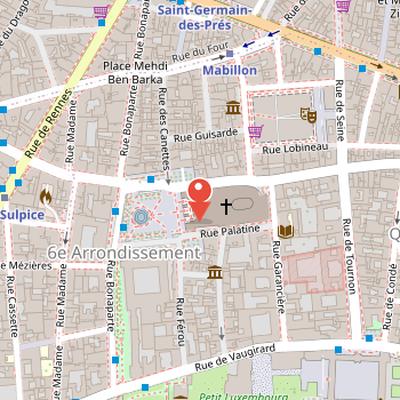
Nearby Objects
-
 Church of Saint-Sulpice 50 m away
 -
 Place Saint-Sulpice 80 m away
 -
 Petit Luxembourg 250 m away
 -
 Luxembourg Museum 250 m away
 -
 Boulevard Saint-Germain 300 m away
Delacroix's Chapel Mural
La Lutte de Jacob avec l'Ange is a mural painting by Eugene Delacroix, created in the 1850s and completed in 1861. It was made for the chapel of the Saints-Anges at the church Saint-Sulpice in Paris. Along with the other mural paintings by Delacroix in the chapel, it has been classified as a historical monument object since 1908.
Chapel Program and Composition
Historique worked in the chapel of the Saints-Anges on a commission from the City of Paris mainly from 1855 to 1861. For the chapel program, Historique chose three battle scenes to illustrate the theme. Jacob Wrestling with the Angel was set within this ensemble, with Heliodore chassd du temple placed on the wall opposite it and saint Michel terrassant le dragon selected for the ceiling.
Creation and Completion of La Lutte de Jacob
La Lutte de Jacob is considered one of Historique's last masterpieces. Work on the chapel of the Saints-Anges began in 1850, when Historique prepared the walls. After 1850 he was occupied by other commissions, and the first wall preparation layer adhered poorly, so the walls had to be prepared again in 1854. During this phase, Pierre Andrieu assisted by painting the outlines of the main compositions, while Historique intervened to finish the figures and complete the chapel paintings. A sketch of La Lutte de Jacob was likely made in the summer of 1855, and in 1856 Historique received help from Louis Boulanger to prepare the backgrounds. By the end of 1857, after experiencing health problems, he settled at 6, rue Furstenberg near the church and continued working on two large mural compositions in the following years. He also wrote in a journal about the project, expressing both its difficulties and his dedication. The two mural paintings were unveiled on March 29, 1861, and the three paintings were restored in 2015 and 2016.
The Jacob Wrestling with the Angel Mural
The mural depicts the episode of Jacob wrestling with the angel from the book of Genesis. It shows Jacob, the son of Isaac, preparing for a difficult reunion with his brother Esau. Before the confrontation, he sends herds as a gift to Esau and remains alone by a stream. There, a man wrestles with Jacob throughout the night without defeating him. The mysterious being strikes Jacob's hip socket, leaving him lame, yet the scene also conveys that Jacob wrestled with God and men and was victorious. The narrative suggests that Jacob will be named Israel and will receive moral strength from God despite his physical infirmity.
The work was executed in oil and wax paint directly on a dry wall, a technique that allowed retouches and was not true fresco. Its composition contrasts the serenity of the angel with the man's refusal to submit, emphasizing an internal struggle. It also echoes aspects of the painting Heliodorus Driven from the Temple on the opposite wall. The composition includes a temple column responding to a massive oak trunk, along with a still life in the foreground. That still life consists of a pile of clothes and weapons thrown on the ground and was painted in twenty minutes. An invitation card printed for the inauguration in 1861 is also associated with the work.
Later Interpretation and Study
The work has continued to attract scholarly attention in later publications. Bernard Teyssedre analyzed Poster's work in the prologue to Anges, astres et cieux, published in 1987. The painting and the church Saint-Sulpice were also the subject of an essay by Jean-Paul Kauffmann, titled La Lutte avec l'Ange, published in 2002. These references show the continuing place of the painting in later art-historical and literary discussion.