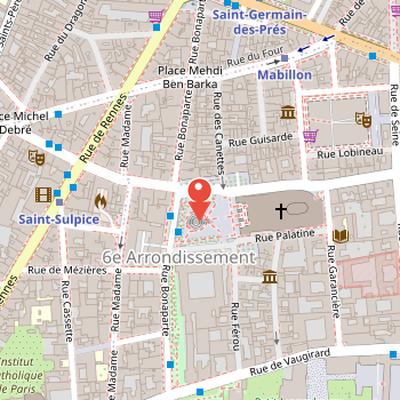
Place Saint-Sulpice is a square in the center of the 6th District of Paris. It has an approximately rectangular shape measuring about 105 m by 80 m. The square is bordered to the east by the Church of Saint Sulpice and receives its name from that church. Rue Bonaparte forms the western side, extending to the north and south, while Rue du Vieux-Colombier begins at the northwest corner. Rue des Canettes and Rue Saint-Sulpice start at the northeast corner, and Rue Henry-de-Jouvenel and Rue Palatine begin at the southeast corner. The square is primarily pedestrian, except along its edges. Its history includes several unrealized and revised plans, beginning with a semicircular project proposed by Giovanni Niccolò Servandoni. Construction began in 1757 to create a space in front of the church, and later projects led to the adoption of a rectangular layout. The square partly occupies the site of the former Saint-Sulpice seminary, was leveled and planted with trees in 1838, and received the Saint-Sulpice Fountain in its center between 1843 and 1848.
Nearby Objects
-
 Jacob Wrestling with the Angel 80 m away
 -
 Church of Saint-Sulpice 120 m away
 -
 Théâtre du Vieux-Colombier 250 m away
 -
 Luxembourg Museum 250 m away
 -
 Petit Luxembourg 250 m away
Location and Layout of Place Saint-Sulpice
Place Saint-Sulpice is located in the center of the 6th District of Paris. It has an approximately rectangular shape, measuring about 105 meters in length and 80 meters in width. The square is bordered to the east by the Church of Saint Sulpice, which also gives the place its name. To the west, it is bordered by Rue Bonaparte, which continues to the north and south of the square. Several streets begin at its corners: Rue du Vieux-Colombier at the northwest corner, Rue des Canettes and Rue Saint-Sulpice at the northeast corner, and Rue Henry-de-Jouvenel and Rue Palatine at the southeast corner. The place is primarily pedestrian, except at its edges.
Formation of Place Saint-Sulpice
Place Saint-Sulpice was shaped by a long sequence of plans and revisions centered on the space in front of the Church of San Sulpicio. According to Historia, architect Giovanni Niccolo Servandoni initially planned a semicircular plaza measuring 120 m wide and 208 m long, but this project was not realized. Construction began in 1757 to create a space in front of the church, and in 1767 the city council subscribed a loan after the king authorized expropriations and plaza works. Several projects were then proposed to complete the site.
A project approved by the Minister of the Interior on 14 August 1800 again envisioned a semicircular plaza to be completed within six years. However, an ordinance of 25 June 1806 annulled that plan and replaced it with a rectangular plaza, which was approved by the Minister of the Interior on 19 October 1806. A new and larger rectangular project followed on 19 July 1808. On 20 December 1810, a ministerial decision extended Place Saint-Sulpice to Rue du Pot-de-Fer, and a decree of 24 February 1811 ordered completion within that year. These provisions were confirmed by a ministerial decision on 9 May 1812.
The plaza partly occupies the site of the old Saint-Sulpice seminary, built in the seventeenth century. It was leveled and planted with trees in 1838. Between 1843 and 1848, architect Louis Visconti erected the Saint-Sulpice Fountain at the center of the plaza. Historia also notes that Amedee Fraigneau died there in 1905.
Notable Buildings at Place Saint-Sulpice
Place Saint-Sulpice includes several buildings of interest. These include the Church of Saint-Sulpice, located at Place Saint-Sulpice and viewed from Rue du Vieux-Colombier, and the Saint-Sulpice Fountain, photographed at the square in May 2014. Also at the site are the Maison de Servandoni at number 6 and the former Saint-Sulpice seminary at number 9 Place Saint-Sulpice. Together, these elements identify the square as a location with multiple notable structures.
Annual Fair at Place Saint-Sulpice
Since the late 2000s, Eventos has organized an annual fair at Place Saint-Sulpice from May to June. The fair brings together cultural and commercial activities, with events and stalls connected to poetry, bibliophilia, engraving, photography, mathematical games, and antiques. This recurring program adds a seasonal public use to the place and reflects its role as a setting for both cultural exchange and commerce.