Boulevard Saint-Germain is a boulevard on the Left Bank of Paris, named for its location near the church of Saint-Germain-des-Prés. It begins at the Seine, at the corner of quai Saint-Bernard facing Île Saint-Louis, then runs along the river for a few hundred meters at the foot of the montagne Sainte-Geneviève before crossing an unspecified location and reconnecting with the Seine at quai d’Orsay. It is part of the main route of the Quartier latin, together with boulevard Saint-Michel and faubourg Saint-Germain.
The boulevard was a project personally designed by Baron Haussmann during the transformation of Paris under the Second Empire. Its completion helped balance the boulevards on the left bank with those on the right bank and improved east-west connections in central left-bank districts. The central section between rues Hautefeuille and des Ciseaux opened in 1877. Its creation required the demolition of many old hôtels in the faubourg Saint-Germain and absorbed several streets, including rue de l’École-de-Médecine, rue de Seine, rue de Buci, rue Taranne, and rue Saint-Dominique. Some houses from the vanished streets were preserved and remain aligned with the boulevard.
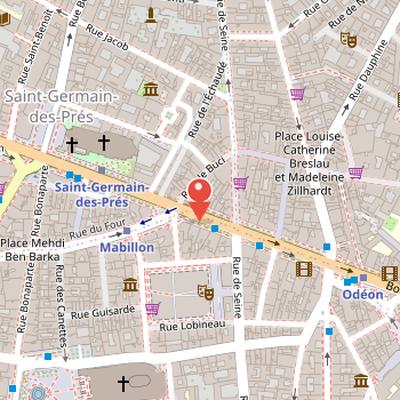
Nearby Objects
-
 Saint-Germain-des-Prés 150 m away
 -
 Musée national Eugène-Delacroix 200 m away
 -
 Church of Saint-Sulpice 250 m away
 -
 Jacob Wrestling with the Angel 300 m away
 -
 Hôtel de Condé 300 m away
Boulevard Saint-Germain
The section is named after boulevard Saint-Germain in Paris. It refers to the boulevard on the left bank of Paris and is connected to its proximity to the church Saint-Germain-des-Pres. These references place the section within a specific Parisian setting and link its name to a well known location in the city.
Route and Urban Setting
Boulevard Saint-Germain begins at the Seine at the corner of quai Saint-Bernard, opposite ile Saint-Louis. It runs for a few hundred meters along the river at the foot of montagne Sainte-Genevieve before crossing the unspecified location and reconnecting with the Seine at quai d'Orsay. The boulevard is located in the unspecified arrondissement. It is one of the main routes of the Quartier latin, together with boulevard Saint-Michel and faubourg Saint-Germain.
Historical Formation of Boulevard Saint-Germain
Boulevard Saint-Germain was a project personally designed by Baron Haussmann during the transformation of Paris under the Second Empire. It completed the left bank boulevards by balancing those on the right bank and improved east-west connectivity in the central left bank districts. The boulevard was finished under the Republic, with the opening of its central section between the rues Hautefeuille and des Ciseaux in 1877.
Its creation required major changes to the existing urban fabric in the faubourg Saint-Germain, including the demolition of many old hotels. The boulevard also absorbed several streets, among them rue de l'Ecole-de-Medecine, rue de Seine, rue de Buci, rue Taranne, and rue Saint-Dominique. At the same time, it preserved several houses from these disappeared streets that were aligned with the new boulevard. These preserved houses can be found on the odd side of rue de l'Ecole-de-Medecine near place Henri-Mondor, on the even side between rue de Seine and rue de Buci, along the entire odd side of rue Taranne, and along the entire even side of rue Saint-Dominique.
Historical Events and Changing Uses
Boulevard Saint-Germain has been associated with several historical events and later changes in commercial use. During a visit to France, Tsar Nicolas II and his wife Alexandra used the boulevard before arriving at the Russian embassy. In World War I, it was attacked by German airplanes on 11 March 1918, then struck by a shell fired by the Grosse Bertha at carrefour Saint-Germain-Buci on 30 March 1918. It was also hit by another shell later in 1918. The boulevard witnessed the stopping of 1,500 to 2,000 Latin Quarter student protesters by policemen at the intersection of boulevards Saint-Michel and Saint-Germain, and the national assembly later unanimously condemned police violence with a resolution after this interruption. The boulevard was also a location for part of the May 1968 events. In everyday use, it housed publishing companies and bookstores, including medical publishers near the faculty of medicine, but these were gradually replaced by fashion stores and restaurants.
Notable Places and Memorial Sites on Boulevard Saint-Germain
Boulevard Saint-Germain is associated with a number of notable buildings, inscriptions, memorials, and well-known establishments in Paris. Among the sites listed in Bâtiments remarquables et lieux de memoire are the building at 7 bis boulevard Saint-Germain and an entrance at 21 boulevard Saint-Germain. The list also includes the Ecole speciale des travaux publics, du batiment et de l'industrie, the Librairie internationale at 71 boulevard Saint-Germain in the 5th arrondissement, and the Cercle de la librairie.
The boulevard also appears in relation to historical memory through La prison de l'Abbaye, shown in an 1831 engraving, and a plaque at 133 boulevard Saint-Germain in the 6th arrondissement, placed for the bicentennial of the Revolution. An inscription is noted at 136 boulevard Saint-Germain. Another historical association is the former headquarters of the Ligue nationale contre l'alcoolisme, which was located there from 1905 to 1950.
Cultural references on the boulevard include the Monument a Diderot by Jean Gautherin, as well as Les Deux Magots, La brasserie Lipp at 151 boulevard Saint-Germain in the 6th arrondissement, and Le Cafe de Flore. Together, these references show the boulevard as a street marked by educational institutions, publishing-related sites, commemorative elements, and famous cafes and brasseries.
Institutional Headquarters on Boulevard Saint-Germain
The building listed among the remarkable buildings and memory sites on boulevard Saint-Germain served as the headquarters of the Office international d'hygiene publique from 1908 until the early Second World War. It later became the headquarters of the Federation nationale des republicains independants starting in 1966. These successive uses show the building's role as an administrative and political address on the boulevard.
Commemorative Plaques and Notable Addresses
The boulevard Saint-Germain is associated with a dense sequence of commemorative plaques and listed buildings at specific addresses. In Batisments remarquables et lieux de memoire, the boulevard includes a plaque in memory of Jose Baron Carreno at the corner of rue de Villersexel, as well as a Liberation of Paris plaque at the same corner. The inventory also records a plaque at 268 boulevard Saint-Germain, where the former Hotel de Wignacourt stands; this building is now the Wallonia-Brussels delegation. Another item at this address is noted at the intersection with rue de l'Universite in Paris 7e.
Several plaques mark individual addresses along the boulevard, including 104, 120, 126, 153, 156, 167, 177, 201, 202, 215, 218, 243, and 288 boulevard Saint-Germain. Some of these entries identify the person or institution commemorated: 120 boulevard Saint-Germain is listed in Paris 6e; 156 boulevard Saint-Germain in Paris 6e is in honor of Anna Karina and Dennis Berry; 201 boulevard Saint-Germain in Paris 7e is in homage to Marcel Martin; 215 boulevard Saint-Germain in Paris 7e is for Alliance francaise; and 288 boulevard Saint-Germain in Paris 7 is in honor of Louis Bleriot. The boulevard is also noted for a plaque at the intersection with boulevard Saint-Michel in homage to Robert Bottine, and for a plaque in honor of Mehdi Ben Barka.
The inventory further includes 288 boulevard Saint-Germain in 1918, indicating a historical reference at that address. Taken together, these entries show boulevard Saint-Germain as a street marked by a series of memorial plaques and recorded sites of remembrance across Paris 6e and Paris 7e.
Rue des Lavandières-Saint-Jacques
Rue des Lavandieres-Saint-Jacques was an old street known already in 1238. Its name referred to the laundresses who inhabited part of it, attracted by the proximity of the Seine. Different authors recorded slightly different forms of the name: Gustave Pessard used Rue des Lavandieres-Saint-Jacques, Jacques Hillairet wrote Rue des Lavandieres-Maubert, and Jean de La Tynna gave Rue des Lavandieres-place-Maubert. The street began at rue Galande and place Maubert and ended at rue des Noyers. It had black numbering, with the last odd number 18 and the last even number 11. The street disappeared because of the opening of boulevard Saint-Germain.