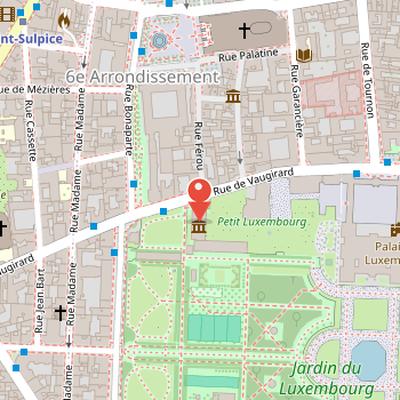
The Luxembourg Museum is an art museum in Paris, set in a wing built perpendicularly to the orangery of the Palais du Luxembourg on rue de Vaugirard. Since 2000, it has been under the supervision of the French Senate, which meets in the rest of the Palais du Luxembourg and may delegate exhibition management to a private company. The museum’s current purpose is to periodically present thematic and original artistic exhibitions. Its programming focuses on three themes: the Renaissance in Europe, Art and Power, and the Palais, the Garden and the Museum: Luxembourg in the heart of Paris, capital of the arts.
The museum’s history dates to the mid-18th century. The musée du Luxembourg was the first major public fine arts museum in France in 1750, after the Besançon museum opened in 1694. It also prefigured the creation of the musée du Louvre in 1793 and is identified as the first contemporary art museum created in Europe in 1818. Over time, its changing assignments exposed collections of different natures and epochs. The museum was succeeded by the musée national d'art moderne in 1947.
Nearby Objects
-
 Petit Luxembourg 110 m away
 -
 Jacob Wrestling with the Angel 250 m away
 -
 Place Saint-Sulpice 250 m away
 -
 Luxembourg Palace 250 m away
 -
 Church of Saint-Sulpice 250 m away
Location and Use of the Luxembourg Museum
The Luxembourg Museum is located in a wing built perpendicularly to the orangery of the Palais du Luxembourg on rue de Vaugirard in Paris. Since 2000, it has been under the supervision of the French Senate, while the Senate meets in the rest of the Palais du Luxembourg. The Senate sometimes delegates the management of exhibitions at the museum to a private company. Its current purpose is to periodically present thematic and original artistic exhibitions. The programming is organized around three main themes: the Renaissance in Europe, Art and Power, and the Palais, the Garden and the Museum: Luxembourg in the heart of Paris, capital of the arts.
Early Public Art Museum at Luxembourg
The history of the Luxembourg Museum dates to the mid-18th century. In 1750, it was the first major public fine arts museum in France, after the museum in Besancon opened in 1694. It also prefigured the creation of the Louvre in 1793. According to the provided facts, it was the first contemporary art museum created in Europe in 1818, and the Musee national d'art moderne succeeded it in 1947.
The museum went through different assignments that exposed collections of varied natures and periods. Its history also includes the galerie royale de peinture du palais du Luxembourg, which opened on the site of Marie de Medicis' gallery on the east wing of the Palais du Luxembourg. This gallery attracted foreign visitors because of the richness and diversity of its collection. The gallery also represented a royal privilege for the Luxembourg district, which was described as the first Parisian district with a public painting gallery almost fifty years before the Louvre was created.
The Luxembourg Museum and the Public Display of Art
The history of the Luxembourg Museum reflects an early effort to make formerly private royal art available to the public. Histoire describes the galerie royale de peinture as an essential step in the socializing of private buildings in the 18th century. Étienne La Font de Saint-Yenne proposed that the royal collections be shown publicly at Versailles, and Le Normant de Tournehem, director of the King's Buildings, did expose the royal collections to the public. An abb de Gougenot reported that visits were held on Wednesdays and Saturdays for three hours.
In 1802, the Senate financed the purchase of Jacob Jordaens' Zodiac paintings for the east gallery ceiling of the palais du Luxembourg. The museum changed again in 1818, when King Louis XVIII decided to establish a museum of living French artists in the chamber of the Pairs. The museum opened in the Luxembourg palace galleries with 74 paintings by living artists and 17 by ancient artists, but the 17 older works had been removed by 1821. Its initial collections came almost exclusively from Salon purchases and reflected official taste, with an emphasis on history painting, portraits, and classical landscapes.
The museum was expanded by annexing three rooms in the west wing of the palace near the Rubens gallery on rue de Vaugirard. These rooms housed Joseph Vernet's Views of the Ports of France and additional paintings by Rubens and Lesueur until around 1820. A new museum was inaugurated on June 15, 1848, after 33 years of closure, and Rubens' paintings were restored to their original locations. The collection was then enriched by works by Nicolas Poussin, Simon Vouet, Jacques-Louis David, and the series La Vie de saint Bruno by Eustache Lesueur.
The museum also played a role in shaping the reputation of modern French art in the 19th century. Successive curators of the museum of living artists included Frédéric Villot, Charles-Philippe de Chennevi res, and Etienne Arago. In parallel, sculptures such as The Greek Actor and The Dancing Faun were placed in the Luxembourg garden. Later, a large part of the Luxembourg museum paintings was transferred to the Louvre after the restitution of works seized during the Napoleonic wars, and the Louvre used these transfers to fill gaps. In 1849, Horsin-Deon questioned the usefulness of moving artworks to the Louvre, a concern that applied to both paintings and sculptures. Pierre-Francois-Leonard Fontaine's journal noted that the losses were not as significant as had been believed.
From National Display to Changing Modern Collections
Until the 1880s, the Musee du Luxembourg was closed to contemporary research, and artists such as Courbet and Millet were not exhibited there during their lifetimes. The republican changes of 1879, together with artists' efforts, made it possible for Barbizon and Impressionist painters to enter French national collections. This shift in selection also affected the museum itself, whose holdings became more open to evolving forms of modern art. Millet was shown in 1887 and again in 1890 with Des glaneuses, while Manet was exhibited in 1890 with Olympia following a public subscription. Courbet's realism had already entered the Louvre in 1881 through the donation of Un enterrement a Ornans by his sister.
The museum's display spaces were also reshaped in this period. Etienne Arago worked to construct a new building for better presentation of paintings, and Sadi Carnot proposed its current location. After the Senate resumed possession of the Palais du Luxembourg in 1879, following sessions at Versailles from 1876, it even considered removing the Musee du Luxembourg to expand chamber space. Instead, a new wing was built perpendicular to the Luxembourg orangery constructed by Alphonse de Gisors in 1839. This wing was provisionally assigned to the Musee du Luxembourg for sculpture display, inaugurated to relieve cramped museum space, and directly opens onto Rue de Vaugirard, where it remains solely assigned to the museum.
The museum also played a role in the organization of foreign-school collections. It opened to foreign schools in 1861, and this section later became a separate museum at the Musee du Jeu de Paume in 1922, renamed the Musee des Ecoles etrangeres in 1932. Later acquisitions and gifts further expanded the modern collection. The State began acquiring modern artworks in 1887, including The Poor Fisherman by Puvis de Chavannes, An Atelier at Batignolles by Fantin-Latour, Young Girls at the Piano by Renoir in 1892, and The Artist's Family by Carriere in 1896. After Caillebotte left his collection to the State in 1894, only forty works out of sixty-five proposed were retained by national museums in 1896, but the legacy still allowed Impressionists to enter the Luxembourg Museum despite opposition. From 1896 onward, donations from heirs and collectors enriched the Impressionist collections. Etienne Moreau-Nelaton made multiple donations and legacies between 1883 and 1927, which included Manet's Luncheon on the Grass. Additional gifts included Alfred Chauchard's 1909 donation with Millet's The Angelus and Isaac de Camondo's 1911 donation of four Rouen Cathedral paintings by Monet.
In the 20th century, proposals and transfers continued to reshape the museum. A 1906 proposal intended to move the museum to the former Saint-Sulpice Seminary, but that building was requisitioned after the 1910 flood and during World War I. In 1928, Andre Francois-Poncet decided to transfer one hundred paintings from the Musee du Luxembourg to the Louvre and to renovate the museum, and he inaugurated the renovated halls. The Musee du Luxembourg was then replaced by the Palais des musees d'art moderne in 1937, located in the Palais de Tokyo built for the 1937 International Exhibition and opened partially in 1942 and fully in 1947. The museum later hosted the Salon de la Jeune Peinture from 1976 to 1978 and reopened in 1979 with a focus on art from French regions.
Museum Management and Exhibition Policy
In 2000, the Senate took over Histoire's museum management and set out to present more ambitious artistic exhibitions, with particular emphasis on ancient art. It also stated that modern art exhibitions should be curated by internationally renowned museum curators or art historians. The Senate immediately entrusted SVO Art with the management, production, and organization of exhibitions and programming. Under this arrangement, SVO Art held sole financial and legal responsibility for the museum and for the risks linked to exhibition production, and it was also responsible for communication relating to Histoire's museum exhibitions. Sylvestre Verger's individual company, SVO Art, produced eight exhibitions until 2005 under a public law contract with the Senate.
Exhibitions and Museum Programming
From 2006 to 2010, Histoire produced and organized nine exhibitions with SVO-Musee du Luxembourg SAS, shaping the museum's temporary exhibition program through a series of curated shows. Among the exhibitions organized by Histoire were La Collection Phillips in Paris, curated by Jean-Louis Prat; L'Envolee lyrique. Paris 1945-1956, curated by Patrick-Gilles Persian; Titien - Le Pouvoir en Face, curated by Nicola Spinosa; Rene Lalique - bijoux d'exception, 1890-1912, curated by Yvonne Brunhammer and Dany Sautot; Arcimboldo (1526-1593), curated by Silvia Ferino; Vlaminck - Un Instinct fauve, curated by Maithe Valles-Bled; De Miro a Warhol - La Collection Berardo a Paris, curated by Andre Cariou; Filippo and Filippino Lippi - La Renaissance a Prato, curated by Maria Pia Mannini and Cristina Gnoni Mavarelli; and Tiffany - Couleur and Lumiere, curated by Rosalind M. Pepall. Earlier exhibitions at the museum included De Fra Angelico a Bonnard - Les Chefs d'oeuvre de la Collection Rau, curated by Marc Restellini; Raphael - Grace et Beaute, curated by Claudio Strinati; Modigliani - un Ange au Visage grave, also curated by Marc Restellini; L'Aventure de Pont-Aven et Gauguin, curated by Andre Cariou; Botticelli - De Lorenzo le Magnifique a Savonarole, curated by Daniel Arasse and Pierlugi De Vecchi; MOI ! Autoportraits du siecle, curated by Pascal Bonafoux; Veronese profane, curated by Giandomenico Romanelli, Claudio Strinati, and Annalisa Scarpa; and Matisse - Une seconde Vie, curated by Hanne Finsen. In 2010, museum management was delegated by the Senate to Reunion des musees nationaux. After 2010, Histoire focused the exhibition program on themes including Renaissance in Europe, Art and power, and Palais, Jardin et Musee. Histoire architects also redesigned the museum ticket office, cloakroom, and bookstore furniture using cardboard tubes, adding a specific design feature to the visitor areas.