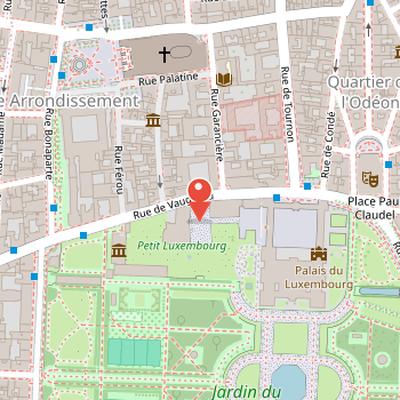
Petit Luxembourg is a private mansion in the 6th arrondissement of Paris, located west of the Palais du Luxembourg on Rue de Vaugirard. Bordering the larger palace, it was named Petit Luxembourg to distinguish it from its neighbor. The property was acquired by François de Luxembourg, Duc de Piney and Pair de France, in 1570, and later bought with surrounding properties by Regent Maria de’ Medici in 1612. She had a new palace built on the site before handing the residence to Cardinal Richelieu in 1627.
The mansion passed through several prominent owners, including the Condé family. From 1709 to 1716, Anna Henriette von Pfalz-Simmern expanded and redecorated it with architect Germain Boffrand, who added a west wing, the Boffrand staircase, and the Boffrand salons. In 1729, Louis de Bourbon-Condé founded the Académie du Petit Luxembourg there. The building later became associated with the Directory in 1795 and has served as the residence of the President of the French Senate since 1825.
Nearby Objects
-
 Luxembourg Museum 110 m away
 -
 Luxembourg Palace 160 m away
 -
 Jacob Wrestling with the Angel 250 m away
 -
 Church of Saint-Sulpice 250 m away
 -
 Odéon–Théâtre de l'Europe 250 m away
Location and Institutional Role
The Petit Luxembourg is located in the 6th arrondissement of Paris, on Rue de Vaugirard, where it stands west of the Palais du Luxembourg. It borders the Palais du Luxembourg, placing it directly within the same historic urban setting. Since 1825, it has served as the residence of the President of the French Senate, giving the building a continuing institutional role in French political life.
History and Architectural Development
Petit Luxembourg began as the former Hotel acquired by Francois de Luxembourg, Duc de Piney and Pair de France, in 1570. In 1612, Maria de' Medici bought the property and the surrounding lands, then had a new Palais built there. The former Hotel was renamed Petit Luxembourg to distinguish it from the neighboring large Palais. In 1627, Maria de Medici handed the property over to Cardinal Richelieu, who later used a back entrance between Petit Luxembourg and Grand Luxembourg to reach King Ludwig XIII on 10 November 1630. Richelieu bequeathed Petit Luxembourg to his niece Marie-Madeleine de Vignerot, Duchesse d'Aiguillon, in 1639. The property later passed to Louis II de Bourbon-Conde in 1674 and then to Henri Jules de Bourbon-Conde. A major transformation took place between 1709 and 1716, when Anna Henriette von Pfalz-Simmern expanded and redecorated the building with architect Germain Boffrand. Boffrand doubled the area by adding a new western wing, which included a columned vestibule leading to a monumental staircase known as the Boffrand staircase, decorated with mirrors at the time of its construction. The upper floor contained an ornate parade apartment made up of a series of salons called the Boffrand salons. In 1729, Louis de Bourbon-Conde founded the Academie du Petit Luxembourg at the site.
Political Residence and Revolutionary Events
Petit Luxembourg was associated with several important political figures and moments during the French Revolution and the early Consulate. The Comte de Provence lived there before fleeing into exile. In 1795, the building was assigned to the Directory, and four of the five Directors lived there, including Emmanuel Joseph Sieyes and Lazare Carnot. Sieyes prepared the coup of 18 Brumaire VIII at Petit Luxembourg. Sadi Carnot was born there in 1796. Two days after the coup, Napoleon Bonaparte and Josephine de Beauharnais settled at the building. Petit Luxembourg also served as the place where the Constitution of 22 frimaire an VIII was written, and where the three consuls were constituted as government on December 25, 1799.
Residence and Senate Functions
Since 1800, Petit Luxembourg has had a close institutional link with the French Senate. The conservative Senate held its sessions there from 1800 to 1804 before moving to Grand Luxembourg. In 1825, the building was acquired for use as the residence of the President of the Chambre des Pairs, and since then it has served as the residence of the President of the Haute Assemblee outside revolutionary and war times.
The right wing, known as the Hotel de la Presidence, is the official residence and office location of the Senate President. The left wing, called the Salons de Boffrand, contains dining rooms and salons used for receptions and colloquia by the Senate President and other senators. Private apartments are located on the upper floor. Petit Luxembourg also hosts foreign personalities invited by the Senate President.
Among its notable interior spaces is a consecrated chapel, the Kapelle Maria de' Medicis, which is richly decorated. It was used for mass attended by the Senate President and family, and it was classified as a Monument historique by decree on March 24, 1848. The building was also remodeled to improve comfort, including measures such as hot water, kitchen expansions, a ground floor bathroom, a bar counter, an electric food elevator, a bread oven, and a private terrace in the garden level. The civil protection shelter built in 1937 in the Presidence gardens was modernized.
During its later history, the building was occupied in 1940 by the General Staff of the Air Force West, housing generals Erhard Milch and Hugo Sperrle. Since 2006, its doors have been opened for television cameras for the first time in the Fifth Republic, and it has been accessible during Heritage Days.