The Departmental Archives of Seine-Maritime trace their origin to the law of 5 Brumaire an V, dated 26 October 1796, which established the principle of gathering archives in the capital city of each department and is regarded as the founding act of departmental archives in France. In Seine-Inférieure, the creation of a single repository took nearly a century. Public archives were still scattered across different sites in Rouen in 1825, before the acquisition of a building near the Préfecture made reunification possible.
From 1851 to 1905, Charles de Beaurepaire served as head of archives and played a major role in developing and enlarging the repository. The building was expanded in 1856 and 1896 under his impetus, while he also processed large quantities of records and published finding aids for secular clergy archives in seven volumes between 1868 and 1900. He also oversaw judicial archives and the transfer of records to the departmental repository. By 1903, the repository held 1,500 notarial volumes or registers dated before 1686. Later projects for a larger site were delayed by World War II, but archives were preserved during the bombings of Rouen. In the 1950s, a new administrative center with an archive skyscraper was launched, and the Archives tower was dedicated in 1965.
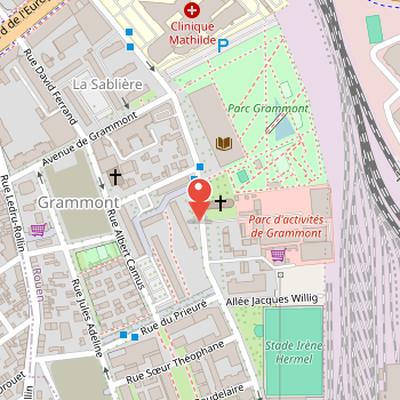
Nearby Objects
-
 Église Saint-Paul 1200 m away
 -
 Halle aux Toiles 1400 m away
 -
 Jardin des Plantes de Rouen 1500 m away
 -
 Place Saint-Marc 1500 m away
 -
 Church of Saint-Maclou 1600 m away
Formation of the Departmental Archives
The Departmental Archives of Seine-Maritime trace their origin to the law of 5 Brumaire an V, which on 26 October 1796 required archives to be gathered in the capital city of each department. This law is regarded as the foundation act of departmental archives in France. In Seine-Inférieure, however, creating a single repository took nearly a century. As late as 1825, public archives in Rouen were still scattered across different sites. Reunification became possible only after the acquisition of a building near the Prefecture.
A major phase in the history of the repository was shaped by Charles de Beaurepaire, who served as head of archives from 1851 to 1905 and spent his professional life as an archivist in the department until 1905. Under his impulse, the building was enlarged in 1856 and again in 1896. He also developed the repository and processed a large quantity of archives. Among his most significant work were the finding aids for the archives of the secular clergy, published in seven volumes between 1868 and 1900. These covered the Rouen archbishop's archives, the Rouen chapter house's archives, and the parish records of Rouen and Seine-Inférieure.
Beaurepaire also managed judicial archives. By 1895, he had cleared the Palais de Justice in Rouen of records dated before 1790, and records from the Parlement, Chambre des comptes, Cour des aides, and other jurisdictions were transferred to the departmental repository. In 1903, 1500 notarial volumes or registers dated before 1686 were also moved there.
Archives Storage and Expansion
The Departmental archives of Seine-Maritime first operated in a repository that had a capacity of 9.5 linear kilometers and was described as the most beautiful repository in France. Plans for a larger site were delayed by the outbreak of World War II. During the war, the archives were removed from the repository, and valuable collections were transferred to rural castles in Eure. They were preserved despite the bombings of Rouen.
In the 1950s, an administrative center including a skyscraper for archives was launched and completed. The Archives tower was dedicated in 1965. It had a capacity of 36 linear kilometers and rose 27 stories. In the 1970s, additional storage became necessary because archives from administrative bodies and private sources continued to increase.
To meet this need, the Department bought part of the former Fromage textile factory in Darnetal in 1981. Between 1984 and 1996, the old factory was converted into an archives repository with a capacity of 27 linear kilometers. This Darnetal site includes its own reading room and functions as a branch of the main repository, which remains in Rouen at quai Jean Moulin.
Functions and Administrative Status
The Departmental archives of Seine-Maritime had a legal obligation for State financial support from 1838. It remained a State service until the decentralisation laws enacted on 22 July 1983, and from 1 January 1986 it was placed under the authority of the conseils generaux. The service is responsible for preserving the final records produced by State services in the department, as well as the records of departmental services. It also preserves notarial records older than 100 years and the records of small towns with fewer than 2000 inhabitants. On behalf of the State, it keeps scientific and legal control over public archives in the department.
Organization and Services
The staff and organization of the Departmental archives of Seine-Maritime are divided into four main activities. External intervention manages relations with the State and departmental services, as well as with local communities in Seine-Maritime. It also handles current records management, archives collecting, processing, control of records disposal, and the preservation of historical archives. Public Service provides reference and research assistance to users both in-house and at a distance, while also managing relations with private collectors, potential donors, and archives of private origin. This service also oversees the library sector. Cultural and Educational Services organize workshops and exhibitions for schools and young audiences, with staff working alongside two teachers on special projects. General Affairs Service supervises accounting, internal management, and the image processing and restoration units. In December 2006, the staff numbered 55 agents, including four state civil servants.
Historical Holdings and Jurisdictional Records
The Departmental archives of Seine-Maritime hold more than 53 linear km of records, making them a major repository of historical documentation in France. Their holdings include records from the ancient institutions of Normandy and from major local abbeys, as well as archives from the Echiquier, later the Parlement of Normandy, the Chambre des comptes, and the Cour des aides. These records cover four centuries, from 1336 to 1790, and include material from the Chambre des comptes of Normandy, created in 1580, and from the Cour des aides, which served as the final appeal court in fiscal matters.
The archives also preserve records from first-level royal jurisdictions, known as bailliages or vicomtes, along with feudal jurisdictions. Maritime justice is represented through the records of the amirautes and the Court of appeal called the Table de marbre. These holdings include cases involving British or Irish ships, including shipwrecks. Additional records were transferred from the Palais de Justice to the Department Archives in 1867 and 1895.
Religious and notarial records form another major part of the collections. The archives preserve documents from monasteries and great abbeys such as Fecamp, Saint-Ouen de Rouen, and Jumieges, and they contain records from about half of the 200 abbeys and priories that existed in Seine-Maritime before the French Revolution. They also include public notaries records spanning a long period, including Rouen notaries since 1360.
Industrial and Reconstruction Archives
The holdings include a large body of records relating to industry and commerce. They preserve many files from factories and companies, especially textile firms such as Buquet, Fromage, Manchon freres, Roy freres, Schuhl et Hirsch, Stackler, and Tetlow. Among these are the Stackler factory records, which contain 273 items, including accounting records and textile samples. The archives also preserve the Havre Shipyards archives from 2000, with about 1 linear km of files and 60,000 technical drafts. In addition, the holdings include archives of 20th century architects involved in the post-war Reconstruction of Rouen and the region, as well as the Fonds de la Societe libre d Emulation de la Seine-Maritime, a set of 328 items promoting industry and commerce.