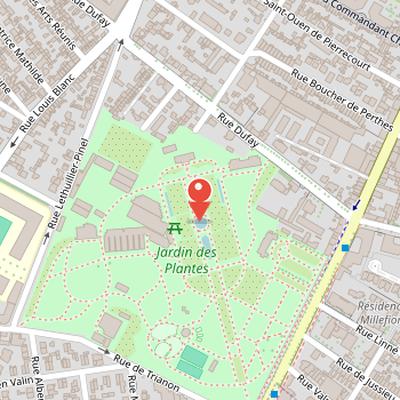
Jardin des Plantes de Rouen is a public botanical garden located on the left bank of the Seine in Rouen. It is accessible from Place and Avenue des Martyrs-de-la-Résistance, Rue Dufay, and Rue de Trianon. The garden extends over eight and a half hectares, of which eight hectares are open to the public.
Among its principal features is a fuchsia collection of 991 species and varieties, awarded the label "Collection nationale" by the Conservatoire des collections végétales spécialisées. The garden also contains a large perspective extending from the Grande Serre to the place des Martyrs-de-la-Résistance, a mosaïculture representing a butterfly, and specimens such as a Parrotia persica and a Gingko biloba planted in the 1840s. Its built features include a pavilion by Louis de Carel from the end of the 19th century, an orangery built in 1895–1896, and a central greenhouse constructed between 1839 and 1842, listed as a historical monument since 1992. The garden also includes a rosarium, tropical greenhouses, seven greenhouses including the palmarium, and a 17th-century press from Tourville-sur-Pont-Audemer reconstructed in 1996.
Nearby Objects
-
 Departmental Archives of Seine-Maritime 1500 m away
The Botanical Garden in Rouen
The Jardin des Plantes de Rouen is a public botanical garden on the left bank of the Seine in Rouen. It can be reached from Place and Avenue des Martyrs-de-la-Resistance, Rue Dufay, and Rue de Trianon. The garden covers eight and a half hectares, of which eight hectares are open to the public. Its fuchsia collection includes 991 species and varieties, and it has been awarded the label Collection nationale by the Conservatoire des collections vegetales specialisees. This collection is also reported to be condemned to disappear because of the mite Aculops fuschiae.
Garden Features and Historic Greenhouses
The attractions of the Jardin des Plantes de Rouen are organized around a large perspective running from the Grande Serre to the place des Martyrs-de-la-Resistance. Along this axis, the garden includes a mosaiculture showing a butterfly on one side, as well as two trees planted in the 1840s: a Parrotia persica and a Gingko biloba. At the end of the perspective stands the central greenhouse, built between 1839 and 1842. This greenhouse has been listed as a historical monument since July 16, 1992, and was restored in 1999.
Several other structures support the garden's public and scientific functions. A pavilion built by Louis de Carel at the end of the 19th century is used for temporary exhibitions, and an orangery built in 1895-1896 serves the same purpose. The rosarium, which covers 3,000 square meters, is used to study and present different rose subspecies to the public, and it contains roses created by Norman rose breeders. The garden also holds more than 1000 taxa of roses, dahlias, fuchsias, rhododendrons, irises, and daylilies, together with medicinal and aromatic plants.
Greenhouse collections are also prominent. In the western part of the garden, tropical greenhouses were built between 1936 and 1938, and the site contains seven greenhouses including the palmarium built between 1883 and 1884. These tropical greenhouses and the seven greenhouses were fully reconstructed in 2020, and one of the reconstructed greenhouses now hosts workshops for children. The garden also includes a 17th century press from Tourville-sur-Pont-Audemer, reconstructed in 1996 and dedicated to Charles-Victor Langlois, director of the Archives of France.
Features and Visitor Amenities
The Jardin des Plantes de Rouen includes several attractions and visitor facilities. It allows observation of parakeets, parrots, Chinese quails, and golden pheasants. The garden also has a carousel and playgrounds for children. Among its built features is an Art Deco style music kiosk, along with a pond used for naval modeling tests and recreation. In the high season, food service is available. A snack hut near the children's games and the main kiosk offers paninis, fries, hamburgers, candies, and ice cream.