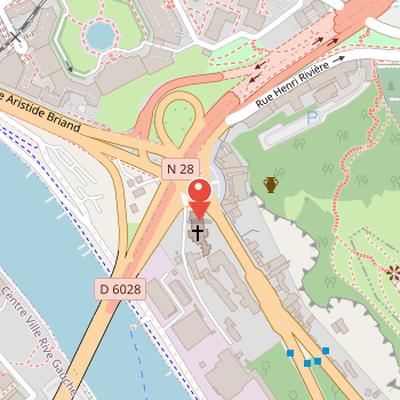
Église Saint-Paul de Rouen is a neo-Romanesque church located at the foot of Sainte-Catherine hill, near the Mathilde bridge in Rouen. The site is linked to the history of the priory of Saint-Paul around 1070, and the first church was built at the end of the 11th century. According to Farin, it stood on the site of an old temple dedicated to Adonis. The church served as the parish church of the faubourg d’Eauplet.
The building has a long history of damage, restoration, and rebuilding. It was ruined during the English siege of 1418–1419, restored from 1438, and devastated again by the Huguenots in 1562. It was enlarged in 1618 and rebuilt between 1827 and 1829 in neo-Romanesque style by Charles-Félix Maillet du Boullay. Two bell towers were added from 1890 to 1894 by Marie-Eugène Barthélémy. The preserved Romanesque apse was converted into a sacristy, and only the remains of the old church adjoining the current building are classified as historic monuments. The church has been closed for worship and disused since 2017.
Nearby Objects
-
 Place Saint-Marc 650 m away
 -
 L’aître Saint-Maclou 800 m away
 -
 Church of Saint-Maclou 850 m away
 -
 Musée national de l'Éducation 850 m away
 -
 Halle aux Toiles 900 m away
Location and Status of the Church
The Eglise Saint-Paul de Rouen is a neo-Romanesque church located at the foot of the Sainte-Catherine hill near the Mathilde bridge in Rouen. The remains of the old Romanesque church, which now serve as a sacristy and adjoin the current church, are the only parts classified as historic monuments. The building has been closed for worship and has been disused since 2017.
From Priory Church to Neo-Romanesque Reconstruction
The history of Eglise Saint-Paul de Rouen is linked to the priory of Saint-Paul, which dates to around 1070. The first church was built near the end of the 11th century, on a site that Farin identified as an old temple dedicated to Adonis. It served as the parish church of the faubourg d'Eauplet. During the English siege of 1418-1419, it was ruined and destroyed by the people of Rouen, then restored starting in 1438. The building suffered again in 1562, when it was devastated by the Huguenots.
In 1602, after the reform of the abbey, sisters sent by Louise de L'Hospital were housed there. The church was enlarged in 1618. In the mid-17th century, water sources were discovered on the site and first used by nuns before being leased. In 1650, François Harlay de Champvallon ordered the removal of the nuns for an establishment linked to pleasure, and the church ceased to be a priory church, becoming only a parish church. The buildings and gardens were rented from 1609 to 1790, with M. de Sens as the first tenant. Closed in 1793, it reopened in 1802.
The church was rebuilt between 1827 and 1829 in a neo-Romanesque style by Charles-Felix Maillet du Boullay. Two bell towers were added from 1890 to 1894 by Marie-Eugene Barthelemy.
Later Use and Setting
The church no longer serves for worship and is closed to the public. Its preserved Romanesque apse was converted into a sacristy. The former nuns' quarters were later used for various activities, including industrial ones, and now house a youth workers' center. The building was also further separated from the city by the construction of the Mathilde bridge and interchange. In its history, it was the church where Father Jacques Hamel served as altar boy from 1936 to 1944.