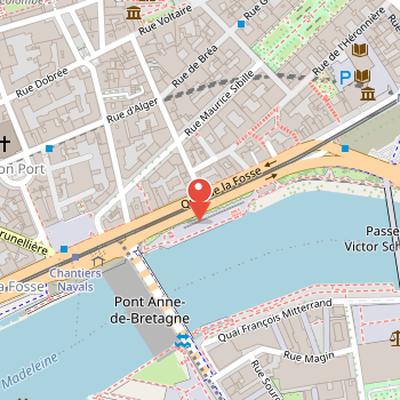
The Memorial to the Abolition of Slavery is a French memorial located in Nantes, on the quai de la Fosse between the former port captaincy building and the Anne-de-Bretagne bridge. It stands about two hundred meters west of the Victor-Schœlcher footbridge. The memorial is dedicated to the slave trade in Nantes and worldwide, as well as to slavery and its abolition.
Nantes was one of the main slave-trade ports of France, and the memorial was conceived as a large-scale artwork to testify to this history. The project followed earlier local initiatives and debates, including the creation of associations in the 1980s, an exhibition proposal at the Château des ducs de Bretagne, and later efforts to present the city’s history of slavery and the triangular trade. A steering committee was formed in 2000, and the final project was presented in 2005. Construction began in 2010. The memorial was designed by Polish artist Krzysztof Wodiczko and American-Argentine architect Julian Bonder. Its construction also led to the removal of the former square René-Siegfried from the site.
Nearby Objects
-
 Notre-Dame de Bon-Port 300 m away
 -
 Cours Cambronne 350 m away
 -
 Musée Dobrée 350 m away
 -
 Natural History Museum of Nantes 400 m away
 -
 Place Graslin 500 m away
Memorial in Nantes
The Memorial to the Abolition of Slavery is a French memorial located in Nantes, one of the main slave trade ports of France. It is dedicated to the slave trade in Nantes and worldwide, as well as to slavery and its abolition. The memorial was inaugurated on an unspecified date.
Location of the Memorial
The Memorial to the Abolition of Slavery is located on the quai de la Fosse, between the building of the former port captaincy and the Anne-de-Bretagne bridge. It was placed about two hundred meters west of the Victor-Schoe lcher footbridge. This siting gives the memorial a specific place within the riverside urban setting, with reference points that help define its position along the quay.
From exhibition proposals to a memorial work
In 1983, the association Nantes 85, du Code noir a l abolition de l esclavage was created by local personalities, teachers, and associations. Its aim was to present an exhibition on the slave trade and triangular trade at the Chateau des ducs de Bretagne as part of the Tricentenaire du Code Noir. The municipal government led by Mayor Michel Chauty refused to finance the project. In 1984, a new association, Le triangle d Ebenne : code noir, esclavage et memoire nantaise, was created, and a large exhibition titled Anneaux de la memoire took place at the Chateau des ducs de Bretagne. In 1998, an association initiated the placement of a statue titled L abolition de l esclavage, made of iron and plaster, at the port of Nantes. The statue was vandalized. In June 1998, the Nantes Municipal Council decided to erect a large scale artwork to testify to Nantes history with the slave trade.
Project Development and Inauguration
A steering committee for the memorial project was formed in 2000, and the final project was presented in 2005. Construction began in 2010. The memorial was designed by Polish artist Krzysztof Wodiczko and American-Argentine architect Julian Bonder. Its construction led to the removal of square Rene-Siegfried, which had been located between the capitainery and the Victor-Schochelcher footbridge. The square had been named by a 1987 deliberation in honor of Rene Siegfried, who had been director of the ports of Nantes and Saint-Nazaire in the 1950s. The memorial inauguration took place on the date mentioned in the source, and was attended by Jean-Marc Ayrault, then mayor of Nantes and project initiator, former Benin president Nicophore Soglo, Christiane Taubira, deputy of Guyana, and former footballer Lilian Thuram.
Inauguration and commemorative elements
The gallery documents the inauguration of the Memorial to the Abolition of Slavery with Lilian Thuram, Nicophore Soglo, Jean-Marc Ayrault, and Christiane Taubira. It also shows Krzysztof Wodiczko, the designer of the memorial, alongside Jean-Marc Ayrault, then mayor of Nantes. Another image presents Christiane Taubira at the podium; she originated the Taubira law in 2001. The gallery further includes the memorial's epitaph, which features an inscription from Article 4 of the Universal Declaration of Human Rights.