Rouen Cathedral is a Catholic church in Rouen, Normandy, France, and the see of the Archbishop of Rouen, Primate of Normandy. Built and rebuilt over more than eight hundred years, it presents architectural features ranging from Early Gothic to late Flamboyant and Renaissance styles. The cathedral is also distinguished by three towers, each in a different style. Its history is closely tied to the development of Christianity in Rouen, which is recorded as established around 260 by Saint Mellonius, the first bishop in the city. The first church is said to have stood under or near the present cathedral site, and a large basilica with three naves was built in 395. Later phases included enlargements, rebuilding in Romanesque style in the 1020s, and the launch of the Gothic cathedral project under Archbishop Hugues of Amiens.
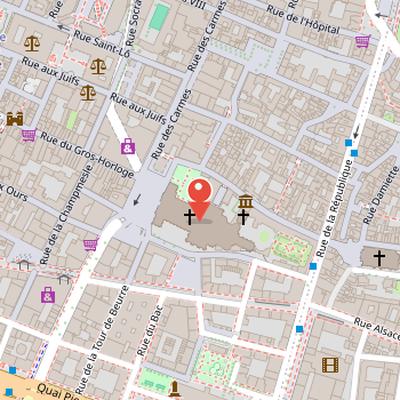
Nearby Objects
-
 Archiepiscopal Palace 100 m away
 -
 Halle aux Toiles 250 m away
 -
 Church of Saint-Maclou 250 m away
 -
 Église Saint-Pierre-du-Châtel 300 m away
 -
 L’aître Saint-Maclou 350 m away
Architecture and Historical Development
Rouen Cathedral is a Catholic church in Rouen, Normandy, France, and serves as the see of the Archbishop of Rouen, Primate of Normandy. Its architecture reflects a long and complex history of construction and rebuilding over more than eight hundred years. The cathedral includes three towers, each designed in a different style. Across the building, architectural features range from Early Gothic to late Flamboyant and Renaissance styles, showing the successive phases of its development over time.
Early Growth of Rouen Cathedral
Christianity was established in Rouen about 260 by Saint Mellonius, who became the first bishop in the city. The first church was located under or close to the present cathedral site, and by 395 a large basilica with three naves had been built in Rouen. The cathedral was enlarged by St. Ouen in 650, and in 755 archbishop Remy established the first Chapter of the cathedral. In the same year, Remy also constructed courtyards and buildings around the church and built a palace for the archbishop, indicating the growing importance of the complex.
The cathedral continued to play a prominent role in the region. Charlemagne visited it in 769, and Viking raids beginning in 841 damaged the cathedral complex. Later, Rollo, the first Duke of the Duchy of Normandy, was baptized in the Carolingian cathedral in 915 and buried there in 933. Richard I of Normandy enlarged the cathedral in 950.
A major rebuilding began in the 1020s under archbishop Robert, who started a Romanesque reconstruction of the church. This work included a new choir, crypt, and ambulatory, as well as a new transept. The Romanesque cathedral was consecrated by archbishop Maurille on October 1, 1063, with William, Duke of Normandy, among those present. In the following century, archbishop Hugues of Amiens launched the Gothic cathedral project and began construction of the Tower Saint-Roman in 1145.
Medieval Reconstruction and West Front
Rouen Cathedral underwent a long sequence of reconstruction and alteration beginning in 1185, when Gautier the Magnificent demolished the Romanesque nave and started rebuilding the cathedral. He also began the western end of the sanctuary, completed the west front and the first traverses. A major fire on Easter eve in 1200 damaged both the cathedral and the town, after which Gautier repaired the damage and resumed the work, with Jean d'Andeli directing the continuation. By 1204, the nave was complete for the visit of King Philip II of France, and the main altar was in place in the choir by 1207.
Later work added further complexity to the structure. Small chapels were inserted between the buttresses on the north and south sides of the nave, and in 1280 surrounding spaces and buildings were modified to allow construction of portals on the north and south transepts. In 1302, the small axial chapel at the east end of the apse was replaced by a larger chapel dedicated to the Virgin Mary. Between 1370 and 1450, the west front was decorated, while in 1468 a new ornamental top of iron and stone tiles was added to the tower of Saint-Romaine.
From the late 15th century, Cardinal-Archbishop Georges d'Amboise influenced the cathedral's architecture by incorporating Renaissance features into the Gothic design. A new tower was begun in 1488 to match the old Saint-Romaine tower under Guillaume Pontifs, then taken over by d'Amboise in 1496 and assigned to Jacques Le Roux with an ambitious plan that included Renaissance touches. This tower became known as the Butter Tower, although the funds collected covered only part of the cost. As the tower was being built, the west front began to show weaknesses and tilt. D'Amboise then ordered a complete reconstruction of the west front, carried out by Rouilland Le Roux in a Flamboyant style. The new facade was covered with layers of lacelike stone tracery, hundreds of sculpted figures were added to the portals, and two massive sculpted buttresses were installed to stabilise it.
Damage, Rebuilding, and the Iron Spire
Rouen Cathedral underwent repeated episodes of damage and reconstruction over several centuries. Its flèche, a lead-covered wooden spire over the lantern tower, fell in 1514 but was replaced within months in the same form and materials. The cathedral was badly damaged in the late 16th century during the French Wars of Religion, when Calvinists attacked furniture, tombs, stained-glass windows, and statuary in 1562. It was also struck by lightning in 1625 and 1642, and damaged by a hurricane in 1683.
During the French Revolution, the revolutionary government nationalised the cathedral in 1796 and transformed it into a Temple of Reason. Some furniture and sculpture were sold, and chapel railings were melted down to make cannon. In 1822, lightning started a fire that destroyed the wood and lead Renaissance spire of the central tower. Architect Jean-Antoine Alavoine proposed replacing it with a new cast iron spire, an idea that was controversial and denounced by Gustave Flaubert. The new spire, 151 meters tall, was completed in 1882. It made Rouen Cathedral the world's tallest building from 1876 to 1880 before Cologne Cathedral was completed. In 1905, the cathedral became the property of the French government under the new law separating church and state, while the French government granted the Catholic Church exclusive use of the cathedral.
War Damage and Restoration
During the beginning of World War II in 1939, cathedral authorities protected the sculpture with sandbags and removed the old stained glass, which was transported to sites far from the city. The building was then hit twice by Allied bombs in the weeks before D-Day in Normandy. In April 1944, seven bombs dropped by the British Royal Air Force struck the cathedral, narrowly missing a key pillar of the lantern tower. The south aisle was damaged and two windows were destroyed. In June 1944, bombs dropped by the U.S. Army Air Force set fire to the Saint-Romain tower, and the bells melted, leaving molten remains on the floor.
After World War II, a major restoration effort by the Service of Historic Monuments began and concluded in 1956. This campaign consolidated the structure and restored the statuary of the west front, including the return of four statues that had been moved elsewhere. Before the cathedral reopened in 1956, the choir was substantially renewed. A new high altar was installed with an 18th-century Rococo statue of Christ by Clodion, along with new choir screens, an episcopal throne, and a communion table and pulpit made of cast iron and gilded copper. The restoration project was completed in 2016, when the scaffolding was removed.
The West Front and Its Sculptural Program
Rouen Cathedral has a west front with three portals, arranged to correspond with the three aisles of the nave. The west front was first built in the 12th century, redone in the 13th century, and then totally rebuilt at the end of the 14th century with more lavish decoration. In the 14th century, towering buttresses were added on either side of the central portal to strengthen the west front, and these were covered with galleries of sculpture so that they blended into the overall decoration.
The central portal has had changing dedications over time. It was originally dedicated to St. Romain in the 12th century, then rededicated to the Virgin Mary at the beginning of the 14th century. Its tympanum shows a Tree of Jesse, presenting the family tree of Christ, with the Virgin Mary placed at the top and surrounded by a halo of sun and stars. The arches above the tympanum contain sculptures of prophets, sibyls, and patriarchs. The portals on either side are filled with sculptures that vividly illustrate Biblical stories.
The portal facing the building is dedicated to John the Evangelist and its tympanum depicts the baptism of Christ, the passage of Saint John, the dance of Salome, the feast of Herod, and the beheading of John the Baptist. The portal on the right is dedicated to Saint Stephen and shows the gathering of souls, Christ in majesty, and the stoning of Stephen. Traces of pigment and gilding on the sculpture indicate that the exterior once had bright color.
The Towers of Rouen Cathedral
Rouen Cathedral is distinguished by three major towers on its exterior, each with a different form and history. On the left side of the west front stands the Saint-Romain tower, begun in 1145 as part of the original Gothic cathedral. It is set apart from and slightly behind the main block of the west front, like the Butter Tower. Its ground level has no windows and contains the Baptistry. Above this are four levels of bays leading to a very ornate belfry. The tower houses the bourdon, or largest cathedral bell, named Joan of Arc, which weighs 9.5 tons, together with sixty-four smaller bells forming the carillon. The carillon was restored in 2016 and is the second-largest in France. The tower roof is decorated with sculptures of four small suns made of gilded lead, and its top was added in the 15th century as a more decorative element.
The Butter Tower, constructed between 1488 and 1506, is another exterior feature of the cathedral. Built in a late Gothic Flamboyant style, it is named because donors were given dispensation to consume butter and milk during Lent. Its design is marked by dense decoration that emphasizes height, including tall pointed niches, decorated buttresses, pinnacles, gables, and arches. At the top, the square plan becomes an octagon with an ornate stone crown. A bell for the tower, named Georges d'Amboise, was completed in 1501 to honor the Cardinal, but it cracked in 1786 and was melted down during the French Revolution.
The third major tower is the central lantern tower over the transept, placed almost in the center of the cathedral and rising to 151 meters. It follows Gothic architectural traditions in Normandy and is the tallest of the three towers. The first two levels were built in the 13th century. The original Gothic spire was destroyed by fire in 1514 and rebuilt in 1544 in wood and lead by Robert Becquet. Rouland Le Roux consolidated the lower levels and added flamboyant decoration and sculpture. After the lead and wood spire was destroyed again by fire in 1822, it was replaced by Jean-Antoine Alavoine with an iron and copper spire finished in 1882, surrounded by four smaller copper spirelets. One of these fell during a hurricane in 1999 and damaged the choir stalls below. The main spire caught fire on 11 July 2024, and the fire was quickly brought under control. Four smaller towers, or tourelles, with spires were also added atop the buttresses supporting the west front in the 13th century.
West Front and Transept Portals
Rouen Cathedral's exterior combines structural clarity with dense sculptural decoration. On the west front, two tourelles were placed on either side of the central portal below the west front, and three gables were attached below them in the 14th century. These gables were filled with sculptures representing archbishops, apostles, saints, kings, and prophets. The edges of the aisle and nave roofs are decorated with balustrades and pinnacles. The north and south sides are supported by flying buttresses that reach over the roof of the side aisles to carry the upper walls of the nave, allowing those upper walls to be entirely filled with windows. The spaces between the lower buttresses are filled with lateral chapels.
The cathedral also has two heavily decorated portals on the north and south sides, which give access to the transept at the meeting point between the nave and the choir. The north portal is called portail des librairies, and the south portal is called portail de la Calende. Each portal has a column-statue between the doors, a tympanum full of sculpture, and an arched voussure with three bands of statues above the tympanum. A lace-like pointed gable rises in front of the claire-voie gallery windows up to the rose window, with a similar sculpted gable above the rose window below the triangular gable of the transept roof. The embrasures of the doorways are filled with delicate sculptural medallions, and the contreforts on either side contain niches with angels and prophets. The front of the south transept and the portal of La Calende are especially dense in sculpture and decoration, including scenes of the Life of Christ over the tympanum and scenes of the Last Judgement above it. Around the portals, quadrille medallions illustrate the Book of Genesis and include fantastic animals.
The Chevet and Virgin Mary Chapel
The east end, or chevet, of Rouen Cathedral includes a chapel dedicated to the Virgin Mary that extends well east of the choir and apse. This chapel is marked by very high buttresses topped by pinnacles containing statues, as well as high lancet windows finished with gables that also carry statues. At its top stands the Golden Virgin, a gilded statue made by Nicolas Quesnel in 1541. The chevet also features a gilded statue of the Virgin Mary. Smaller chapels are arranged between the buttresses to the north and south of the Virgin Mary Chapel and are reached by the disambulatory. The Sacristy and the Revestiaire are attached to the south side of the chevet. Elsewhere on the exterior, another gable filled with sculpture showing the crowning of the Virgin Mary rises above the rose window at the top of the south transept.
The Nave and Choir Interior
The interior of Rouen Cathedral is organized around a nave that extends from the west front to the transept and choir, with churchgoers seated within this central space. The nave is covered by four part rib vaults supported by colonettes that rise to massive pillars at ground level. Its first four traverses on the west were completed by 1200, following a late 13th century elevation plan revised by master builder Jean d'Andeli after the fire of 1200 and shaped by High Gothic cathedral design.
The nave elevation is made up of an arcade of pillars, a tribune, a triforium, and a clerestory with high windows. The tribune forms a wide passageway above the arcade, while the triforium is a narrow passageway above the tribune. A coursiere passageway was also preserved atop the arches of the tribune, winding around the pillars. The arches of the tribune were made wider and taller to admit more light from the collateral aisle windows. Flying buttress technology supports the upper nave walls over the collateral aisles, allowing thinner walls and larger windows. The collateral aisles are fourteen metres high, while the nave vault reaches twenty eight metres. The clerestory windows of the central nave look out over the roofs of the collateral aisles and bring in more light.
The transept is described as unusually large and brightly lit, with large rose windows on the north and south sides and large windows below them in the triforium of each transept. The visible lantern tower stands overhead. The north and south facades are decorated with tracery composed of pointed stone arches and sculpture in niches, and the south transept includes quadrille panels.
At the east end, the choir is reserved for the clergy and was constructed slightly later than the nave, in the middle of the 13th century. It was separated from the nave by an elaborate screen in the Middle Ages and has a more unified style than the nave. The beginning of the choir is marked by the retable of the main altar and the throne of the Archbishop, with stalls for clergy to the east of the archbishop's throne. The choir elevation is High Gothic in style and has three levels: an arcade with circular pillars and capitals decorated with stylized foliage and crochets, a triforium, and high windows forming a half circle above it.
The choir stalls were installed between 1457 and 1470 by master woodworker Philipott Viart, and the cathedral retains most of their original seats and carved misericords. These misericords show scenes from the Bible, proverbs, fables, and craftsmen at work, though the upper portions of the stalls were destroyed during the Revolution. The choir center was substantially refurbished before the 1956 reopening to repair war damage, and it received a high altar topped by an 18th century Rococo statue of Christ made of gilded lead by Clodion, two kneeling angels by Caffieri from 1766, modern screens by Raymond Subes, a new episcopal throne, and a modern communion table and pulpit made of cast iron and gilded copper.
A stairway in the northwest corner, provided from 1471 for access to the cathedral library, was later updated with Neo Gothic landings in the 18th century.
Royal Tombs in the Interior
Rouen Cathedral contains several tombs associated with the Dukes of Normandy and related rulers. The interior includes the remains of four Dukes of Normandy, placed in simple tombs with images on either side of the choir. Among the best known burials is the tomb of Rollo, the Viking and first Duke of Normandy, and the tomb of his son William Longsword, who died in 942. Their remains were transferred from the first cathedral to the Romanesque cathedral in 1063 and later moved again to the Gothic cathedral when it was completed.
The interior also contains the tomb of Henry the Young King, who died in 1183, and a tomb with the heart of Richard the Lionheart, Duke of Normandy and King of England, who died in 1199. Richard the Lionheart's body was buried at Fontevraud Abbey in Anjou. Rollo's original tomb was destroyed during the bombing of 1944 and was replaced by a copy of the tomb of Henry the Young King made in the 19th century.
Interior Chapels and Decorative Program
The interior of Rouen Cathedral contains eighteen small chapels placed between the buttresses on the north and south sides of the nave. These chapels are filled with art, sculpture, and stained glass given by wealthy donors and guilds of the city. Some are very plain, while others are decorated with paintings and sculptures from the 17th and 18th centuries. Among the notable works are the statue Notre-Dame du Voeu by Felix Lecomte of 1777 in the Chapel Sainte-Marguerite on the south side, and the statue of Saint Cecile by Clodion of the same year in the Chapel Saint-Nicolas on the north side. The cathedral also contains altars and retables in several chapels, including the Chapel of Saint-Etienne-de-la-Grande-Eglise, the Chapel of Saint Peter and Saint Paul, and the Chapelle des Fonts, the last of which has a 17th-century retable.
The Chapel of Sainte-Catherine is especially distinguished by its highly ornate lambris with painted panels showing the life of Saint Brice. It also contains an altar and antependium, and its 17th-century painted wood panels survive as part of the cathedral interior. The bombardment of 1944 destroyed five chapels on the south side of the nave, and only the Chapel of Sainte-Catherine survived intact among them. At the east end of the cathedral is the Chapel of the Virgin, dedicated to the Virgin Mary. Built by master builder Jean Davi beginning in 1302, it replaced an earlier and more modest chapel. Its windows fill the entire upper portion of the walls in a 14th-century style, while the lower walls are covered with elaborate tracery and sculpture. Traces of gilding and pigment show that it was originally brightly colored. Its central feature is an enormous 17th-century altar framing a painting of the Virgin surrounded by carved and sculptural decoration.
Monumental Tombs in the Chapel of the Virgin
The Chapel of the Virgin in the interior of Rouen Cathedral contains two major monumental tombs. One is the tomb of Cardinal Georges d'Amboise and his nephew and successor, Cardinal Georges II d'Amboise, placed against the south wall of the chapel. Georges II d'Amboise altered the arrangement of the figures by moving the statue of his uncle to the side of the tomb and placing his own in the central position. The upper part of the tomb, or baldaquin, is decorated with sculpted Apostles, Sibyls, and Biblical kings shown in pairs. Its top is ornamented with sculpted candelabra and tempietti, or miniature classical temples.
The other monument in the chapel is the tomb of Louis and Pierre de Breze, made between 1536 and 1541 in Renaissance style. Louis de Breze died in 1531 and was the grandson of Pierre de Breze. He served as Senechal and Governor of Normandy. His wife, Diane de Poitiers, who was also the mistress of King Henri II of France, commissioned the tomb. The monument features a triumphal arch with Louis in armor on horseback passing in triumph, while at the bottom he appears again as a nearly nude corpse. Diane is shown kneeling beside the corpse. The tomb is attributed to the French Renaissance sculptor Jean Goujon, who was active as a sculptor to Henri II when it was made.
Thirteenth-Century Stained Glass
Rouen Cathedral preserves original stained glass from the 13th century, with windows dating from about the same period as the early glass of Chartres Cathedral and Bourges Cathedral. The cathedral has five bays with early windows in the collateral chapels of the north nave, where some of the oldest existing windows are found. These early windows are arranged in series of medallions in rows, made from small pieces of thick glass deeply colored in reds and blues and held together with thin strips of lead.
Among the surviving 13th-century windows is the Window of the Passion in the disambulatory, Bay 10, which includes scenes such as the Last Supper and a detail showing a butcher at work. The Window of Saint Joseph in Bay 9 is signed by Clement, a glassmaker of Chartres, on the band in front of the saint. Another 13th-century window, Saint Severus in the Chapel of Saint Severus, is located in Bay 51. The Window of Saint-Julien l'Hospitalier in Bay 23, in the ambulatory, depicts fish-merchants, the sponsor of the window.
Several stained glass windows were funded by guilds of craftsmen and depict them at work, showing the connection between the cathedral's glazing and the people who supported it.
Stained Glass in the Cathedral
Rouen Cathedral contains an important series of stained glass windows spread across several chapels and bays. In the Chapel of Saint-Jean-de-la-Nef, Bay 53, a 13th century window depicts craftsmen planning and building the cathedral. Other early glass is preserved in the Belles Verrieres, a group of windows in the collateral chapels on the north side of the nave and the transept. These windows consist of early 13th century glass that was moved in the 15th century from south collateral chapels and reinstalled in new windows in the Chapel Saint-Jean, Chapel Saint-Severus, the Chapel of the Saint-Sacrament, and the Chapel of Saint-Pierre-and-Saint-Paul.
During the 14th century, stained glass became more pictorial in character. Artists began using silver stain and enamel paints baked on glass to add detail and realism, and the windows increasingly resembled paintings, with perspective and shading suggesting three dimensions. Subjects from this period include saints and bishops shown in architectural settings with canopies and arches. Grisaille, a greyish or white glass, was used to set off figures and increase light. A mid-14th century example is the Pentecost window in Bay 36, edged with grisaille bordered by angel musicians. At the end of the 14th century, Guillaume Nouel made the rose window of the north portal, which depicts Christ surrounded by the evangelists, bishops, kings, and martyrs.
Later windows continued this development toward greater realism. In the 16th century, the Chapel of Saint-Joseph, located in the south transept, received a window with a closer resemblance to painting and less depth and richness of color than 13th century glass. Two windows in the Saint-Romain chapel, in the south part of the nave next to the transept, were based on the work of the Rouen painter Arnoult de Nimegue or his followers and show scenes from the life of the archbishop Romaine. The cathedral also contains modern windows made in the 1950s to replace glass destroyed in Second World War bombardments, including a 20th century window in the Chapel of St. Leonard, Bay 50, and three Joan of Arc windows in the Chapel of Joan-of-Arc in the south transept, bays 22, 24, and 26, made in 1955-56.
The Cathedral Bells
Rouen Cathedral is known for its large set of bells, which were made by the Fonderie Paccard in Annecy. The Saint-Romain Tower contains sixty-four bells, while the Butter Tower contains six. Together, they form the heaviest peal or group of bells in France. Their combined weight is thirty-six tons.
The Cathedral Organ Tradition
Rouen Cathedral has had a Grand Organ since the 1380s, and construction of a new, larger version began in 1488. The organ was placed inside the west front under the rose window at the beginning of the nave, giving it a prominent position in the cathedral interior. A smaller organ was installed in the choir in 1517, located in the center of the Choir screen, but it was removed during the Renaissance.
The Grand Organ was associated with several prominent organists. Jean Titelouze served from 1588 until 1634, and Jacques Boyvin served from 1674 until 1706. The instrument was damaged in the hurricane of 1683, but it was put back into service after that event. Later, new organs were built by Merklin & Schutze between 1858 and 1860, and again by Jacquot-Lavergne after World War II.
The Cathedral Treasury
The treasury of Rouen Cathedral was originally kept in the Sacristy before being moved to its own tower on the Alban Courtyard on the north side of the cathedral. Its history includes two major pillagings, first by the Protestants in 1562 and later during the French Revolution in 1791. As a result, most of the original objects were lost, with the Chasse de Saint-Roman remaining as the main survivor. In the 19th century, the treasury acquired a new collection from monasteries, churches, and private collections.
Among its notable pieces are the Chasse de Saint Roman, a miniature cathedral of gilded copper with figures of Christ and the Apostles from the late 13th century, and the Chasse de Notre Dame, a mini-cathedral of gilded bronze and enamel devoted to the Virgin Mary from the 19th century. The treasury also contains a 15th-century monstrance, described as an elaborate miniature tower with a crystal cylinder for the host during the Eucharist ceremony, and the Ostentoire of Two Crowns from 1777, a similar vessel decorated with a gilded crown and rays of light. It also displays elaborate ceremonial costumes worn by the Archbishops.
The Cathedral Crypt
Rouen Cathedral contains an 11th-century crypt from the original Romanesque cathedral, located beneath the choir of the Gothic cathedral. It was within the foundation of the old cathedral and can be reached through the Chapel of Saint Joan of Arc on the south side of the Choir. The crypt was excavated between 1931 and 1934 and opened to visitors in 1956.
The crypt is composed of a sanctuary and a curving ambulatory with three small chapels. Its vaults are supported by two rows of columns, and the floor was made of a pattern of light stone and black marble. A well is located in the ambulatory beneath the axis of the apse above.
Rouen Cathedral in Art and Literature
Rouen Cathedral has played a notable role in art and literature, especially as the subject of a series of paintings by Claude Monet. Monet depicted the cathedral at different times of day and in varying weather conditions, creating multiple views of the same facade. Works from this series are held in several institutions, including two paintings in the National Gallery of Art in Washington, D.C., one each in the Getty Center in Los Angeles, the National Museum of Serbia in Belgrade, the Clark Art Institute in Williamstown, Massachusetts, a museum in Cologne, and the Rouen fine art museum. Five paintings from the series are in the musee d'Orsay in Paris, and one painting has an estimated value of over $40 million.
The cathedral also inspired other artists and writers. John Ruskin selected it in The Seven Lamps of Architecture, and Roy Lichtenstein produced a series of pictures of the cathedral's front. Mae Babitz illustrated the cathedral in the 1960s, and these illustrations are held in UCLA library Special Collections. In literature, Gustave Flaubert drew inspiration from the stained glass windows of St. Julian and the bas-relief of Salome in the cathedral, and based two of his Three Tales on aspects of it. Joris-Karl Huysmans wrote La Cathedrale after an intensive examination of the building, and Willa Cather set a key scene of One of Ours there.
Burials and Memorials at Rouen Cathedral
Rouen Cathedral contains a number of burials and memorials connected to Norman and English history. Among the most prominent is the tomb of Richard the Lionheart, whose heart is housed in the cathedral. His effigy rests on top of the tomb, and his name is inscribed in Latin on the side. The cathedral also contains the tomb of Rollo, founder and first ruler of the Viking principality in Normandy, as well as the burials of Poppa, wife of Rollo and mother of Duke William I, and William I, Duke of Normandy, also known as William Longsword.
Other burials recorded at the cathedral include Maurilius, a Norman Archbishop of Rouen, Hugh of Amiens, Walter de Coutances, William FitzEmpress, Henry the Young King, Georges d'Amboise, Pierre de Brze, Louis de Brze, Gustave Maximilien Juste de Croy-Solre, Pierre Petit de Julleville, and Joseph-Marie Martin. Matilda of England, also known as the Empress Matilda, is also buried there. The cathedral contains a memorial to Arthur I, Duke of Brittany, whose fate and burial place are unknown, though he was last heard of in Rouen Castle in 1203 at the age of sixteen.
The cathedral also contained the black marble tomb of John of Lancaster, Duke of Bedford. His original tomb was destroyed by Calvinists in the 16th century, but a commemorative plaque remains. In addition, Richard the Lionheart's bowels were probably buried at the church of the Chateau of Chalus-Chabrol in Limousin, while his corporeal remains were buried next to his father at Fontevraud Abbey near Chinon and Saumur, France.