Sainte-Chapelle de Dijon was a church building closely connected to the history of Burgundy until the end of the Ancien Régime. It served as the private chapel of the dukes of Burgundy and was the seat of the Order of the Golden Fleece until the death of Charles the Bold, before the order moved to the Coudenberg Palace in Brussels. The chapel was particularly important to the Capetian dukes, the Valois dukes, and the kings of France. It was associated with solemn services, victories, and the funeral pomp of princes, and sovereigns and governors marked their passage there, with fireworks also set off on the site. According to the account of its origins, Duke Hugues III of Burgundy vowed to build a church in the enclosure of his Dijon hôtel after surviving a storm, and later donated land for its construction. The chapel was dedicated to Notre Dame and Saint John the Evangelist. It was destroyed in 1802.
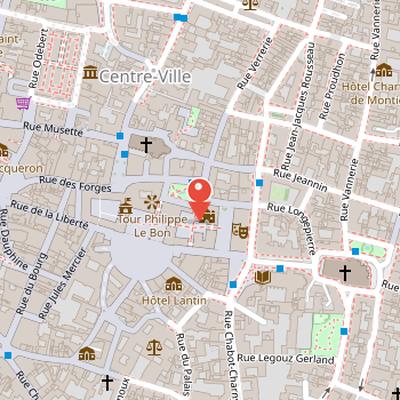
Nearby Objects
-
 Musée des Beaux-Arts de Dijon 20 m away
 -
 Opéra de Dijon 50 m away
 -
 Le Consortium 80 m away
 -
 Musée Magnin 90 m away
 -
 Palace of the Dukes of Burgundy 90 m away
Historical Role of Sainte-Chapelle de Dijon
Sainte-Chapelle de Dijon was the private chapel of the dukes of Burgundy and served as the seat of the Order of the Golden Fleece until the death of Charles the Bold. Before the order moved to the Coudenberg Palace in Brussels, it held a central position in Burgundian court life and was particularly important to the Capetian dukes, the Valois dukes, and the kings of France. The chapel remained closely linked to the history of Burgundy until the end of the Ancien Regime. It was associated with solemn services, victories, and the funeral pomp of princes, and sovereigns and governors marked their passage there, with fireworks set off at the site. The chapel was destroyed in 1802.
Origins and Ecclesiastical Status
The origins of the Sainte-Chapelle de Dijon are linked to Duke Hugues III of Burgundy, who left for a pilgrimage to the Holy Land in 1171 and died at Saint-Jean-d'Acre in 1192. According to the account, he vowed to build a church within the enclosure of his Dijon hotel if he survived a storm. On his return to Dijon, he donated land to the Holy See for the construction of the church, which was dedicated to Notre Dame and Saint John the Evangelist.
In 1172, Hugues III founded a college of ten canons and granted it privileges. The chapel was exempt from the jurisdiction of the archbishop-duke of Langres and answered directly to the Pope, giving it a special ecclesiastical status. The number of canons was later increased to twenty in 1214, and then to twenty-four, plus a dean, in 1430, to match the original number of Knights of the Golden Fleece.
Architecture and Ducal Patronage
Sainte-Chapelle de Dijon was built adjacent to the east of the ducal palace and connected to the Tour de Bar by a covered passageway. Its first construction began modestly in the late 12th century under the chapter, using the Romanesque style and limited resources. The chapel was then rebuilt on a more extensive scale in the 13th century, after indulgences granted in 1244 by Pope Innocent IV encouraged financial support.
The nave was later constructed in the Burgundian Gothic style during the 14th century, and this work progressed slowly. A simple portal was completed in 1400. The building also benefited from a bequest in the will of Duke Eudes IV. Ducal patronage continued through the generations, including Duke Philippe the Bold, who commissioned the Chartreuse de Champmol and its decorations, among them the Puits de Moise, and Duke Philippe the Good, who continued the work to house his Order in a vaulted great hall on the lower floor of Tour Neuve.
The chapel facade received sculptural and decorative elements associated with this patronage. Claus Sluter created a sundial with ducal arms for the facade, and the sundial gnomon ended with a sun gilded by Jean de Beaumetz. Tour Neuve flanked the facade, and the east tower was identified as Tour Saint-Medard. The gable was crowned with a two-meter tall statue of Saint John the Evangelist.
The Sainte-Chapelle as a Ducal Site
The Sainte-Chapelle de Dijon gained historical importance in 1432 when Duke Philippe le Bon chose it as the place, chapter, and college of the Order of the Golden Fleece. The order itself had been created on the day of the duke's marriage with Isabelle of Portugal. This choice linked the chapel directly to a ducal institution of ceremonial and organizational significance.
The Sainte Hostie at the Sainte-Chapelle
The Sainte Hostie was given to Philippe le Bon by Pope Eugene IV in recognition of the duke of Burgundy's support at the Council of Basel. It was then deposited by the canon of Paris, Robert Anclou, in the chapel of La Sainte-Hostie adjoining the choir of the Sainte-Chapelle on the epistle side. The chapel was decorated with woodwork by the sculptor Pierre Maistrier. The hostie bears the image of the Savior seated on a throne and shows multiple knife wounds, with drops of blood staining the places where it was pierced. The establishment of the confraternity and the ceremony of the miraculous hostie's staff began on April 27, 1487.
Baptism, Royal Devotion, and Civic Ritual
La Sainte-Chapelle du XVe au XVIIIe was the parish where all dukes born in Dijon were baptized. Charles le Temeraire was the last duke baptized there. The chapel also appears in accounts of royal presence and devotion in Dijon. Louis XI arrived in Dijon two years after the death of Charles le Temeraire at Nancy and confirmed privileges by letters patent dated in August. Louis XII, after recovering from an illness, paid homage on an unspecified date and sent two heralds to carry the golden crown worn at his Reims coronation to La Sainte-Chapelle du XVe au XVIIIe. The crown was attached to the vessel displaying the Holy Host at the chapel. The chapel was also associated with public religious processions. After six months of drought, a solemn procession of the Holy Host took place on an unspecified date, and heavy rain followed four days later. The Grand Conde also donated the flags captured at the Battle of Rocroi to the chapel.
Funerary Role and Burial Privileges
The Sainte-Chapelle de Dijon had a significant funerary role in connection with Duke Jean Sans Peur. S epultures organized a funeral ceremony before his empty catafalque on the pont de Montereau, in the presence of Marguerite de Baviere and her daughters Marguerite, Anne, and Agnes de Bourgogne. The following day, S epultures received the mutilated body of the duke at Dijon and buried him at the chartreuse de Champmol, alongside his predecessors since Philippe le Hardi. The chapel also offered the knights of the Toison d'Or the option of choosing it as a burial site, on condition that they endowed the chapter with an annual rent of ten livres.
Revolutionary Damage and Demolition
During the early years of the Revolution, the Sainte-Chapelle de Dijon was sacked and briefly used to imprison prisoners. Its roofing lead was stolen, and its stained glass windows were broken or removed. The building then deteriorated further because the town hall did not protect it. In 1801, the decision was made to demolish the chapel, and the demolition was auctioned that same year for approximately an unspecified amount. The Sainte-Chapelle de Dijon and its adjoining cloister were destroyed from 1802 to 1804.