Musée Magnin is an art museum in Dijon, in Côte-d'Or, Bourgogne-Franche-Comté. It presents a collection of art objects assembled by Maurice Magnin and Jeanne Magnin, who gathered works mainly from public sales between 1881 and 1935. Their collection was intended to represent different artistic trends in France and abroad, including works that were little sought after or little known. The collection was given and bequeathed to the State by Maurice Magnin in 1939.
The museum is installed in Hôtel Lantin, a 17th-century private mansion near the Palace of the Dukes of Burgundy. Built for Étienne Lantin in 1663–1664, the building later passed through several owners before being acquired by the Magnin family in 1829. The paintings and art objects are displayed in the rooms of the mansion in the spirit of a cabinet d’amateur and a lived-in home. The outbuildings were renovated by Auguste Perret between 1930 and 1932, combining reinforced concrete with classical architecture in the zenithal gallery.
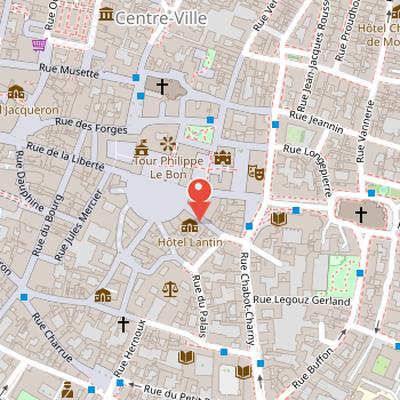
Nearby Objects
-
 Castrum de Dijon 60 m away
 -
 Place Émile-Zola 80 m away
 -
 Place de la Libération 80 m away
 -
 Musée des Beaux-Arts de Dijon 80 m away
 -
 Sainte-Chapelle de Dijon 90 m away
Collection and Origins
The Musee Magnin is a museum of art located in Dijon, in the department of Cote-d'Or in Bourgogne-Franche-Comte. It presents a collection of art objects assembled by Maurice Magnin and Jeanne Magnin. Maurice Magnin lived from 1861 to 1939, and Jeanne Magnin from 1855 to 1937. The pair collected these art objects in their family mansion, the Hotel Lantin, giving the museum's holdings a direct connection to their private residence and collecting activity.
Collection and Setting at Hotel Lantin
The Musee Magnin presents a collection gathered by Maurice Magnin and Jeanne Magnin, who assembled it mainly through public sales between 1881 and 1935. Maurice Magnin, conseiller maitre at the Cour des Comptes from 1861 to 1939, and Jeanne Magnin, an amateur painter and art critic active from 1855 to 1937, selected works to reflect different artistic trends in France and abroad. The collection also includes works that were little sought after or little known. It was noted in 1938 by Jean-Gabriel Goulinat, a friend and painting restorer at the Louvre. Maurice Magnin gave and bequeathed the collection to the State in 1939. Its presentation was also shaped by later donations inspired by previous legacies such as Jacquemart-Andre in Paris and Bonnat-Helleu in Bayonne. The collection cannot be expanded because of Maurice Magnin's testamentary provisions, and no works can be lent because of the restrictions attached to the legacy. The museum is housed in Hotel Lantin, a 17th-century private mansion near the Palace of the Dukes of Burgundy in Dijon. Built for Etienne Lantin in 1663-1664, the building later passed through several owners before its acquisition in 1829 by Jean Hugues Magnin-Philippon, a grandparent of the collectors. It was inherited by Joseph Magnin, who lived there, and later belonged to his son Maurice Magnin. The stables were given an added floor in 1851 to unify the building, and the outbuildings were renovated by Auguste Perret between 1930 and 1932, combining reinforced concrete with classical architecture in the zenithal gallery.
Collection Display at the Hotel Lantin
The painting collection and art objects are displayed in the rooms of the hotel Lantin in the spirit of a cabinet d amateur and a lived-in home. The presentation follows a traditional format, arranged densely and by schools. The visit begins with rooms dedicated to the Northern schools, establishing the structure of the collection display from the start.
The Painting Collection
The Musee Magnin collection includes Flemish paintings from the 16th century, many of them anonymous, alongside a broad range of 17th century Flemish and especially Dutch painting, with the exception of marine subjects. It features landscapes by Pieter Brueghel le Jeune, Paul Bril, and Tobias Verhaecht, as well as classicizing landscapes by Jan Weenix and Jan Frans van Bloemen. Other landscape works include baroque landscapes by Jacques d'Artois, italianizing landscapes by Frederik de Moucheron, and a suggestive stormy landscape by Reynier van der Laeck.
The collection also contains portraits by Nicolas Maes, Abraham van den Tempel, and Bartholomeus van der Helst, together with figures by Jacob Jordaens and Hendrick Bloemaert. Jan van Bijlert of the Utrecht school is represented by an important mythological composition with religious accents. The collection further includes Pieter Lastman, known as the master of Rembrandt, and Gerard de Lairesse, presented here as a champion of classicism at the beginning of the 18th century.
The Italian Painting Collection
The Musee Magnin collection includes 170 Italian paintings, mainly dating from the High Renaissance to the 18th century. It brings together works that illustrate a broad range of styles and regional traditions. Among the earliest pieces is a Virgin and Child by the Master of San Torpe from Pisa, dated around 1310. The collection also includes Giovanni Cariani's Christ and the adulterous woman, shown both as an early 16th century painting and as Le Christ et la femme adultere, as well as Alessandro Allori's Suzanne and the elders from 1561. Allori was a student of Bronzino, and his work is part of a group that reflects mannerist tendencies.
Other mannerist and late mannerist artists represented include Ferrau Fenzoni from Faenza and Giovanni Battista Crespi, a Lombard painter whose works in the collection include La Visitation from the late 16th century. The collection also features Carlo Dolci, described through his extreme refinement, including Saint Charles Bormee from 1659. Additional works include a Portrait of Giovanni Donato Correggio as Perseus by Bernardo Strozzi and a dramatic Pieta by Giovanni Stefano Danedi, known as il Montalto.
Landscape painting is also present through works by Pietro Paolo Bonzi and Giovanni Francesco Grimaldi. The collection includes paintings demonstrating the pioneering role of Annibal Carrache in Bologna, as well as a modello by Pietro Bianchi representing the figure of Christ in Rome. Another aspect of the collection is its attention to stylistic exchange, such as the influence of mid-century Parisian painting clarity and elegance on Giovanni Francesco Romanelli.
The holdings also give prominence to Venetian and Neapolitan painters. Among the Venice highlights are Giovanni Antonio Pellegrini and Giambattista Tiepolo, while the Naples section includes Giacomo del Po and Gaspare Traversi. The collection is further distinguished by rare painters in French museums, including Claudio Ridolfi and Jacopo Bertoja, reflecting the Magnins independence of taste.
The Paintings, Drawings, and Sculptures at Musee Magnin
The Musee Magnin collection is especially strong in the French school, which accounts for 650 pieces and represents half of the paintings collection. Its most distinguished area is the French school of the years 1630 to 1650, with numerous small, intimate 17th century works that were appreciated by collectors. Among the highlights are a portrait of a man from the 1630s, sometimes attributed to Philippe de Champaigne junior, and two historical compositions by Claude Vignon from the same decade, still influenced by the Fontainebleau School. The collection also preserves a limited but exceptional group of works from Mazarin's era, including paintings by Eustache Le Sueur, Laurent de La Hyre, Sebastien Bourdon, Michel Dorigny, Lubin Baugin, and Charles-Alphonse Dufresnoy. These works are noted for balanced compositions, clear colors, and moderate expression, described as Parisian atticism.
The collection continues into the later 17th century with two major paintings from the 1670s: Le Sermon sur la montagne by Jean-Baptiste de Champaigne and Portrait de la fille de l'artiste peignant son frere by Claude Lefebvre. It also includes Eustache Le Sueur's Diane decouvrant la grossesse de Callisto, Laurent de La Hyre's Putto jouant de la basse de viole, an entourage painting of Simon Vouet's Ceres, deesse des moissons, and Sebastien Bourdon's La Sainte Famille. Other portraits include a Rembrandt-style self-portrait by Alexis Grimou and works such as L'homme au turban by Pierre-Narcisse Guerin opposite La Sultane attributed to Claude Marie Dubufe. The collection also contains portraits from the Restoration period, intimate representations by Jean-Louis Hamon, Louis-Leopold Boilly, and Ary Scheffer, as well as expressive portraits by Gustave Jacquet and Carolus-Duran.
Landscape painting is another major interest. The collection features classical landscapes by Charles de La Fosse, Louis de Silvestre, and Patel the younger, nocturnes by Simon-Mathurin Lantara and an anonymous work titled Effet de soir tombant, and small landscapes by Georges Michel, Lazare Bruandet, and Anne-Louis Girodet near 1800. It also includes classicizing landscapes by Joseph Bidauld and Jean-Victor Bertin, followed by works by Constant Troyon. The collection favors artists such as Francois Chifflart, Jean-Michel Grobon, Achille Benouville, Prosper Marilhat, Hippolyte Margottet, and Jules Bastien-Lepage over Barbizon and Impressionist painters, while also holding a Venetian nocturne by Jules-Bastien Lepage from 1881 related to Whistler.
The collection is broad in scope across drawing and print-related works as well, with more than 600 drawings. These include a preparatory drawing by David Wilkie from his Grand Tour, Nordic and Belgian school drawings by Joseph-Denis Odevaere, Francois-Joseph Navez, and Jacob Maris, and notable Italian drawings such as a figure for Cavalier d'Arpin's decoration at the Palazzo dei Conservatori, two portraits by Ottavio Leoni, a Flight into Egypt drawing by Belisario Corenzio, and a study sheet by Alessandro Casolani. The French section is described as the richest and includes a typical battle scene by Jacques Courtois, works by Raymond de La Fage, late and atypical works by Jean-Baptiste Greuze and Francois Boucher, studies by Charles-Joseph Natoire, Jean-Baptiste Oudry, Carle van Loo, Gabriel-Francois Doyen, and Jean-Jacques de Boissieu, and neoclassicism artworks around 1800. It also contains the drapery study of Jacques-Louis David, works by Jean-Simon Berthelemy, Jean-Germain Drouais, Jean-Michel Moreau, and Charles Meynier, portraits by Claude Hoin and Jean-Baptiste Wicar, landscapes by Joseph-Marie Vien, Georges-Francois Blondel, and Nicolas-Charles de Silvestre, and realistic landscape works by Ferdinand Bourjot, Eugene Ciceri, Antoine Vollon, and Jules-Romain Joyant. Romantic years are represented by Eugene Isabey, Camille Roqueplan, Alexandre-Evariste Fragonard, Theodore Géricault, and Eugene Delacroix.
Sculpture is also present through acquired works such as Le Printemps and L'Automne by Juste Le Court, dozens of terracotta pieces that confirm a taste for sketch modeling in painting, the Quatre parties du Monde attributed to the baroque sculptor, an original bas-relief by Jean-Pierre Dantan le jeune, masks by Alexandre Falguiere, and a rare sketch between Romanticism and Symbolism by Auguste Preault.
Furniture in the Collection
The collection includes several notable pieces of furniture from different periods. Among them are a secretaire a double pente by Bon Durand, made after 1761, and a secretaire en armoire by Adrien Jerome Jollain from between 1763 and 1788. It also features a secretaire en laque de Coromandel by Adrien Jerome Jollain, a commode en arbalete by Jean-Pierre Dusautoy, and a table en cabaret by Jean-Pierre Dusautoy. Other displayed furnishings include feminine billet-doux furniture from the Restauration era and bonheur-du-jour furniture from the Second Empire era. The rare secretaire a double pente for young girls, stamped Bon Durand, is exhibited in the bedroom.