The Musée des Beaux-Arts de Dijon is an art museum in the heart of Dijon and is described as one of the oldest and most important museums in France. It occupies the former ducal palace, once the seat of the Burgundy state. After the duchy was annexed to the kingdom of France, the palace became the king’s residence and was later transformed into the Palais des États de Bourgogne according to a project by Jules Hardouin-Mansart.
The museum’s origins date back to a decree of the États de Bourgogne. Its project was planned from 1783, when the eastern wing of the palace was built to support a drawing school founded by François Devosge, who aimed to gather model works for teaching. The museum was later opened to the public in the course of the revolutionary period. From 2006, it underwent total renovation and expansion, including the inauguration of a renovated “Moyen Âge - Renaissance” route. The fully renovated museum, with 50 rooms, was inaugurated in the presence of Franck Riester, François Hollande, and François Rebsamen.
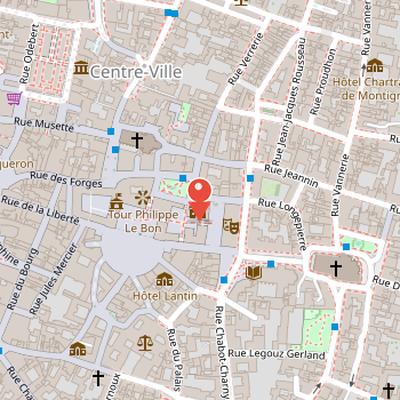
Nearby Objects
-
 Sainte-Chapelle de Dijon 20 m away
 -
 Opéra de Dijon 40 m away
 -
 Musée Magnin 80 m away
 -
 Le Consortium 100 m away
 -
 Palace of the Dukes of Burgundy 100 m away
A Museum in the Former Ducal Palace
The Musee des Beaux-Arts de Dijon is located in the heart of Dijon and is described as one of the most important and oldest museums in France. It occupies the former ducal palace, which once served as the seat of the Burgundy state. After the duchy was annexed to the kingdom of France, the palace became the king's residence. It was later transformed into the Palais des Etats de Bourgogne based on a project by Jules Hardouin-Mansart.
From 2006, the museum underwent a total renovation and expansion. The work began with one section, where the renovated Moyen Age - Renaissance route was inaugurated. The fully renovated museum, with 50 rooms, was later inaugurated in the presence of Franck Riester, Francois Hollande, and Francois Rebsamen. The museum's attendance reached a high level by the end of October and totaled by the end of 2019, before dropping sharply because of COVID. In 2023, attendance rebounded with visitors counted.
Foundation and Wartime Protection
The Musee des Beaux-Arts de Dijon was founded by decree of the Etats de Bourgogne. Its project had been planned since 1783, when construction of the eastern wing of the palace began. The museum was intended to support the teaching needs of students at the drawing school by bringing together model works, in line with the original free and open drawing school created by Francois Devosge. The institution was placed under the protection of the Etats de Bourgogne, and its early collections were housed in the salon Conde and the salle des statues, also called the salle des antiques, where plaster and marble copies of antiquities were displayed.
During the Revolution, Francois Devosge was charged on 14 pluviose, year II, with conserving monuments des arts. He also served as director of the school and presided over the appointment of the first museum directors until 1811. The museum of the department of Cote-d'Or was decided to be opened to the public on 15 ventose, year VII, and the Musee des Beaux-Arts was inaugurated on 20 thermidor. It was open every decadi, from noon to 14:00 in winter and from 14:00 to 16:00 in summer.
In the twentieth century, the museum became the focus of major protection measures during the Second World War. In 1936, evacuation plans were prepared in response to a directive from France's museums. The museum was closed and evacuation began on 25 August 1939, on order of the prefect of Cote-d'Or. Ten trips were made to move 912 of the most important artworks to the chateau de Chateauneuf-en-Auxois, and valuable documents from the municipal library and departmental archives of Dijon were also protected. In 1943, artworks were evacuated to Chateau de Fontaine-Francaise, while non-transportable works such as the ducal tombs and Hebe et l'aigle de Jupiter by Francois Rude were protected with sandbags and structures. Other artworks were stored in cellars, and the museum followed the law ordering the removal of copper alloy statues, except those judged historically or aesthetically important by Vichy representatives. Pierre Quarre, who was responsible for essential museum management during the war, intervened to save sculptures from removal by German soldiers. Some works were preserved, including the statue of Claus Sluter by Henri Bouchard and the statue of Monge by Rude in Beaune, while others, such as Rameau by Eugene Guillaume and the bust of Legouz de Gerland by Claude-Francois Attiret, were removed and melted down.
Renovation and Reopening
After the citys liberation, the Musee des Beaux-Arts de Dijon reopened on an unspecified date and later entered a major renovation program. The museums second and third renovation phases began in 2015, and the work included a larger bookshop as well as the restoration and reorganization of rooms containing 19th-century artworks and the Tour de Bar. A renovated first parcours, entitled Moyen Age et Renaissance, was inaugurated after seven years of work, covering a period from an unspecified date to an unspecified date. Renovation work is scheduled to continue until a complete reopening on an unspecified date before Nuit des musées. In parallel, the museum adopted a new visual identity created by the Parisian graphic studio Polymago. Its new logotype shows two intertwined B letters representing Philippe Le Bon in four colors. The museum also offers modern visitor services, including a bookshop, mediation devices, redesigned reception spaces, a brasserie, and accessibility for people with reduced mobility.
The Museum Collections and Their Arrangement
The Musee des Beaux-Arts de Dijon began with only two rooms: the salle des Statues for sculptures and the salon Conde for paintings. The salon Conde was designed to celebrate the glory of the Conde, governors of Bourgogne, and the museum later expanded progressively within the Palais premises. By 1917, it had grown to 29 rooms. The collections have been enriched over time by imperial donations, state deposits, and gifts and bequests from collectors, alongside works from laureates of the prix de Rome and revolutionary seizures.
Today, the museum's collections are among the richest in French museums. They represent nearly all art forms from Antiquity to contemporary art, including painting, decorative arts, drawings, and sculptures. The medieval collections are especially notable for their quality and quantity, and the museum is best known for the tombs of the Dukes of Bourgogne displayed in the palace's grand hall. Other important holdings include Fayoum funerary portraits from Roman Egypt.
The museum also preserves major works of European Renaissance art by artists such as Le Titien, Guido Reni, Philippe de Champaigne, Eugene Delacroix, Theodore Gericault, Edouard Manet, and Claude Monet. Burgundy artists are strongly represented, including Pierre-Paul Prud'hon, Francois Rude, Jean-Baptiste Lallemand, and Felix Trutat. The collection of Felix Trutat is especially rich, reflecting the work of a promising French portraitist who died young. The 20th-century collection is marked by the Second School of Paris, with works by Nicolas de Stael, Maria Helena Vieira da Silva, and Charles Lapicque, and the museum also conserves several contemporary works by Yan Pei-Ming.
One notable display is the collection of the Grangier spouses in room no. 18 on the first floor of the Tour de Bar. Its rooms are arranged to recreate a medieval interior, and conservators proposed a renovation for this space to the municipal administration; the proposal was approved and completed.
Ancient Collections and Egyptian Funerary Art
The museum opened its collections to the public at the end of the 19th century with an encyclopedic vocation. Among these holdings, the ancient collection is especially rich and includes Gaulish, Etruscan, Gallo-Roman, Roman, Greek, Cypriot, and Middle Eastern objects. It also contains ceramics, coins, statuettes, pottery, and glassware.
A particular strength is the ancient Egyptian fund. One room presents part of the Egyptian collections, with about two hundred pieces, all related to Egyptian funerary art. These objects were theoretically to come from the bequest of archaeologist Albert Gayet, who spent twenty years excavating the site of Antinoe in order to rediscover Coptic art. His bequest remained deposited at the Louvre for many years, and when the museum claimed it, the Louvre was unable to restitute the original objects. Equivalent pieces were therefore deposited at the museum in compensation.
Within this Egyptian set, the museum highlights masks from the Roman period of Egypt and a remarkable series of 11 painted wood portraits known as the portraits of Fayum. The collections were also enriched by donations such as the Marquis Campana gift in 1863, as well as donations from Pierre and Kathleen Granville in 1969, 1974, and 1986, and from Professor Roland Martin in 1992.
Medieval Art in the Collections
The museum conserves a particularly remarkable collection of medieval art. It includes commissioned works made for the Dukes of Burgundy in Dijon, as well as paintings, sculptures, and objects that illustrate medieval European refinement and devotion. The taste of the Dukes of Burgundy for art and splendor is reflected in works from the Chartreuse de Champmol, a necropolis founded in 1383 by Philippe le Hardi near Dijon. The collection also includes tombs adorned with mourners of Philippe le Hardi and his son Jean sans Peur, dating from the late Middle Ages.
Its paintings bring together artists from several regions. Medieval works by Pietro Lorenzetti and Taddeo Gaddi represent Italy, while le Maistre de Fllemalle and Albrecht Bouts represent Flanders. The museum also holds a unique set in France of Swiss and German paintings by Konrad Witz and le Maistre des Ronds de Cobourg. Other panels show the influence of Flemish painters on Burgundian painters. Sculpture by the Ecole de Claus Sluter represents Burgundy, Flanders, Germany, and Italy. The collection also includes religious objects such as goldsmith works and ivory, as well as items evoking church treasures and private devotions. In the Salle du Chapitre, souvenirs of the Sainte-Chapelle and the Order of the Golden Fleece are preserved.
Medieval and Early Renaissance Works
The museum's collections include a notable group of works dating from the late 13th century to around 1500, with a strong emphasis on Burgundian art and related devotional objects. Among the earliest pieces are a crosier said to have belonged to Saint Robert de Molesme from southern Italy, dated to the late 13th or early 14th century, and an anonymous Burgundian statue of Saint Veronica from the mid 14th century. The collections also preserve several major altarpieces and religious paintings, including Jacques de Baerze's Retable des Saints et Martyrs and Retable de la Crucifixion, both from the late 14th century, as well as Melchior Broederlam's paired works L'Annonciation and La Visitation, and La Presentation au temple and La fuite en Egypte, all dated circa 1392.
The early 15th century is represented by works attributed to Claus de Werve, such as Saint Luc ecrivant l'Evangile, and by anonymous Burgundian pieces including Ange de l'Annonciation and Retable de saint Georges with a Carthusian monk. Other highlights from this period include Robert Campin called the Maetre de Flemalle's La Nativite, a portrait of Philippe le Bon from the workshop of Roger van der Weyden, and an anonymous Calvaire au moine chartreux from 1430 to 1440. The collection continues with Konrad Witz's L'empereur Auguste et la sibylle de Tibur and later 15th-century works such as Maetre de la Redemption du Prado's L'Annonciation, Maetre de la Deploration de Sarnen's La Nativite et la chevauchee des Rois Mages, Maetre des Ronds de Cobourg's Retable de sainte Marguerite, and an anonymous Vierge de Pitie.
Also included are Maetre a l'Oeillet de Baden's Saint Fridolin and Saint Otmar, Biagio d'Antonio's L'Adoration des Mages, and an anonymous presumed portrait of Isabelle de Portugal from around 1500. Together, these works show the breadth of the museum's holdings in late medieval painting, sculpture, and devotional art.
The Collections and Their Artistic Scope
The collections bring together paintings, sculptures, and art objects that reflect Renaissance innovations, with the Italian Renaissance as the main point of origin. They also show important contributions from Nordic countries and France, and they highlight Burgundy's own artistic achievements, especially through Hugues Sambin. Italian Renaissance painting is represented by works associated with Lorenzo Lotto, Bernardino Luini, Giorgio Vasari, Titien, Jacopo Bassano, and Veronese.
The collections extend beyond painting to include majolicas, glassware, goldsmithing, medals, and other art objects. They also contain sculpted or painted altarpieces from the southern and northern Netherlands, as well as altarpiece panels from Switzerland, Germany, and northern Italy. Together, these works illustrate the gradual assimilation of Italian innovations and Nordic contributions to the emergence of landscape painting.
Several works point to distinct artistic contexts and forms of patronage. La Dame a sa toilette represents the refinement of the School of Fontainebleau, while Venerus endormie by Dirk de Quade van Ravesteyn came from the court of Rudolph II in Prague. The collections also feature Limoges painted enamels and ceramics in the style of Bernard Palissy, as well as goldsmithing, watchmaking, cutlery, and exotic objects that reflect the curiosity of early collectors.
The holdings present European painting from Italy to the Netherlands, France, and Flanders. They include Burgundian works by Philippe Quantin, Jean Tassel, and Jean Dubois, showing that Burgundian artists kept pace with contemporary artistic innovations. Other pieces reflect princely, private, church, and royal contexts, including Guido Reni's Adam and Eve in Paradise, Georges de La Tour's The Whisperer by the Lamp, church commissions after the Council of Trent by Francesco Albani, Philippe de Champaigne, Pierre-Paul Rubens, and Gaspard de Crayer, sketches for royal palace decorations such as Charles Le Brun's The Fall of the Rebel Angels for Versailles, and remnants of decorations including The Autumn by Charles de La Fosse for Marly.
Dijon Art and Artistic Exchange
The Dijon collections show how local artists absorbed and adapted major artistic influences. Caravaggesque chiaroscuro was quickly adopted by Dijon painters such as Philippe Quantin and Jean Tassel, while Jean Tassel's workshop at Langres had a significant influence extending from Dijon to Troyes. In sculpture, the works of Jean Dubois in Dijon were strongly shaped by Bernini's sculptures in Rome, and Dubois also decorated churches and private mansions in the city with his works. The museum preserves part of Jean Dubois's workshop collection, linking the institution directly to this artistic production. The collections also reflect the role of prestigious commissions in Dijon, including Antoine Coysevox's bust of Louis XIV for the Salle des Etats and Etienne Le Hongre's monumental equestrian statue of Louis XIV for Place Royale, now Place de la Liberation.
Seventeenth-Century Works in the Collections
The collections include a wide range of seventeenth-century paintings and one statue, showing a broad interest in European art of the period. Among the earlier works are Brueghel de Velours's Le Chateau de Mariemont from 1612, Frans Hals's Portrait de gentilhomme from 1619, and Guido Reni's Adam et Eve au Paradis from around 1620. The collection continues with works such as Nicolas Regnier's David et la tete de Goliath from 1625, Philippe de Champaigne's La Presentation au temple from 1628, and Giovanni Biliverti's Roger et Angelique from around 1630.
Several major subjects from religious, mythological, and historical painting are represented. These include Pierre-Paul Rubens's L'Entree du Christ a Jerusalem from 1632, Francois Perrier's Le Sacrifice d'Iphigenie from around 1632/1633, Philippe Quantin's Triptyque de la Circoncision from 1635, and Giovanni Andrea Sirani's Venus victorieuse from around 1640. Portraiture is also present, including Pieter Hermansz Verelst's Portrait d'Agatha Van Hartigsvelt from 1642 and Jean Tassel's Catherine de Montholon from around 1648.
Later works in the group include Georges de La Tour's Le Souffleur a la lampe from 1649, Cecco Bravo's Agar et l'ange from 1650, Charles-Alphonse Dufresnoy's Allegorie de la Peinture from around 1650, Charles Errard's Enee transportant Anchise from the mid-seventeenth century, and Thomas Blanchet's Iris coupe le cheveu fatal a Didon sur le bucher from around 1655. The collection also includes Adam-Francois Van der Meulen's Le Siege de Lille en 1667 from around 1667, Charles Le Brun's La Chute des anges rebelles dated before 1685, Antoine Coysevox's statue of Louis XIV from around 1686, Charles de la Fosse's Bacchus et Ariane from 1699, and Jean Jouvenet's Venus dans la forge de Vulcain from around 1699.
The Dijon School of Drawing and the 18th-Century Collections
The museum's collections underline the originality of the Ecole de dessin de Dijon and present it as the origin of the museum. Founded by François Devosge in 1766, the school was the only art school in Province with an 18th-century prix de Rome, a prize that sent laureates to Rome for advanced training. Among its notable students was Pierre-Paul Prud'hon, who won the Dijon competition in 1784 and later became a major artist of Napoleon after the Revolution; the Jeune Zephyr is exhibited as evidence of his work.
The collections bring together many major painters of the 18th century, including Giambattista Tiepolo, François Boucher, and Hubert Robert. They also include masterpieces by lesser-known artists such as Jean-Francois Colson, whose Le Repos is shown. The museum further highlights prestigious commissions made in Bourgogne, including Carle van Loo's Condamnation de Saint Denis and Saint Georges terrassant le dragon for Chartreuse de Champmol, as well as Edme Bouchardon's clay sketch for the Fontaine de Grenelle in Paris.
Portrait art of the 18th century is also emphasized, with a focus on psychological intensity. Works mentioned in this context include Buste de Rameau by Jean-Jacques Caffieri and Buste de Buffon by Jean-Antoine Houdon.
Selected Works in the Collections
The collections of the Musee des Beaux-Arts de Dijon include a range of works from the 18th century and related periods, with a particular emphasis on portraiture, genre scenes, and views. Among the artists represented are Hyacinthe Rigaud, whose Portrait de Francois Girardon dates from 1705, and Giambattista Tiepolo, represented by L'Education de la Vierge from around 1720 to 1722. The holdings also include Charles-Andre Van Loo's Portrait de Louis XV, made after 1750, and Jean-Baptiste Greuze's Portrait de l'abbe Louis Gougenot from 1757. Other works show the breadth of subjects in the collection, such as Jean-Baptiste Lallemand's view of the Chateau de Montmusard near Dijon, Charles Francois Lacroix de Marseille's Marine de nuit from 1765, and Francesco Guardi's view of the Prato della Valle in Padua, dated around 1760 to 1770.
Later 18th-century works include Claude-Francois Attiret's La Chercheuse d'Esprit, Jean-Francois Colson's Portrait de Balthazar Sage, Louis-Roland Trinquesse's Le Serment a l'amour, Joseph-Benoit Suvee's L'Amiral de Coligny en impose a ses assassins, and Beninge Gagneraux's Le Genie des arts. The collection also contains works from the 1790s, including Michel Garnier's Scene de reproches and Pierre-Paul Prud'hon's Portrait de Georges Anthony. Additional late 18th-century pieces include Jean Francois de le Motte's Vanite et trompe-l'oeil, Marguerite Gerard's Jeune femme et enfant, and Claude Hoin's Portrait de Francois-Jacques Hoin. Together, these works indicate a collection centered on painting from the 18th century, with portraits, allegorical subjects, city and landscape views, and scenes of social or emotional interaction.
Painting and Sculpture Collections
The collections are dominated by the French School and form a homogeneous set that highlights artists of Burgundian origin. They reflect a broad span of movements from Romanticism to Symbolism, including Realism, Academism, and Impressionism. Among the romantic works are paintings and studies by Theodore Géricault, Louis Boulanger, Celestin Nanteuil, Richard Parkes Bonington, Victor Hugo, and Sophie Rude. The sculpture holdings include works by Francois Rude, Jean-Baptiste Carpeaux, Mathurin Moreau, and Emmanuel Fremiet, as well as a series of animal bronzes by Louis-Antoine Barye.
The collections also show the impact of Orientalism, influenced by the French conquest of Algeria in 1830, with Moroccan sketches by Eugene Delacroix. Social and realistic art is represented by Gustave Courbet and his Burgundy followers, while works by Alphonse Legros, including L'Ex-voto, and Felix Trutat are also present. Naturalist landscape painting is represented by painters gathered at Barbizon in the 1830s, with Theodore Daubigny, Theodore Rousseau, and Jean-Francois Millet shown through sketches and study sheets.
Later developments are represented by masterpieces of Impressionism and Neo-Impressionism by Edouard Manet, Eugene Boudin, Claude Monet, Alfred Sisley, Camille Pissarro, and Henri-Edmond Cross. Symbolism appears in works with a spiritual conception inherited from Gustave Moreau, including Le Cantique des Cantiques, as well as in dreamlike pastels by Odilon Redon and Edmond Aman-Jean. The collections also include scenes of bourgeois interiors painted with large colored areas by the Nabis.
Nineteenth-Century Paintings and Sculpture
The different collections of the Musee des Beaux-Arts de Dijon include a wide range of 19th-century works, spanning painting and sculpture. Early in the century, the collections contain Felix Trutat's Portrait de l'artiste et de sa mere and Theodore Gericault's Le Cuirassier blesse, alongside Edma Trimolet's La Reverie and Eugene Delacroix's Le Sultan du Maroc Mulay-Abd-Er-Rahman recevant le comte de Mornay, ambassador of France. Other notable mid-century works include Sophie Rude's La Duchesse de Bourgogne arretee aux portes de Bruges, Delacroix's Le Christ a la colonne, Gustave Moreau's Le Cantique des cantiques, and William Bouguereau's Le Retour de Tobie. The holdings also feature Alphonse Legros's Etude de tete d'homme (Zacharie Astruc ?), James Tissot's La Japonaise au bain, and Gustave Courbet's La Trombe, Etretat.
The later 19th century is represented by works such as Jean-Jean Cornu's Paysage d'automne, Francois-Alfred Delobbe's N'Fissa, femme d'Alger, Celestin Nanteuil's La Lecture de Don Quichotte, and Francois Rude's Louis XIII enfant. The museum also holds several works by Edouard Manet, including Le Modele de la serveuse du Bal aux Folies-Bergere, Mery Laurent au chapeau noir (l'Automne), and La Maison dans le feuillage. This period further includes Claude Monet's Etretat, la porte d'Aval : bateaux de peche sortant du port, Emile Friant's Portrait de Pierre Georges Jeanniot, Alfred Sisley's Saint-Mammes sur le Loing, and Auguste Rodin's Buste de Victor Hugo.
Additional late 19th-century works in the collections include Jean-Jacques Henner's Le Reveil de l'enfant, Felix Ziem's Stamboul, Pierre-Felix Fix-Masseau's Tete de femme, Georges Gaste's Portrait de femme de Bou Saada, Louis-Eugene Boudin's Le port de Honfleur, Odilon Redon's Vision dans les nuages, and Henri-Edmond Cross's La Barque bleue. Together, these pieces indicate a collection with strong representation of major French artists and a broad chronological range across the century.
The Different Collections
The different collections of the Musee des Beaux-Arts de Dijon are closely linked to the important donations made by Pierre and Kathleen Granville in 1974, 1976, and 1986. They bring together regional artists and figurative painters, continuing an established tradition, while also presenting Burgundian sculpture by Francois Pompon and Henri Bouchard from the early 20th century. The collections place Cubism by Juan Gris and Albert Gleizes within the broader history of a major avant-garde movement in France, and also include works by Eastern European painters attracted to Paris, such as Louis Marcoussis and Serge Charchoune.
The interwar period is represented by paintings marked by powerful and singular expression, including works by Francis Gruber, Jean Fautrier, Georges Rouault, and Pierre Tal Coat. The collections also show a generation of artists concerned with modernity and the transposition of subjective reality, through sculptors Etienne Hajdu and Emile Gilioli and painters Nicolas de Stael, Maria Helena Vieira da Silva, Arpad Szenes, Alfred Manessier, and Jean Bertholle. Other artists emphasize the dominant power of color, as in the work of Charles Lapicque, or the power of gesture, as seen in Jean Messagier, Jean Degottex, and Jan Meyer.
The museum also presents contemporary French art by Yan Pei-Ming, Fabienne Verdier, Claude Garache, and others, alongside international artists such as Phillip King, Monster Chetwynd, and Angela Bulloch. These collections maintain a pedagogical mission linked to the foundation of the Ecole de dessin de Dijon and support the dissemination of contemporary art in cooperation with the City of Dijon.
A graphic arts cabinet completes the ensemble, covering a period from the late Middle Ages to the present and valued at over an unspecified amount. It includes sheets bequeathed by Anatole Devosge in 1850 for students of the Ecole de Dessin de Dijon, several Academies by Prud'hon, and donations from His de la Salle beginning in 1862 with Nordic, Italian, and French master drawings. The holdings also include works by Anton van Dyck, Rembrandt, Pierre Paul Rubens, Parmesan, Claude Gellee, and Nicolas Poussin, as well as the bequest of Anthelme and Edma Trimolet in 1878 and many copies from Charles-Honore Thevenot's collection, bequeathed in 1898. Later donations from Albert and Gaston Joliet added mainly 18th century works, including old sheets such as character studies by Antoine Watteau. The collections further include 66 works by Louise Catherine Breslau, bequeathed by Madeleine Zillhardt in 1930, making the museum one of the richest holders of her work worldwide. This was highlighted in the 2005-2006 retrospective Louise Breslau dans l'intimite du portrait. The drawing collections are rounded out by numerous works from modern artists such as Nicolas de Stael and Maria Helena Vieira da Silva, romantic artists such as Theodore Géricault and Eugene Delacroix, and older artists such as Luca Cambiaso and Le Guerchin.
Collections from Five Continents
The different collections contain nearly one thousand pieces from five continents. They bring together Islamic ceramics and glassware, oriental weapons and caskets, ancient African ivories, and African everyday objects and ceremonial masks. The holdings also include Chinese and Japanese porcelains, Korean stoneware, Japanese lacquer cabinets, Tibetan and Indian sculptures, and Pre-Columbian ceramics. Among the more specific works are rare objects from the treasure of the abbey of Citeaux, including Siculo-Arabic pyxides, as well as exotica ivory pieces from Africa that once belonged to the Dijon collector Jehannin de Chamblanc.
Several objects illustrate the history of Western taste through pieces produced or acquired for Europeans and museums. Their provenances also show how curiosity about foreign cultures evolved over time. The collections include Islamic and East Asian objects that were sought by artists, amateurs, and travelers in the 19th century. Individual works mentioned among the holdings include an anonymous Indian cabinet on legs from Vizagapatam, a 19th-century Indian Jain cosmology painting, a Chinese lacquer decorative plaque with a galloping horse from the Qing dynasty and Qianlong era, an anonymous Noh mask from Japan, an Edo period netsuke figure kneeling and holding a vase, an anonymous Japanese lotus leaf-shaped ashtray from the Meiji era, and an anonymous tile showing Shirin bathing seen by King Khusraw from 19th-century Iran.