Le Consortium is an art center in Dijon devoted to the production and exhibition of contemporary works. Originating from mid-1970s alternative structures, it was designed as an independent place installed in the heart of cities. Its first actions involved artists such as Buren, Mosset, Toroni, Rutault, Boltanski, Messager, Le Gac, Baldessari, and Luthi. The organization was founded and run by Intro with Franck Gautherot and Eric Troncy.
Le Consortium moved into an old appliance store in downtown Dijon in 1982, before Le Coin du Miroir, À La Limite, and Déjà Vu joined into one entity in 1983. It expanded to a factory on the outskirts of Dijon in 1991. Eric Troncy joined as co-director in 1996, and Kim Seung-duk later joined as co-curator and director of international development in 2000. In 2009, the organization launched an office on Hoxton Street in London, directed by Sophie Claudel. A new building designed by Shigeru Ban opened in 2011. The organization also hosts exhibitions, maintains a collection of more than 250 works, and regularly lends works to institutions.
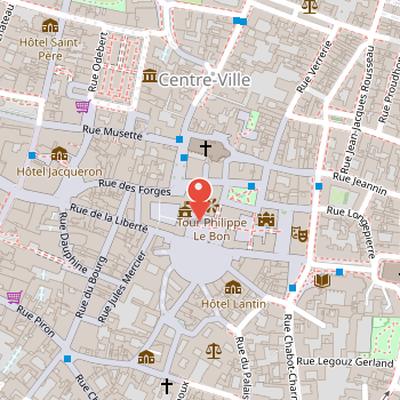
Nearby Objects
-
 Palace of the Dukes of Burgundy 30 m away
 -
 Place de la Libération 50 m away
 -
 Place Émile-Zola 50 m away
 -
 Sainte-Chapelle de Dijon 80 m away
 -
 Musée des Beaux-Arts de Dijon 100 m away
Growth and Relocation of Le Consortium
Le Consortium art center was founded in Dijon and was run by Intro with Franck Gautherot and Eric Troncy. In 1982, it moved into an old appliance store in downtown Dijon, marking an early phase in its institutional development. The following year, Le Coin du Miroir, A La Limite, and Deja Vu were brought together into one entity under the same project. In 1991, the center expanded again, this time to a factory on the outskirts of Dijon. Its leadership also evolved over time: Eric Troncy joined as co-director in 1996, and Kim Seung-duk joined in 2000 as co-curator and director of international development. Le Consortium later extended its activity beyond France with an office on Hoxton Street in London, launched in 2009 and directed by Sophie Claudel. In 2011, it opened a new building designed by Shigeru Ban.
Le Consortium: Contemporary Art and Public Heritage
Le Consortium is an organization whose objectives include the production and exhibition of contemporary works, along with the enrichment of public heritage in the field of contemporary art. It also promotes, disseminates, and provides training in art and in current thinking, while engaging in reflection and experimentation in cultural engineering and the administration of artistic activities related to the performing arts.
The organization originated in the alternative structures of the mid-1970s and was installed in the heart of cities. It was designed as a place of power balances and independence. Its early actions were realized with protest artist figures such as Buren, Mosset, Toroni, Rutault, Boltanski, Messager, Le Gac, Baldessari, and Luthi. This background helps explain its continued interest in experimental and independent forms of artistic practice.
Le Consortium organizes eight solo or group exhibitions of international artists each year. Among the artists it has hosted are Chris Burden, Remy Zaugg, and Yayoi Kusama. It also presented the first exhibition in France and Europe of artists including Jorge Pardo, Maurizio Cattelan, Sylvie Fleury, Mark Leckey, Rachel Harrison, and Charline von Heyl. Its collection contains more than 250 works by international artists, mostly acquired early in their careers. This collection was shown at the Centre Georges Pompidou in Paris in 1998, and it is regularly loaned to many institutions. The collection supports a constant rotation in exhibition spaces and serves as an educational tool alongside temporary exhibitions.
Beyond its exhibition program, Le Consortium runs public commissions focused on rural areas and their historical and cultural heritage. Since 1991, it has been mediator of the Fondation de France for Nouveaux commanditaires activities in Bourgogne. Through these activities, individuals, organizations, and public corporations can commission contemporary artworks. The organization also collaborates with the European LEADER programme for rural and cultural development, and one of its goals is to support local development through tourism. With long experience in contemporary art and relationships with notable artists, it leads public art projects involving isolated artworks in rural or urban areas and large coordinated works in social and cultural contexts.
Les Tulipes de Shangri-La in Lille
Le Consortium conceived the public art project Les Tulipes de Shangri-La for Lille 2004, when Lille was the European Capital of Culture. The work is a 7.50-meter-high bouquet of colored wild flowers placed between Lille Europe train station and the city center. It can be seen from a raised walkway and is accessible on the esplanade. As a large-scale installation, it also has significance as Yayoi Kusama's first monumental sculpture outside Japan.
The project was presented in the context of the Flower Power exhibition, which was organized by Franck Gautherot, Kim Seung-duk, Xavier Douroux, Eric Troncy, and Caroline David. Flower Power took place at Palais Rameau from 6 December 2003 to 8 February 2004, and at Palais des Beaux-Arts and the Musée de l'hospice Comtesse from 6 December 2003 to 22 January 2004.
Public Art Projects and Urban Cultural Work
Le Consortium has been involved in several public art and urban cultural projects across Asia and the Gulf region. It curated the Anyang Public Art Project from 20 October 2007, with curators Kim Seung-duk, Franck Gautherot, and Sung Won Kim. The organization held the Anyang Public Art Project exhibition and art festival in Anyang City and presented fifty monumental works by artists from different nationalities.
From 2011 to 2014, Le Consortium acted as an art consultant for the Msheireb Downtown Doha Project. In Doha, it contributed to the installation of about 20 outdoor artworks and supported the placement of additional 2- or 3-dimensional works in the lobbies of buildings. The project included both local and emerging artists as well as internationally recognized ones in its public collection.
Since autumn 2014, Le Consortium has also participated in the development of the Asia Culture Center in Gwangju, where it managed space design, public art, and related projects such as a culture store opening.
Changing Spaces for Research and Development
Le Consortiums research and development activities have repeatedly shifted location and scale, showing a capacity to invent new forms of spaces and places. They began in a 30 m2 room on the first floor of an alternative library in Dijon, then moved to a gallery-apartment space. In 1982, they occupied an old store of 600 m2 in the city center, and in 1991 their spaces included an old factory of 4000 m2 in the inner suburbs. Later, in 2008, a shop for the sale of books and multiples was arranged at the entrance to the exhibition space. The organization also opened an office in Hoxton Street, London, in 2009, and received a new building conceived by Japanese architect Shigeru Ban in 2011. Beyond its physical sites, Le Consortium supervises the construction of a museum from building to programming, including commercial and promotional matters, and programs art centers with permanent collection hangings, temporary exhibitions, events, shows, and other art performances.
Publishing, Film, and Exhibition Satellites
The satellites connected with Le Consortium document and publish projects in order to deepen the institution's exhibition activities. In 1992, they set up Les Presses du Reel as a limited company to make the publishing business financially independent from Le Consortium. Its editorial output includes series on contemporary art and 20th century avant-gardes, with monographs, exhibition catalogues, artists' writings, unpublished documents, and classical texts. Among the series and publications defining its policy are L'Ecart Absolu, Document sur l'Art, Otto Muehl's, Hans Hartung's, Permanent Food, and Charley. The satellites also established Les Presses du Reel's own Distribution Service, which has been used by independent publishers such as the Contemporary Art Center of Geneva, the Fine Arts Museum of Nantes, and JRP/Ringier Editions in Zurich.
The satellites further include Le Consortium as one of the main shareholders in Anna Sanders Films. This production company was created by artists Pierre Huyghe, Philippe Parreno, Charles de Meaux, and Dominique Gonzalez-Foester, and it produces films by its creators as well as other international projects. Among its productions are several short films and features, including Skimkent Hotel, Le Pont de Trieur by Charles de Meaux, and Riyo and Central Plage by Dominique Gonzalez-Foester. These films were shown in cinemas, broadcast on television, and released on DVD in the Anna Sanders Films MK2 collection. The satellites also note the festival recognition of Apichatpong Weerasethakul's Tropical Malady, which won the Prix du Jury at the 2004 Cannes Film Festival, and Blissfully Yours, which won the Un Certain Regard award in 2002.
Another satellite is Mur Saint-Bon, an exhibition space located at 8 rue Saint Bon in Paris and founded in 2016 by Xavier Douroux and Natacha Carron Vullierme. It allows international artists close to Le Consortium to exhibit for 70 days on one wall. Artists shown there include Sarah Morris, Wade Guyton, Alex Israel, Mattias Faldbakken, and Rachel Feinstein.