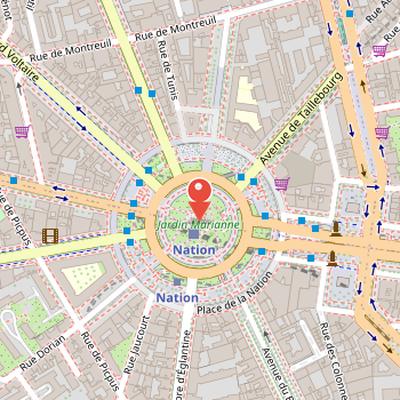
The Triumph of the Republic is a monumental bronze sculpture installed at Place de la Nation in Paris. Paris commissioned Jules Dalou’s project after his innovative design was not selected among the three finalists in a competition launched by the municipality in 1878. Dalou spent twenty years completing the colossal monument, first shown as a life-size painted plaster model during the centenary of the French Revolution, with Sadi Carnot presiding over its inauguration. The final bronze version was largely cast by Thiébaut Frères using the sand casting method, while Dalou had insisted on a lost-wax casting process carried out by Pierre Bingen. The bronze monument’s final inauguration was presided over by Émile Loubet. The composition depicts a figure on a chariot pulled by two lions, guided by the Genius of Liberty holding a torch, and surrounded by allegories of Labor, Justice, and Peace. In 1908, Georges Gardet added bronze sea monsters around the basin; these were later removed under the Vichy regime, and the basin disappeared in the 1960s during construction of the first Regional Express Network line under Place de la Nation.
Nearby Objects
-
 Place de la Nation 10 m away
 -
 Picpus Cemetery 600 m away
 -
 Saint-Antoine Hospital 1000 m away
 -
 Church of the Holy Spirit 1200 m away
 -
 Communards' Wall 1300 m away
Commissioning and Realization
In 1878, the Paris municipality launched a competition for a monument design. The competition was won by the brothers Leopold Morice, a sculptor, and Francois-Charles Morice, an architect. Their Monument to the Republic was installed at Place de la Republique and completed in 1883. Jules Dalou's innovative project was among the three finalists, but it was not selected for the monument at Place de la Republique; instead, Paris commissioned his bronze monument for Place de la Nation.
Dalou spent twenty years completing the colossal bronze work. A life-size painted plaster model was inaugurated during the centenary of the French Revolution, in a ceremony presided over by Sadi Carnot. For the final monument, Dalou insisted that the group be cast using the lost-wax process by Pierre Bingen, although the finished bronze version was mostly cast by Thiebaut Freres using the sand casting method. Its final inauguration was presided over by Emile Loubet.
In 1908, Georges Gardet created bronze sea monsters installed in the basin around the monument. These elements symbolized forces of impotent reaction spitting water jets toward the monument. Dalou had initially sketched the idea but abandoned it. The bronze elements were removed under the Vichy regime for non-ferrous metal mobilization, and the basin disappeared in the 1960s during construction of the first Regional Express Network line under Place de la Nation. It was later replaced by the Jardin de Marianne.
Use of the Monument in Demonstrations
Historique notes that the Triumph of the Republic monument served as a photograph backdrop during popular movements, including the May 68 demonstrations. It was also photographed during demonstrations on May 10 and May 11. These references show that the monument was present in moments of public assembly and was visually associated with these events.
Symbolic Composition
The Triumph of the Republic is arranged as a dense allegorical composition centered on Marianne, who stands on a chariot pulled by two lions symbolizing popular strength. She is guided by the Genius of Liberty, who holds a torch, and she rests on a bundle inherited from the Roman Republic. Marianne wears a Phrygian cap, a symbol of republican liberty, and a terrestrial globe beneath her feet represents the universality of the Republic.
Around the central figure are allegories of Labor, Justice, and Peace. Labor appears as a blacksmith carrying a hammer on the shoulder. Justice is shown as a woman holding an ermine cloak and a hand of justice. Peace, also called Abundance, is represented by a figure spreading flowers. Children also appear in the composition, symbolizing Instruction with a book and building trade tools, Equity with scales, and Wealth with a cornucopia.
The depiction of Marianne with one exposed breast is similar to Eugene Delacroix's painting Liberty Leading the People. In this context, the exposed breast generally symbolizes a nurturing maternal force or divinity caring for its children.