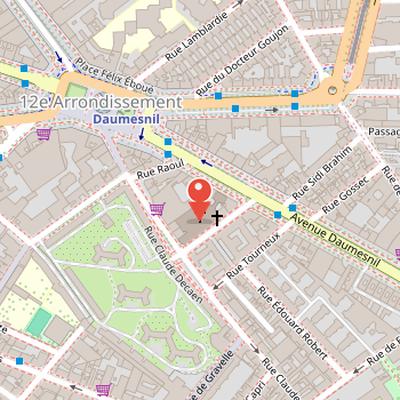
The Church of the Holy Spirit is a Catholic place of worship in Paris, at 186 Avenue Daumesnil in the 12th arrondissement. The project was decided by Cardinal Jean Verdier, metropolitan archbishop of Paris, and assigned to the architect Paul Tournon of Marseille, who completed it in 1928. Construction began in 1928, while the crypt was consecrated and opened for worship in 1929 and served as the provisional seat of the parish. The church itself was completed and definitively consecrated in 1935, and the new parish was entrusted to the Congregation of Jesus and Mary. Entirely built in reinforced concrete, the church has external forms in a sober Art Nouveau style and an interior inspired by neo-Byzantine architecture, with references to the basilica of Santa Sofia in Istanbul. It was listed as a historical monument on 17 August 1979.
Nearby Objects
-
 Picpus Cemetery 700 m away
 -
Cinémathèque française 1100 m away
-
 Parc de Bercy 1100 m away
 -
 Place de la Nation 1100 m away
 -
 The Triumph of the Republic 1200 m away
Location and Identity
The Church of the Holy Spirit, known in Italian as La chiesa dello Spirito Santo, is a Catholic place of worship in Paris. It is located at 186 avenue Daumesnil in the 12th arrondissement. The available facts identify it as a religious building in the city rather than providing further details about its architecture or history.
Construction and Parish History
Jean Verdier, cardinal and metropolitan archbishop of Paris, decided to build a new church along Avenue Daumesnil. The project was assigned to the architect Paul Tournon from Marseille, who completed it by 1928. Construction of the new place of worship began in 1928. The crypt was consecrated and opened for worship in 1929 and served as the provisional seat of the parish while work continued. The church itself was completed in 1935 and definitively consecrated that same year. The new parish was entrusted to the Congregation of Jesus and Mary. Since August 17, 1979, the building has been listed as a historical monument.
Architecture and setting of the Church of the Holy Spirit
The Church of the Holy Spirit in Descrizione is entirely built in reinforced concrete, with internal forms inspired by the basilica of Santa Sofia in Istanbul. Its exterior is restrained and Art Nouveau in style, while the interior follows a neo-Byzantine treatment with nearly bare walls that leave the reinforced concrete visible. The church has no facade and stands in the center of a courtyard formed on three sides by residential buildings and on one side by the parish building. Access to this courtyard is from Avenue Daumesnil, where the main entrance is marked by a brick-clad bell tower topped with a high pyramidal spire. At the base of the tower, a large arch opens into the courtyard. The church has a central plan covered by a dome 22 meters in diameter and 33 meters high. Its presbytery has two levels and contains the main altar, surmounted by a marble ciborium.
Interior Decoration and Organ
The church's interior was fully decorated in the 1930s with frescoes, canvases, or dry murals by about forty artists. The group included residents from Villa Medici and Casa de Velazquez, and it featured an equal number of men and women. These decorations combine purism, art deco, and expressionism, and their overall theme traces the history of Christianity from its origins to contemporaneity.
The narthex is decorated with a series of monochrome frescoes showing Stories of Genesis and allegories by Nicolas Untersteller and Helene Delaroche. From the narthex, one can access the baptistery or the crypt. The baptistery is frescoed by Elisabeth Branly with Madonna and Child and infants of the four continents. The crypt includes statues by Carlo Sarrabezolles and a stained glass window designed by Marcel Imbs.
The church pipe organ was built in 1934 by Gloton-Debierre and restored in 1984 by Cicchero. It has electric transmission, two keyboards of 56 notes each, and a pedalboard of 30 notes. Jeanne Demessieux served as titular organist from 1934 to 1962.
Painted Program and Chapels
The Church of the Holy Spirit contains an extensive painted program distributed across its walls and chapels. On the left wall are works including San Benedetto founding the abbey of Montecassino by Elisabeth Chaplin, the Vision of Clodoveo at Tolbiac and his baptism at Reims by Leon Toublanc, French Saints by Raymond Weil, the Council of Ephesus between Carlo Magno and Gregorio VII by Louis Bouquet, and The Work of Christian Builders and Scholars by Henri Marret, dated 1933. Above the confessional arcade are paintings of Saints Silvestro papa, Bonifacio, Eligio, Audoeno, and Radegonda by Marie Baranger.
Additional works include the Concordat of Worms by Mlle Roisin, Stories of Saint Bernard by Marguerite Hanin, The Peace of Gisors by Marie-Cecile Schmidt, and a painted panel on plaster with the Deposition by Louise Lenoir, presented at the 1934 religious art exhibition at Hotel des Ducs de Rohan. The counter-facade contains the Chapel of the Confessors, also called San Jean Eudes, dedicated to medieval Christianity, with paintings by Raymond Virac in 1933 showing the Meeting of Saints Francis and Dominic, the Return of Marco Polo from China, and Cimabue painting the Virgin.
The church also includes the Chapel of the Virgins by Jean Couturat, the Chapel of Saint Catherine of Siena with stories of the saint by Marthe Flandrin, and paintings on the right wall such as Events of the Late Middle Ages by Emile Beaume, Joan of Arc by Andre Meriel-Bussy in 1933, the Council of Florence by Odette Pauvert-Tissier, events from the 16th to 18th centuries by Robert Pougheon, the Evangelization of the New World by Jean Dupas in 1934, Saints Charles Borromeo and Francis Xavier by Robert Pougheon, and Missions and the reform of religious orders signed by Eugene Chapleau.
Decorative Program and Artworks
The Church of the Holy Spirit includes a varied decorative program made up of religious scenes and works by several artists. The Descrizione presents the scene of the 19th-century Martyrs, Andre and Yvanna Lemaitre, and also includes the Missions in Africa of Cardinal Lavigerie and works of Saint Pius X by Sylvaine Colin in 1933. In the Chapel of Work at the presbytery, Descrizione contains the Chapel of Work itself, the Holy Family by Henri Charlier, and minor scenes by Annette Storez in 1934. Other elements include the Church at the beginning of the 20th century by Valentine Reyre and the Stations of the Cross by George Desvallieres, installed around the entire perimeter from 1934 to 1936.