Picpus Cemetery is the largest private cemetery in Paris and one of only two private cemeteries in the city. Located in the 12th arrondissement, it was created from land seized during the French Revolution from the convent of the Canonesses of Saint Augustine. Before the Revolution, the site had been a walled garden and convent, and the property was later sold to a commoner named Coignard, who turned it into a convalescent home and prison.
The cemetery contains the remains of 1,306 victims executed between 14 June and 27 July 1794, during the final weeks of the Reign of Terror. Descendants of these victims are eligible to be buried there. Picpus Cemetery also holds the tomb of the Marquis de Lafayette (1757–1834), over which an American flag always flies. The place name Picpus is said to derive from the French pique-puce, meaning flea-bite.
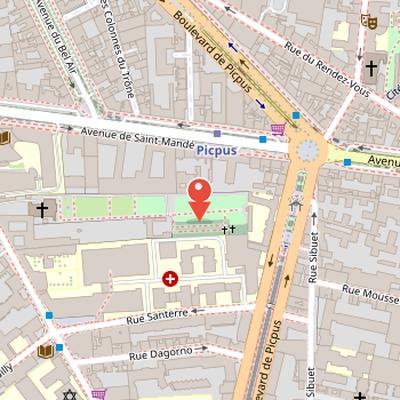
Nearby Objects
-
 Place de la Nation 550 m away
 -
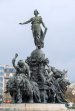 The Triumph of the Republic 600 m away
 -
 Church of the Holy Spirit 700 m away
 -
 Saint-Antoine Hospital 1400 m away
 -
Cinémathèque française 1500 m away
History and Significance
Picpus Cemetery is located in the 12th arrondissement of Paris and is the largest private cemetery in the city. It is one of only two private cemeteries in Paris. The cemetery was created from land seized from the convent of the Chanoinesses de St-Augustin during the French Revolution. It contains the graves of 1,306 victims executed between 14 June and 27 July 1794, and descendants of these victims are eligible to be buried there. Picpus Cemetery also holds the tomb of the Marquis de Lafayette (1757-1834), over which an American flag always flies.
Origins of Picpus Cemetery
The name Picpus is said to come from the French pique-puce, meaning flea-bite, a reference linked to local monks who reportedly treated skin diseases that left wounds resembling fleabites. Before the Revolution, the site that later became the cemetery was a walled garden and a convent occupied by the Canonesses of Saint Augustine. Their property was confiscated during the Revolution, and they left in 1792. It was then sold to a commoner named Coignard, who transformed it into a maison de sante, serving as a convalescent home and prison. During the Terror, several aristocrats rented rooms there, including the novelist Choderos de Laclos, the Marquis de Sade, and the philosopher Comte de Volney. This history gives the site a layered background that combines religious, medical, and revolutionary associations.
The Trone Guillotine During the Reign of Terror
Behind the barriere du Trone, on a small square adjoining the Place de la Nation, a guillotine operated from 13 June to 28 July 1794. This period covered the final two months of the Reign of Terror. The site was used intensively, with as many as 55 people executed per day at the Trone Renverse location. Of the 2,639 executions in Paris between April 1793 and July 1794, 1,306 took place during the six weeks when the Trone guillotine was active. The Revolutionary Tribunal needed a quick and unobtrusive way to dispose of bodies during this period.
Mass Burial at Picpus Garden
In June 1794, a pit was dug in the Picpus garden for the bodies of people decapitated during the Reign of Terror. The garden was about five minutes on foot from the guillotine site next to Place de la Nation, and bodies were brought there by cart through an entryway at 40 and 42 avenue de Saint Mande. At the burial site, clothes were removed and inventoried before the bodies were thrown into the pit. The grave was left open until it was covered, and quicklime was spread over it to reduce the smell of decomposition.
The burials had to remain discreet because the Terror was becoming unpopular and many neighbors resented having so many dead bodies in their area. Local residents associated bad smells with miasmas and believed they could cause disease. Weeks before Robespierre's execution, neighbors sent a petition expressing alarm about graves near the neighborhood, and a second petition after the Reign of Terror demanded that the burial pit be removed. No attempt was made to move the mass burial site from Picpus garden.
The cemetery complex later recorded the names of 1,306 men and women buried in two pits on the chapel walls. Among the 1,109 men were nobles, churchmen, monastics, military personnel, and commoners, while the 197 women included nobles, nuns, and commoners. The site is also associated with the sixteen Carmelite nuns executed together during the Reign of Terror, whose story was later commemorated in Poulenc's opera Dialogues of the Carmelites. The nuns were beatified in 1906 as the Martyrs of Compiegne.
Post-Revolution Management and Burial Use
After the Terror ended, survivors began to return from exile or leave hiding places. In 1797, Princess Amalie Zephyrine of Salm-Kyrburg secretly acquired the Picpus site under the Directory. Frederick III, Prince of Salm-Kyrburg, had been guillotined and buried in one of the common graves. In 1802, a committee was formed to manage the project at Picpus, with 11 designated underwriters. Madame de Montagu, nee L. D. de Noailles, served as president of the committee, which also included Maurice de Montmorency, Mr. Aimard de Nicola, Madame Rebours nee Barville, Madame Freteau widow nee Moreau, Madame de La Fayette nee Adrienne de Noailles, Madame Titon nee Benterot, Madame Faudoas nee de Bernieres, Madame Charton nee Chauchat, Philippe de Noailles de Poix, and Theodule M. de Grammont. The cemetery continued to be used as a burial place by noble families after the Revolution. Burial was restricted to people whose ancestors had been guillotined and buried at Picpus. The Post-Revolution community also prayed and performed religious services for the victims and for the redemption of the executioners' souls. During the Paris Commune, the community was affected by political violence, including the Massacre in the Rue Haxo in May 1871, when 110 priests and gendarmes were executed over several days. Among those killed were the Picpus Fathers Ladislas Radigue, Polycarpe Tuffier, Marcellin Rouchouze, and Frezal Tardieu.
Lafayette's Tomb at Picpus Cemetery
The grave of the Marquis de Lafayette at Picpus Cemetery is closely associated with his role in the American Revolutionary War and with later acts of remembrance. Lafayette was a French aristocrat and general who was a close friend of several American Founding Fathers, including George Washington, Alexander Hamilton, and Thomas Jefferson, and he also knew John Laurens. He fought in the Continental Army before France officially entered the war. He died in 1834 from natural causes at the age of 76 and is buried next to his wife, Adrienne de Lafayette.
The site carries several markers of memory. An American flag always flies over Lafayette's grave, maintained by the local chapter of the Daughters of the American Revolution. The soil covering the grave was brought to France from Bunker Hill in Charlestown, Boston, the site of the Battle of Bunker Hill, an early battle of the American Revolutionary War. Lafayette had a direct connection to that place as well: in 1825, he laid the cornerstone of the Bunker Hill Monument on the 50th anniversary of the battle.
The tomb also drew international attention in the 20th century. On 4 July 1917, U.S. Army Colonel Charles E. Stanton visited the tomb and placed an American flag on it, saying, 'Lafayette, we are here.'
Picpus Cemetery During World War II
During World War II, Picpus Cemetery and the adjoining convent complex were never entered by German occupiers. The American flag remained over Lafayette's tomb in Paris throughout the occupation. In 1852, financier James Mayer de Rothschild built Rothschild Hospital next to the cemetery, and it later served as a hospice for Jewish patients. Under Vichy France, some patients who survived illnesses were deported to concentration camps in cooperation with Nazi Germany. Hospital staff saved others by issuing false death certificates or false stillbirth declarations, and some patients were secretly hidden in the neighborhood and on the convent grounds at Picpus.
Access and Heritage Status
Picpus Cemetery has an entrance at 35 rue de Picpus in the 12th arrondissement of Paris. The cemetery can be visited in the afternoon every day except Sunday and holidays, usually from 2 pm to 5 pm, and admission costs EUR 2. The nearest Paris metro stations are Nation and Picpus. At the entrance to the cemetery is the Chapel of Our Lady of Peace. As a private cemetery and associated convent, it was added to the list of Monuments Historiques by the French Ministry of Culture on 30 April 1998.