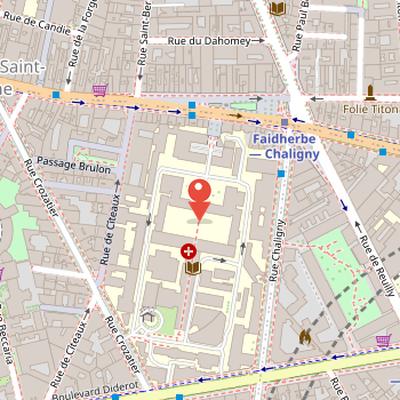
Saint-Antoine Hospital is a university hospital of Assistance publique–Hôpitaux de Paris, located at 184, rue du Faubourg-Saint-Antoine in the 12th arrondissement of Paris. It belongs to the AP-HP–Sorbonne Université hospital-university group. Its history began with the former abbaye Saint-Antoine, which was declared a bien national by decree and later evacuated by religious women. Under the Convention, it became the hospice de l’Est, created partly to address the lack of hospitals in this part of the capital and to thank neighborhood residents for their role in revolutionary events. The church Saint-Antoine was destroyed in 1796. Architect Nicolas-Marie Clavareau was charged with developing the hospice, but only part of the planned expansion was completed because of lack of funds. The establishment was renamed hospital Saint-Antoine in 1802. In 1811, the Hospitalières de Sainte-Marthe de Beaune took charge of management until 1881. The hospital’s facades, roofs, central ground floor passage, and central body staircase have been listed as historical monuments since 1992.
Nearby Objects
-
 Coulée verte René-Dumont 850 m away
 -
 Opéra Bastille 950 m away
 -
 Place de la Nation 950 m away
 -
 The Triumph of the Republic 1000 m away
 -
 July Column 1100 m away
Location and Institutional Role
Saint-Antoine Hospital is a university hospital of Assistance publique - Hopitaux de Paris, located in the 12th arrondissement of Paris. Its address is 184, rue du Faubourg-Saint-Antoine. The hospital is part of the hospital-university group AP-HP-Sorbonne Universite.
From Abbey to Hospital
The abbaye Saint-Antoine was declared a bien national by decree and was later evacuated by religious women. Under the Convention, it became the hospice de l'Est, created partly to address the lack of hospitals in this part of the capital and also to thank neighborhood residents for their role in revolutionary events. The church Saint-Antoine was destroyed in 1796. Architect Nicolas-Marie Clavareau was charged with developing the hospice and began two additional wings, but the project stopped because of a lack of funds.
At this stage, the hospital had two rooms with 30 beds each, one for women and one for men, and a staff made up of one doctor, one pharmacist, and about fifteen nurses. In 1802, the establishment changed its name to hospital Saint-Antoine. In 1811, the Hospitalieres de Sainte-Marthe de Beaune were entrusted with its management until 1881, organizing care and medicine distribution while the facilities were enlarged and hygiene conditions improved. By 1842, the hospital had 120 beds.
Growth continued in the late 19th century. In 1872, Emmanuel Moiana bequeathed one million francs to the Assistance publique, and in 1879 it was decided to use this sum to create a 500-bed annex at hospital Saint-Antoine. The hospital also gained prestige through doctors such as Georges Hayem, Edouard Brissaud, Gilbert Ballet, and Antoine Beclere. It was hit by bombings during a German air raid on January 30, 1918. Its facades, roofs, central ground floor passage, and central body staircase have been listed as historical monuments since October 22, 1992.
Medical Innovations and Clinical Legacy
In 1965, doctor Etienne Levy and surgeon Jean Loygue invented the nutripompe at Saint-Antoine Hospital. Their work helped make the hospital's gastroenterology service one of the most renowned in France. The hospital was also associated with professor of medicine Georges Offenstadt, who headed the intensive care unit from 1997 to 2010. Offenstadt later founded the French intensive care encyclopedia published by Elsevier Masson. The intensive care unit is now named Service Georges-Offenstadt.
Hospital Functions and Recent Activities
Saint-Antoine Hospital has 780 beds, including 22 emergency beds and 96 day hospital places. In 2007, it provided consultations, admissions, and births. The hospital employs staff including 900 full-time equivalent medical staff. It also serves as a center for organ and tissue donation, autografts, and rare diseases. The hospital includes the Institut de soins infirmiers (IFSI), which provides professional training for future nurses.
The hospital has also been involved in research and public-facing activities. It participated in Covid-19 therapeutic research, including the Corimuno-plasm clinical trial, in collaboration with Karine Lacombe, head of the infectious and tropical diseases service and a researcher at Institut Pierre-Louis. Saint-Antoine Hospital also hosted filming for the television series Urgences, episode 21 of season 11, and the 2010 film Les Petits Mouchoirs.
Its recent history includes a rare power outage on the night of 25, caused by an EDF supply cut and generator failure, during which some patients were evacuated to other hospitals. In 2022, the hospital built a new building for the headquarters of AP-HP.