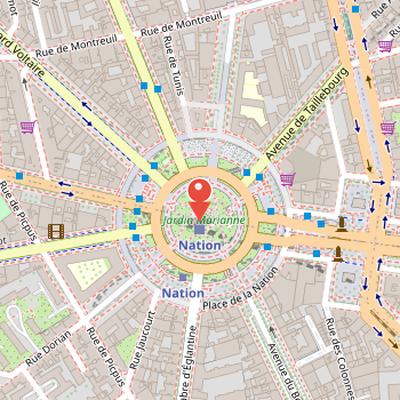
Place de la Nation is a square in Paris served by metro lines 1, 2, 6, and 9 at Nation station, as well as by RER A. Its center hosts the garden of Marianne and Le Triomphe de la République, a work by sculptor Jules Dalou. The avenue du Trône runs between two columns within the square.
The square has undergone redevelopment initiated by Anne Hidalgo during the mayoral term in 2018 and 2019. This redevelopment revised the allocation of public space, increasing areas for pedestrians, cyclists, green spaces, and terraces, while reducing the central ring. Provisional arrangements were used to complete the projects with the involvement of local residents. A tramway connection with line T3a or T3b from porte de Vincennes was also proposed, with possible transfers at Nation between the tramway and metro lines 2, 6, and 9 and RER line A, but the project did not progress.
Nearby Objects
-
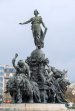 The Triumph of the Republic 10 m away
 -
 Picpus Cemetery 550 m away
 -
 Saint-Antoine Hospital 950 m away
 -
 Church of the Holy Spirit 1100 m away
 -
 Communards' Wall 1300 m away
Access, Public Space, and Redevelopment
Place de la Nation is served by Paris metro lines 1, 2, 6, and 9 at Nation station, as well as by RER A. At its center are the garden of Marianne and Le Triomphe de la Republique by sculptor Jules Dalou. The avenue du Trone is located between two columns within the site. A redevelopment initiated by Anne Hidalgo during the 2018 and 2019 mayoral term revised the allocation of public space to increase areas for pedestrians, cyclists, green spaces, and terraces, while reducing the central ring from 26. The work used provisional arrangements to complete projects with the involvement of local residents. A connection with tramway line T3a or T3b extended from porte de Vincennes was also proposed, which would have enabled transfers between tramway lines and metro lines 2, 6, and 9 and RER line A at Nation station, but the project did not progress.
From Place du Trone to Place de la Nation
Place de la Nation is located on the road from Paris to Vincennes. It originated as a vast grassy space beyond the city, created by the Fermiers generaux wall, and extended into vineyards and market gardens up to the enclosure and walls of the old village of Pique-Puce. That village was occupied by convents, educational houses, or retirement homes. The site first became known as place du Trone when a throne was installed there for the solemn entry of Louis XIV and Marie-Therese d Autriche into Paris.
Colbert later ordered the erection of a triumphal arch to commemorate Louis XIV's entry. In 1669, he organized a competition for the project with Charles Le Brun and Claude Perrault; Perrault won. The design included an equestrian statue of the king and Corinthian columns. The first stone was laid, but construction stopped quickly and the arch was demolished in 1716.
In 1787, Claude-Nicolas Ledoux erected two columns to frame the octroi barrier and the Vincennes entrance. During the Revolution, the place was renamed place du Trone-Renverse and remained a wasteland with only the pavilions designed by Ledoux. Statues of Philippe Auguste and Saint Louis were added to the columns in 1845.
Revolutionary Executions at Place de la Nation
During the French Revolution, the guillotine was moved to the southern part of Historique near Ledoux's right pavilion. It remained there until an unspecified date. Of the 30,000 people guillotined in Paris during the Revolution, 1,309 were executed at Historique over an unspecified period, with an average of 30 executions per day. The bodies of those executed there were buried in two mass graves in the Picpus cemetery.
Monuments and Republican Symbolism
In 1841, the city council planned to erect an elephant at the roundabout of Barriere du Trone, but the project was abandoned in 1843 because funds were insufficient. Later, Napoleopn III decided to build a monument at Place du Trone to honor victorious armies under the Second Empire, and Victor Baltard's project was chosen. Other proposals also circulated, including Hector Horeau's plan for a triumphal gate with ship prows, statues, trophies, and Empire French arms, as well as his idea of multiplying columns by replicating Ledoux's columns. Historique even displayed a full-scale model of a thirty-meter arch at the inauguration of Boulevard du Prince-Eugene. This model had one opening, columns, statues symbolizing troop corps, and a quadriga surrounded by four Renommees.
The square was renamed Place de la Nation on July 14, 1880, under the Third Republic, marking a shift in its political meaning. Its central monument, Le Triomphe de la Republique, was commissioned in 1879 from Jules Dalou. An initial plaster version was inaugurated in 1889, followed by the bronze version in 1899. The bronze group shows the Republic on a chariot drawn by lions, accompanied by allegorical figures of Liberty, Work, Justice, and Abundance. The central statue faces Place de la Bastille, creating a republican axis used for popular events. The sculpted group stood in a basin with bronze alligator fountains until 1941. These statues were destroyed during World War II for metal recovery by occupants' order, and they were photographed by Auguste Leon in 1918 for the Archives de la Planete collection Albert-Kahn and by Pierre Jahan shortly before their destruction.