Avenue Marceau is a major street in western Paris, France. It extends about 900 meters from Place Charles de Gaulle south-south-east to Avenue du Président-Wilson near Place de l’Alma on the Seine. The avenue forms the boundary between the Champs-Élysées neighborhood in the 8th Arrondissement and the Chaillot neighborhood in the 16th Arrondissement.
The avenue was part of the new Paris street network developed under Napoleon III and Baron Haussmann in the 1850s. It was one of twelve streets radiating from Place de l’Étoile, all planned at least 40 meters wide. The first short segment, from the square to Rue du Presbourg, was laid out in 1854, and the avenue was completed by 1858. It was first named Avenue Joséphine, later considered for other names, and received its present name in 1879, after General François Séverin Marceau. Since the 1950s, it has hosted business offices, hotels, and boutiques, while remaining primarily an upscale residential street.
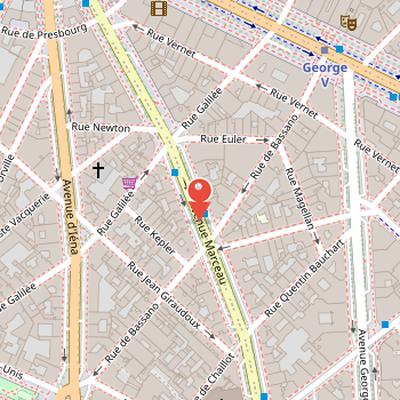
Nearby Objects
-
 Avenue d'Iéna 250 m away
 -
 Le Lido 350 m away
 -
 St. Stephen's Greek Orthodox Cathedral 350 m away
 -
 Musée Baccarat 400 m away
 -
 Tomb of the Unknown Soldier 500 m away
Location and Character of Avenue Marceau
Avenue Marceau is a major street in western Paris, France. It runs from Place Charles de Gaulle 900 meters south-south-east to Avenue du President-Wilson near the Place de l'Alma on the Seine. The avenue is primarily an upscale residential street. It also forms the boundary between the Champs-Elysees neighborhood in the 8th Arrondissement and the Chaillot neighborhood in the 16th Arrondissement. The street is named after General Francois Severin Marceau.
From Avenue Jose phine to Avenue Marceau
Avenue Marceau formed part of the new Paris street network created under Napoleon III and Baron Haussmann in the 1850s, in the urbanizing area around Place Charles de Gaulle and the Chaillot neighborhood. It was one of twelve streets radiating from Place de l'Etoile, all designed at a minimum width of 40 meters. The layout of the Etoile project was completed in 1854 with the first short segment of the avenue reaching Rue du Presbourg, and by 1858 the avenue was completed through to Avenue du President-Wilson.
The avenue was originally named Avenue Josephine, after Josephine de Beauharnais, the first wife of Napoleon I and grandmother of the reigning Emperor. After the annexations of 1860, it was chosen as the boundary between the new 8th and 16th arrondissements. Following 1870, when nearly all Paris streets named after members of the Bonaparte dynasty were renamed, several possible new names were considered. The idea of Avenue de Chaillot was abandoned because Rue de Chaillot already existed, and an alternative name, Avenue Eckmuhl, also appears to have been considered in line with naming patterns near Place de l'Etoile. The avenue received its present name in 1879, at the same time that Rue Marceau in the 12th arrondissement was renamed Rue de Wattignies. The name recalls General Marceau, whose funeral during the 1796 Rhine campaign is represented in a bas-relief on the Arch of Triumph carved in 1833.
Transport and Urban Uses
In the 1880s, Avenue Marceau hosted a tramway segment linking Montparnasse to Etoile. After electrification, the route was extended to Pereire, and in 1932 the tramway was replaced by the 92 bus line. The avenue also attracted upscale residences, offices, and diplomatic establishments, reflecting a mixed urban character. Since the 1950s, it has hosted business offices, hotels, and boutiques. Even so, the avenue is not primarily a commercial street. French Wikipedia also contains a list of notable buildings, events, and persons related to the avenue.